


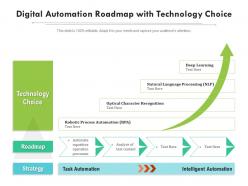
Digital automation roadmap with technology choice





Try Before you Buy Download Free Sample Product
 Impress Your
 Audience
 100%
100% Editable
 Save Hours
 of Time


Our Digital Automation Roadmap With Technology Choice are topically designed to provide an attractive backdrop to any subject. Use them to look like a presentation pro.
People who downloaded this PowerPoint presentation also viewed the following :
Digital automation roadmap with technology choice with all 2 slides:
Use our Digital Automation Roadmap With Technology Choice to effectively help you save your valuable time. They are readymade to fit into any presentation structure.

FAQs for Digital automation roadmap
Key components include process mapping and prioritization, technology selection and integration, change management protocols, performance metrics frameworks, and governance structures. These elements work together by identifying automation opportunities, selecting appropriate tools like RPA or AI platforms, and ensuring seamless implementation, with many organizations finding that strategic combination of these components delivers enhanced operational efficiency and competitive advantage.
Businesses can assess their digital automation through process mapping, workflow analysis, technology audits, performance metrics evaluation, and employee feedback collection. These comprehensive assessments enable organizations to identify automation gaps, redundant manual tasks, and integration opportunities across departments like finance, HR, and operations, ultimately delivering strategic insights for prioritizing automation investments and maximizing operational efficiency.
**INPUT**: What metrics should be used to measure the success of a digital automation strategy? **OUTPUT**: Digital automation success metrics include process completion time, error reduction rates, cost per transaction, employee productivity gains, and customer satisfaction scores. These measurements enable organizations to track operational efficiency improvements, resource allocation optimization, and competitive advantage delivery, with many companies finding that strategic metric combinations provide comprehensive visibility into automation ROI and scalability potential. [Word count: 55 words]
Different industries implement digital automation by tailoring solutions to their specific operational needs, regulatory requirements, and customer touchpoints. Manufacturing focuses on robotic assembly and predictive maintenance, healthcare emphasizes patient record automation and diagnostic support, while financial services prioritize fraud detection and loan processing, with each sector ultimately delivering enhanced efficiency and competitive advantage.
Artificial intelligence serves as the decision-making engine in digital automation, enabling systems to analyze data, predict outcomes, adapt to changing conditions, and optimize processes without human intervention. Through machine learning and pattern recognition, organizations across healthcare, finance, and manufacturing streamline operations, reduce costs, and deliver faster customer services, ultimately gaining significant competitive advantages in increasingly complex business environments.
Organizations overcome resistance to change by implementing comprehensive change management programs, providing extensive employee training, communicating automation benefits clearly, and involving staff in the implementation process. Through phased rollouts and transparent communication, companies in manufacturing, healthcare, and financial services find that addressing concerns proactively, while demonstrating how automation enhances rather than replaces human capabilities, ultimately delivers smoother transitions and higher adoption rates.
Common pitfalls include inadequate change management, lack of employee training, poor process mapping, insufficient data quality assessment, and unrealistic timeline expectations. These challenges can derail automation initiatives by creating resistance, operational inefficiencies, and integration failures, with many organizations finding that strategic planning and stakeholder engagement ultimately delivers smoother implementations and sustainable competitive advantage.
Digital automation enhances customer experience by providing faster response times, personalized interactions, and seamless service delivery across multiple touchpoints. Through AI-powered chatbots, automated workflows, and predictive analytics, businesses streamline customer journeys, reduce wait times, and deliver consistent experiences, with many retail and financial services organizations finding significantly improved satisfaction scores and operational efficiency.
Essential digital automation tools include robotic process automation (RPA), artificial intelligence and machine learning platforms, workflow management systems, API integration tools, and cloud-based analytics solutions. These technologies streamline operations by eliminating manual tasks, enhancing decision-making accuracy, and enabling seamless data flow across departments, with many organizations finding that strategic combinations deliver significant cost reductions and competitive advantages.
Digital automation transforms workforce dynamics by augmenting human capabilities, creating new specialized roles, and eliminating repetitive tasks while requiring upskilling initiatives. Through strategic implementation, organizations enable employees to focus on creative problem-solving, customer relationship management, and strategic decision-making, with many companies finding that automation ultimately enhances job satisfaction and productivity.
Digital automation and data analytics maintain a symbiotic relationship where automation generates vast amounts of operational data, while analytics provide insights that optimize automated processes. Through machine learning algorithms, organizations streamline workflows, enhance decision-making accuracy, and minimize manual interventions, with many financial services and manufacturing companies finding that this strategic combination ultimately delivers improved operational efficiency and competitive advantage.
Small businesses can leverage digital automation through free or low-cost tools like email marketing platforms, social media schedulers, basic CRM systems, and simple workflow automation software. These solutions streamline repetitive tasks, reduce manual errors, and free up valuable time for strategic activities, with many small enterprises finding that even modest automation investments deliver significant productivity gains and competitive advantages in their markets.
Digital automation security implications include data vulnerabilities, system integration risks, access control challenges, compliance requirements, and cyber attack exposure. While these present legitimate concerns, organizations increasingly find that modern automation platforms deliver enhanced security through encrypted processes, audit trails, and centralized monitoring, ultimately strengthening operational resilience and reducing human error risks.
Organizations ensure regulatory compliance during automation through strategic governance frameworks, continuous monitoring systems, and built-in audit trails that track every automated decision and process step. By implementing compliance-by-design principles, companies in sectors like banking and healthcare maintain regulatory standards while streamlining operations, ultimately delivering faster services and reduced compliance costs without sacrificing oversight.
**INPUT**: What future trends in digital automation should businesses be aware of? **OUTPUT**: Key automation trends include intelligent process automation, no-code/low-code platforms, hyperautomation combining multiple technologies, AI-driven decision making, and robotic process automation expansion. These developments enable organizations to streamline operations, reduce manual interventions, and accelerate digital transformation, with many enterprises finding that strategic automation delivers enhanced efficiency and competitive advantage. **Word count: 54 words**
-
Best way of representation of the topic.
-
Great designs, Easily Editable.