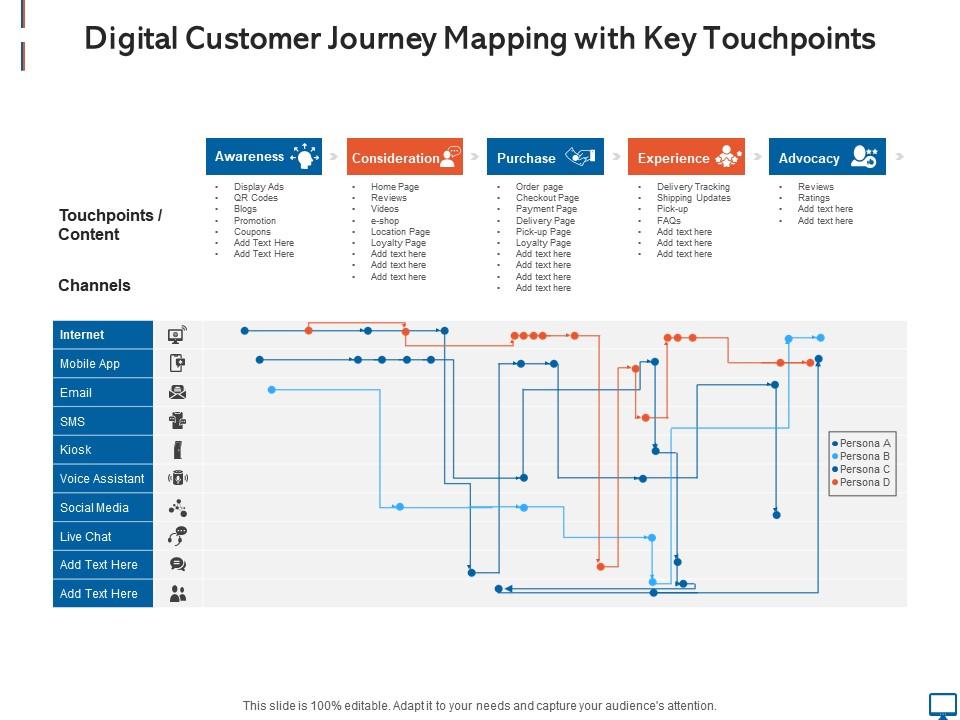
Digital customer journey mapping with key touchpoints

Rating:
93%
Digital customer journey mapping with key touchpoints
Slide 1 of 2

or

Favourites Favourites

Try Before you Buy Download Free Sample Product

Audience Impress Your
Audience
Editable 100%
Editable
Time Save Hours
of Time
The Biggest Sale is ending soon in
0
0
:
0
0
:
0
0
Rating:
93%
Introducing our Digital Customer Journey Mapping With Key Touchpoints set of slides. The topics discussed in these slides are Awareness, Purchase, Experience. This is an immediately available PowerPoint presentation that can be conveniently customized. Download it and convince your audience.

People who downloaded this PowerPoint presentation also viewed the following :

FAQs for Digital customer journey mapping

The key stages include awareness, consideration, purchase, onboarding, engagement, and advocacy, with each requiring distinct touchpoints and interactions. Businesses can effectively map these stages by analyzing customer data across channels, identifying pain points through analytics and feedback, and creating detailed personas, ultimately delivering seamless experiences that enhance retention and drive competitive advantage.

Understanding customer personas significantly enhances digital journey mapping by providing detailed insights into user motivations, pain points, preferences, and behavioral patterns at each touchpoint. These data-driven profiles enable organizations to create more targeted experiences, personalize content delivery, and identify critical optimization opportunities, with many retail and financial services companies finding that persona-based mapping increases conversion rates and customer satisfaction substantially.

Effective digital customer journey mapping tools include analytics platforms like Google Analytics and Adobe Analytics, specialized mapping software such as Lucidchart and Miro, CRM systems, and customer feedback tools like surveys and heatmaps. These technologies streamline visualization by integrating real-time data, enabling collaborative mapping, and providing actionable insights, with many organizations finding that combining multiple tools delivers comprehensive customer understanding and enhanced experience optimization.

Organizations identify pain points through customer feedback analysis, journey analytics, heatmap tracking, conversion funnel examination, and user testing sessions. These methods reveal friction areas like slow checkout processes, confusing navigation, or inadequate mobile experiences, enabling companies to streamline interactions, enhance satisfaction, and ultimately deliver competitive advantage through optimized digital touchpoints.

Data analytics plays a crucial role by identifying friction points, tracking user behavior patterns, measuring conversion rates, and revealing customer preferences across touchpoints. Through predictive analytics and real-time insights, businesses can personalize experiences, streamline processes, and optimize engagement strategies, with many organizations finding that data-driven journey optimization significantly increases customer satisfaction and revenue conversion rates.

Customer feedback can be integrated through real-time surveys, behavioral analytics, social media monitoring, review analysis, and direct customer interviews at each touchpoint. These insights enable organizations to identify pain points, optimize user experiences, and enhance service delivery across channels, with many companies finding that continuous feedback loops significantly improve customer satisfaction and drive strategic decision-making.

Journey mapping enhances cross-channel customer experience by identifying touchpoint gaps, revealing inconsistent messaging, and highlighting friction points across platforms, channels, and devices. Through comprehensive journey visualization, organizations streamline interactions between online, mobile, and in-store experiences, ultimately delivering seamless transitions and personalized engagements that significantly improve customer satisfaction and retention.

Common mistakes include focusing solely on touchpoints rather than emotions, creating overly complex maps, ignoring cross-channel interactions, and failing to update maps regularly. Many businesses also neglect to involve actual customer feedback, assume linear progression through stages, and overlook internal handoffs between departments, ultimately missing optimization opportunities that could streamline experiences and enhance customer satisfaction across digital channels.

Customer journey maps inform marketing strategy by identifying key touchpoints, pain points, messaging opportunities, and optimal channel timing throughout the customer lifecycle. These insights enable businesses to create targeted campaigns, personalize content delivery, and allocate resources more effectively, with many organizations finding that journey-driven strategies significantly improve conversion rates and customer retention.

Key metrics include conversion rates, customer acquisition cost, customer lifetime value, bounce rates, time-to-conversion, and Net Promoter Score across touchpoints. These measurements enable organizations to identify friction points, optimize user experiences, and enhance customer satisfaction, with many companies finding that comprehensive journey analytics ultimately deliver improved retention rates and increased revenue growth.

Cultural differences significantly impact digital customer journeys through varying communication preferences, payment methods, device usage patterns, and privacy expectations across global markets. While European customers prioritize data privacy and formal interactions, Asian markets often favor mobile-first experiences and social commerce integration, with successful global brands adapting their digital touchpoints to respect local cultural nuances while maintaining consistent brand experiences.

Emotional mapping reveals critical pain points, moments of delight, and decision triggers throughout digital touchpoints, enabling businesses to optimize experiences strategically. By understanding emotional peaks and valleys across websites, apps, and digital interactions, companies can reduce friction, enhance satisfaction, and ultimately drive higher conversion rates and customer loyalty.

Businesses should revisit their digital customer journey maps quarterly for minor updates and conduct comprehensive reviews annually, though rapidly evolving industries may require more frequent assessments. This regular cadence enables organizations to capture changing customer behaviors, emerging touchpoints, and new technologies, while many companies find that consistent mapping updates deliver improved conversion rates, enhanced customer experiences, and sustained competitive advantage.

Digital customer journey mapping enhances loyalty and retention by identifying pain points, optimizing touchpoints, and personalizing experiences across all channels. Through data-driven insights, businesses can streamline interactions, reduce friction, and deliver consistent experiences that meet customer expectations, with many retail and financial services companies finding that targeted improvements increase retention rates significantly.

Cross-departmental collaboration for digital customer journey mapping requires establishing shared objectives, creating unified customer personas, and implementing regular touchpoint reviews with representatives from marketing, sales, customer service, and IT. These collaborative practices streamline communication, eliminate data silos, and ensure consistent customer experiences, with many organizations finding that integrated mapping sessions ultimately deliver more comprehensive insights and faster resolution of customer pain points.

Ratings and Reviews

93% of 100
Review Form
Write a review
Most Relevant Reviews
  1. 100%

    by Jones Cook

    Easily Editable.
  2. 100%

    by Michael Clark

    Out of the box and creative design.
  3. 80%

    by Danny Kennedy

    Content of slide is easy to understand and edit.

3 Item(s)

per page: