


Digital Transformation In Banking And Financial Services For Seamless Customer Experience DT CD




Try Before you Buy Download Free Sample Product
 Impress Your
 Audience
 100%
100% Editable
 Save Hours
 of Time


Digital transformation is essential for integrating digital technology into each facet of a financial business. It brings fundamental changes in business operations. This Digital Transformation in Banking and Financial Services for Seamless Customer Experience deck covers an overview of digital transformation in the banking and financial sector with architecture. It assesses the challenges of implementing digital transformation in the banking sector and provides possible solutions. This deck includes a market analysis of digital transformation in the banking sector with the overview, emerging trends, growth drivers, market segmentation, Porters five forces analysis, PESTLE analysis, and SWOT analysis. Further, this deck analyzes digital transformation in the banking sector by application such as adopting digital banking platforms, mobile banking, digital payment wallets, banking data analytics, etc. It also covers digital transformation in education by technology such as blockchain, cloud computing, AI, and big data. Also, the deck will cover slides about the implementation of digital transformation for banking institutions. It caters to slides about digital readiness, technology selection, training workshops, different challenges, impact assessment, and dashboards for measuring digital vitality. Download it now.
People who downloaded this PowerPoint presentation also viewed the following :
Content of this Powerpoint Presentation
Slide 1: This slide showcase title Digital Transformation in Banking and Financial Services for Seamless Customer Experience. State Your Company Name.
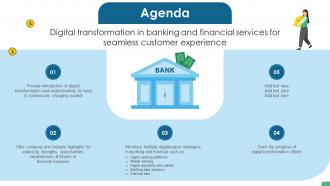
Slide 2: This slide showcase title Agenda.
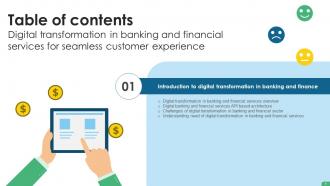
Slide 3: This slide exhibit Table of Content.
Slide 4: This slide exhibit Table of Content: Introduction to digital transformation in banking and finance.
Slide 5: This slide provides glimpse about summary of digital transformation in financial services that help banks integrate latest technologies in their operations.
Slide 6: This slide provides glimpse about API based banking architecture that help banks in adopting digital transformation.
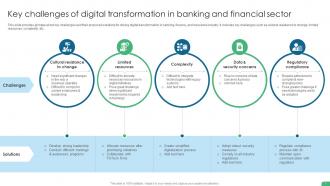
Slide 7: This slide provides glimpse about key challenges and their proposed solutions for driving digital transformation in banking, finance, and insurance industry.
Slide 8: This slide provides glimpse about key benefits of digital transformation that can help banking institutions to become future ready.
Slide 9: This slide exhibit Table of Content: Market overview.
Slide 10: This slide provides glimpse about market size analysis of global digital transformation in banking, financial, & insurance industry (BFSI).
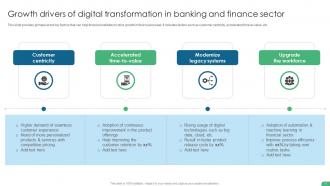
Slide 11: This slide provides glimpse about key factors that can help financial institutes to drive growth in their businesses.
Slide 12: This slide provides glimpse about market trends of digital transformation in banking, finance, and insurance industry.
Slide 13: This slide provides glimpse about different market segments of global digital transformation in BFSI industry.
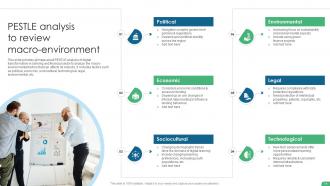
Slide 14: This slide provides glimpse about PESTLE analysis of digital transformation in banking and financial sector to analyze the macro-environmental factors.
Slide 15: This slide provides glimpse about Porter’s five forces analysis of the digital transformation in banking and financial services industry.
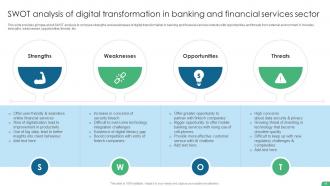
Slide 16: This slide provides glimpse about SWOT analysis to compare strengths and weaknesses of digital transformation in banking and financial services industry.
Slide 17: This slide exhibit Table of Content: Digital banking platforms.
Slide 18: This slide provides glimpse about summary of digital banking solutions that help banks provide 24*7 services to their customers.
Slide 19: This slide provides glimpse about market size analysis of global digital banking platforms for understanding its growing market and utilizing the opportunities.
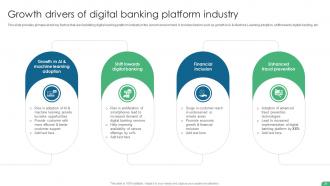
Slide 20: This slide provides glimpse about key factors that are facilitating digital banking platform industry in the current environment.
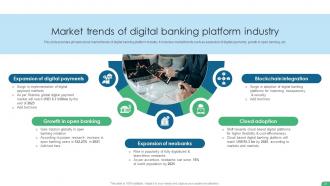
Slide 21: This slide provides glimpse about market trends of digital banking platform industry.
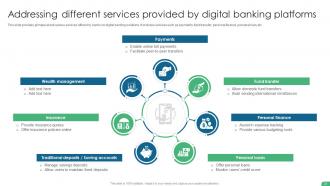
Slide 22: This slide provides glimpse about various services offered by banks on digital banking solutions.
Slide 23: This slide provides glimpse about architecture that help banks provide digital banking solutions to their customers.
Slide 24: This slide provides glimpse about various 3rd party digital banking platforms that help banks select right one for their customers.
Slide 25: This slide exhibit Table of Content: Mobile banking.
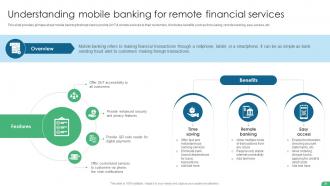
Slide 26: This slide provides glimpse about mobile banking that help banks provide 24*7 & remote services to their customers.
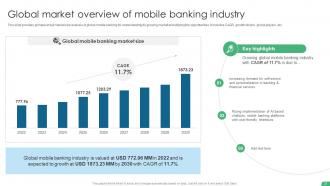
Slide 27: This slide provides glimpse about market size analysis of global mobile banking for understanding its growing market and utilizing the opportunities.
Slide 28: This slide provides glimpse about key factors that are facilitating mobile banking industry in the current environment.
Slide 29: This slide provides glimpse about market trends of mobile banking industry.
Slide 30: This slide provides glimpse about architecture that can help banks provide mobile banking services to their customers.
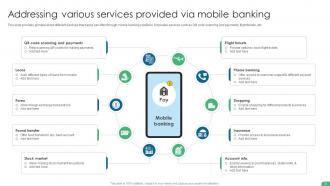
Slide 31: This slide provides glimpse about different services that banks can offer through mobile banking solutions.
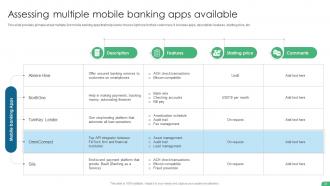
Slide 32: This slide provides glimpse about multiple 3rd mobile banking apps that help banks choose right one for their customers.
Slide 33: This slide exhibit Table of Content: Digital payments and wallets industry.
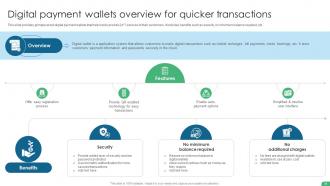
Slide 34: This slide provides glimpse about digital payment wallets that help banks provide 24*7 services to their customers.
Slide 35: This slide provides glimpse about market size analysis of digital payments and wallets industry for understanding its growing market and utilizing the opportunities.
Slide 36: This slide provides glimpse about key factors that are facilitating digital payments and wallets industry in the current environment.
Slide 37: This slide provides glimpse about market trends of digital payments and wallets industry.
Slide 38: This slide provides glimpse about architecture that can help banks set up digital payment wallets for their customers.
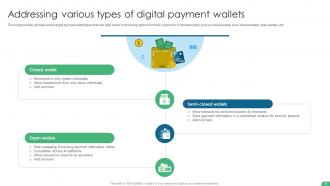
Slide 39: This slide provides glimpse about digital payment wallet types that can help banks in choosing right one for their customers.
Slide 40: This slide provides glimpse about different digital payment wallets that can help banks in choosing right one for their customers.
Slide 41: This slide exhibit Table of Content: Data analytics in banking.
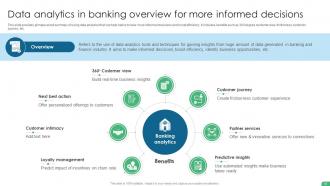
Slide 42: This slide provides glimpse about summary of using data analytics that can help banks to take more informed decisions and boost efficiency.
Slide 43: This slide provides glimpse about market size analysis of data analytics in banking industry for understanding its growing market and utilizing the opportunities.
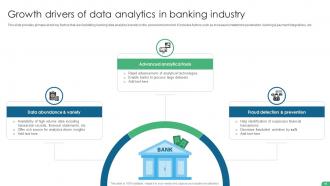
Slide 44: This slide provides glimpse about key factors that are facilitating banking data analytics industry in the current environment.
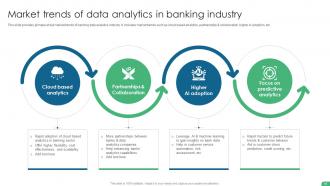
Slide 45: This slide provides glimpse about market trends of banking data analytics industry.
Slide 46: This slide provides glimpse about various aspects across which banks can adopt data analytics and boost operational efficiency.
Slide 47: This slide provides glimpse about different banking data analytics tools available for banks.
Slide 48: This slide exhibit Table of Content: AI in banking.
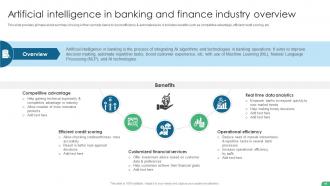
Slide 49: This slide provides glimpse about summary of using AI that can help banks to boost efficiency & automate tasks.
Slide 50: This slide provides glimpse about summary of AI in banking industry for understanding its growing market and utilizing the opportunities.
Slide 51: This slide provides glimpse about key factors that are facilitating adoption of artificial intelligence (AI) in banking industry in the current environment.
Slide 52: This slide provides glimpse about market trends of artificial intelligence (AI) in banking and financial industry.
Slide 53: This slide provides glimpse about steps that can help banks become AI enabled institutions.
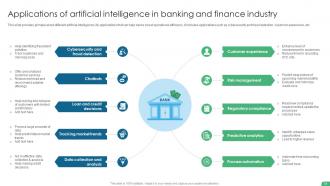
Slide 54: This slide provides glimpse about different artificial intelligence (AI) applications that can help banks boost operational efficiency.
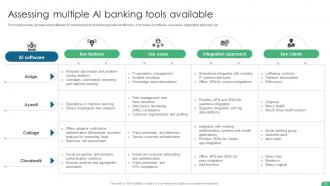
Slide 55: This slide provides glimpse about different AI banking tools to enhance operational efficiency. It includes AI software, use cases, integration approach, etc.
Slide 56: This slide exhibit Table of Content: By technology.
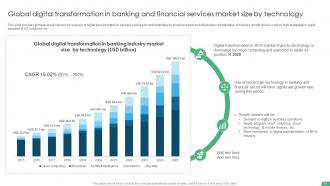
Slide 57: This slide provides glimpse about market size analysis of digital transformation in banking services for understanding its growing market.
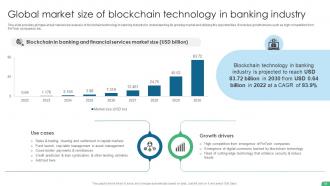
Slide 58: This slide provides glimpse about market size analysis of blockchain technology in banking industry for understanding its growing market.
Slide 59: This slide provides glimpse about market size analysis of cloud computing in banking industry for understanding its growing market and utilizing the opportunities.
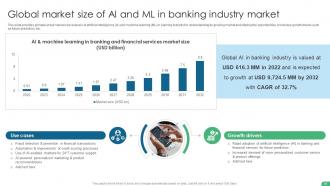
Slide 60: This slide provides glimpse about market size analysis of artificial intelligence (AI) and machine learning (ML) in banking industry.
Slide 61: This slide provides glimpse about market size analysis of big data in banking industry for understanding its growing market and utilizing the opportunities.
Slide 62: This slide exhibit Table of Content: By region.
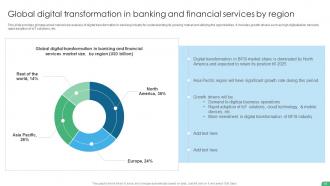
Slide 63: This slide provides glimpse about market size analysis of digital transformation in banking industry for understanding its growing market.
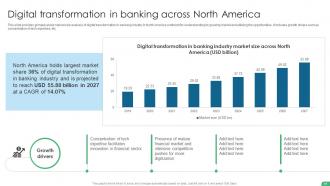
Slide 64: This slide provides glimpse about market size analysis of digital transformation in banking industry in North America.
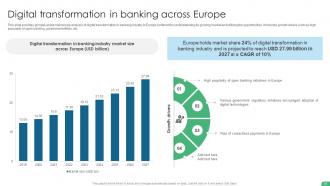
Slide 65: This slide provides glimpse about market size analysis of digital transformation in banking industry in Europe continent for understanding its growing market.
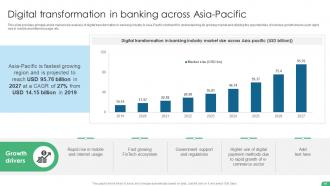
Slide 66: This slide provides glimpse about market size analysis of digital transformation in banking industry in Asia-Pacific continent for understanding its growing market.
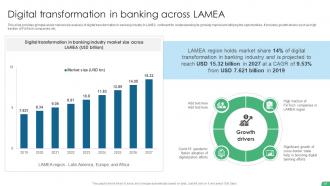
Slide 67: This slide provides glimpse about market size analysis of digital transformation in banking industry in LAMEA continent for understanding its growing market.
Slide 68: This slide exhibit Table of Content: Steps to implement different digital transformation strategies.
Slide 69: This slide provides glimpse about process of adopting digital transformation that can help remodelling the whole banking business to achieve greater efficiencies.
Slide 70: This slide exhibit Table of Content: Steps to implement different digital transformation strategies.
Slide 71: This slide provides glimpse about current and desired state analysis for adoption digital transformation that can help remodelling the whole business.
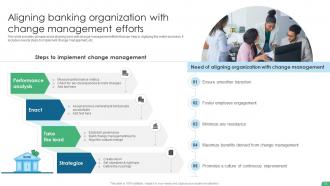
Slide 72: This slide provides glimpse about aligning bank with change management efforts that can help in digitizing the entire business.
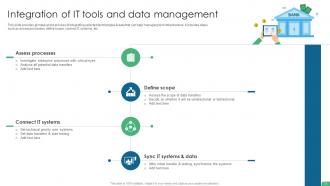
Slide 73: This slide provides glimpse about process of integrating selected technologies & data that can help managing tech infrastructure.
Slide 74: This slide provides glimpse about enhancing talent acquisition and boosting skills of existing employees to fasten digitization process.
Slide 75: This slide provides glimpse about various aspects that can help businesses in measuring impact of adopting digital transformation.
Slide 76: This slide provides glimpse about building continuous improvement culture in banking and financial institution by adopting PDCA framework.
Slide 77: This slide exhibit Table of Content: Cost assessment for digitalization of banking services.
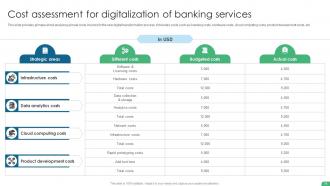
Slide 78: This slide provides glimpse about analyzing annual costs incurred in the new digital transformation process.
Slide 79: This slide exhibit Table of Content: Impact analysis.
Slide 80: This slide provides glimpse about impact analysis of adopting digitalizing education through different applications.
Slide 81: This slide provides glimpse about how digital transformation has changed the banking and financial services industry.
Slide 82: This slide exhibit Table of Content: Case studies.
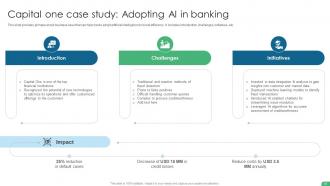
Slide 83: This slide provides glimpse about business case that can help banks adopt artificial intelligence to boost efficiency.
Slide 84: This slide provides glimpse about business case that can help banks adopt mobile banking to enhance customer experience.
Slide 85: This slide provides glimpse about business case that can help banks adopt digital payments and wallets to enhance customer experience.
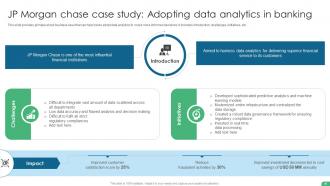
Slide 86: This slide provides glimpse about business case that can help banks adopt data analytics to make more informed decisions.
Slide 87: This slide shows all the icons included in the presentation.
Slide 88: This is a Thank You slide with address, contact numbers and email address.
Digital Transformation In Banking And Financial Services For Seamless Customer Experience DT CD with all 96 slides:
Use our Digital Transformation In Banking And Financial Services For Seamless Customer Experience DT CD to effectively help you save your valuable time. They are readymade to fit into any presentation structure.












































FAQs for Digital Transformation In Banking And Financial Services For Seamless Customer
Honestly, leadership buy-in is make-or-break here. Without executives actually caring, you're basically screwed from day one. Focus on customer experience as your main goal, then build your tech stack around that. Your team needs proper training though - can't just throw new tools at people and expect magic. Change management is probably the hardest part since everyone hates switching up their workflow. I'd say start small with one area first. Get some quick wins to prove it works, then expand from there. Oh and don't treat this like a project with an end date - it's more like an ongoing thing you'll keep tweaking.
Honestly, you gotta measure both the numbers and the fuzzy stuff. ROI and cost savings are obvious ones, plus productivity gains and customer satisfaction scores. Revenue growth is clutch too. But here's the thing - don't sleep on the qualitative metrics like how well employees actually adopt the new tools and whether your processes feel smoother day-to-day. Oh, and definitely track if customers are happier with your digital stuff. Set your baselines before you start (super important) and pick maybe 3-5 metrics that actually matter for what you're trying to do. Review quarterly.
Dude, culture literally makes or breaks this whole thing. Your best tech means nothing if people aren't willing to change how they work. Look for team members who actually get excited about trying new stuff - they're gold. Leadership needs to walk the walk too, not just talk about it. Oh and create space for people to mess up without getting their heads bitten off, because trust me, there will be failures. Find your culture champions first (you probably already know who they are) and get them planning with you. They'll sell the vision way better than any top-down mandate ever could.
Dude, build security in from the start - don't just slap it on later. Encrypt everything (data sitting around, stuff moving between systems, all of it). Zero-trust is huge too since you're basically never trusting anyone automatically. I swear this stuff gives me anxiety because one screw-up destroys years of work. Train your people though - most hacks happen because someone clicked the wrong link or whatever. Run security audits and pen tests regularly to find problems first. Oh, and get security involved right when you start planning. Not months later when everything's half-built and they're like "um, this won't work."
Cloud computing's the big one right now - everything's going that route for flexibility and remote access. AI and machine learning are crushing it for automating boring stuff and finding patterns in data. IoT's connecting all our devices (my smart thermostat still creeps me out sometimes), while 5G makes everything lightning fast. Automation tools are everywhere too. The whole pace feels insane lately. My advice? Figure out what's actually broken in your workflow first, then see which tech fixes it. Don't just jump on trends because they're shiny.
Honestly, don't try to do everything at once - I made that mistake and it was a disaster! Pick one thing to focus on first. There's tons of free stuff out there for basics like scheduling posts or tracking customers. I'd go after whatever helps your customers most directly first, like maybe online ordering? That makes the biggest difference. Oh and definitely look into small business programs - lots of them offer discounted software that's actually decent. You'll save yourself a headache by being picky about where you spend your money and energy.
Honestly, customer experience drives pretty much everything when it comes to digital transformation. You're usually trying to make stuff faster or easier for people - chatbots, mobile apps, better checkout flows, whatever. It's kind of a cycle too: good digital tools create better experiences, then you want to keep improving. I always tell people to start with "how does this actually help customers?" instead of just going after shiny new tech. Way too many companies get distracted by trends when they should focus on what their users actually need. Makes the whole process way more effective.
Here's the thing - when companies go digital, your current team suddenly needs tech skills they've never had to learn before. You'll also need completely new positions like data analysts and UX people. Training becomes this ongoing cycle instead of just onboarding once, which honestly makes sense since tech moves so damn fast. The smart move? Figure out what skills your people already have that can transfer over, then identify what needs total retraining. I'd start with a skills audit - compare where your team is now versus where your industry's headed. That'll show you exactly which training programs to tackle first.
Honestly, most people try cramming everything into phase one and it's a disaster. Get your team on board first or you're dead in the water. I've watched so many managers think their staff will just magically embrace change - spoiler alert, that never happens. Budget disappears quick without a solid plan, and data migration is way messier than anyone expects. Oh, and don't rebuild your old broken processes in shiny new software, that's just expensive stupidity. Pick one thing, nail it, then move on. Talk to people constantly and actually solve real problems instead of buying cool tech.
Honestly, AI can be a game-changer for your business transformation. Chatbots take over customer service. Predictive stuff helps with inventory planning. Recommendation engines boost your sales numbers pretty well. The best part? You don't need to be some tech genius anymore - tons of ready-made tools exist now. My advice: pick one annoying problem first instead of going crazy with everything. Maybe start with automating those repetitive tasks that drive everyone nuts. Test it out, see what actually moves the needle, then expand from there. Way less overwhelming that way.
Honestly, start with making people feel safe to mess up - nobody's gonna take risks if they think you'll throw them under the bus. Maybe try that Google thing where they get 20% time for random projects? Mix up your teams too, like put marketing with engineering or whatever. I know celebrating failures sounds super corporate-y, but people actually do need to hear it's okay when stuff doesn't work out. Give them new tools to play with and some training so they don't feel clueless. Oh, and pick something small first where if it goes sideways, it's not a big deal.
Oh man, compliance stuff will absolutely tank your timeline - we're talking months of delays, maybe more. Healthcare and finance are the worst for this. Banking regs are insane. You'll need all these extra security layers and data protection things that just weren't part of the original plan. Here's what actually works though: loop in your compliance people right from the start. I know it sounds boring, but they can help you build everything the right way from day one instead of having to redo it all later. Trust me, that conversation now saves you so much headache down the road.
Get everyone involved upfront when you're defining the vision - don't just show up with a finished plan. Cross-functional teams work best when they can actually make decisions without running to leadership constantly (seriously, that kills everything). Two-way communication is where it's at. Skip the boring status meetings and do workshops, surveys, feedback sessions instead. People need to feel like they're building this thing with you, not just watching from the sidelines. Oh, and pilot programs are clutch - let stakeholders mess around with stuff before you roll it out everywhere.
Honestly, skip the massive overhauls - they never work out like you think they will. Small changes are way easier to fix when stuff goes sideways. Get your teams talking to each other so they can actually make decisions without waiting for approval from like 15 different people. Cloud stuff and modular tech are your friends here since you can switch things out without rebuilding everything. Your people need to know it's cool to experiment and mess up sometimes. That's huge. Check in regularly and don't be afraid to axe projects that aren't working.
Look, most digital transformations pretty much depend on cloud computing - it's what gives you that flexibility to modernize without getting stuck with old systems. You can test new stuff and scale up or down based on what you actually need, no huge upfront costs. Remote work became way easier too (pandemic taught us that the hard way). The coolest part? You get access to AI and machine learning tools that would cost a fortune to build yourself. Oh, and different systems actually talk to each other properly. I'd say figure out which of your processes need the most wiggle room first - that's your best starting point.
-
The quality of the templates is as fine as it could get. It was a purchase well made!
-
Attractive design and informative presentation.