

Disciplined agile delivery roles powerpoint presentation slides




Try Before you Buy Download Free Sample Product
 Impress Your
 Audience
 100%
100% Editable
 Save Hours
 of Time


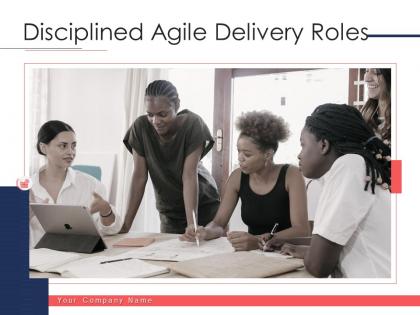
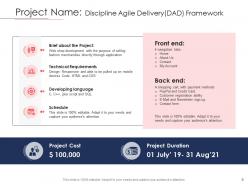
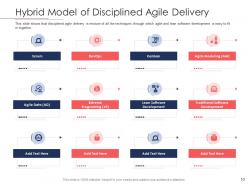
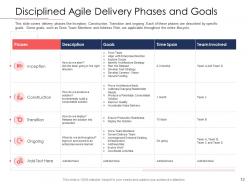
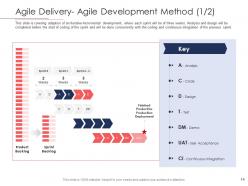
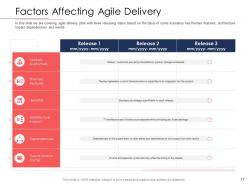
Get our readily available Disciplined Agile Delivery Roles PowerPoint Presentation Slides to create a process that best suits the project and the organization. The presentation highlights a description of the project with technical requirements, developing language, and schedule. Discuss the problems that organizations currently face in agile project methodologies by utilizing these ready-to-use PPT visuals. The slides also display the survey of the issues faced by the organization while choosing software development methods. List out different software development frameworks that are differentiated based on criteria like scope, technology, adoption, scaling. Take advantage of ready-to-use lean software development PPT layouts to demonstrate the hybrid model of disciplined agile delivery. Highlight the goals and phases of agile delivery by using these content-ready PowerPoint templates. The slides also cover the framework of agile delivery from initiation to release. Methods of agile development can also be demonstrated using these content-driven PowerPoint infographics. Discuss the factors affecting agile delivery, and the role of the team to discipline agile development by downloading our professionally designed PPT slide design.
People who downloaded this PowerPoint presentation also viewed the following :
Disciplined agile delivery roles powerpoint presentation slides with all 48 slides:
Use our Disciplined Agile Delivery Roles Powerpoint Presentation Slides to effectively help you save your valuable time. They are readymade to fit into any presentation structure.




















FAQs for Disciplined agile delivery roles
DAD defines primary roles including Team Lead, Product Owner, Architecture Owner, Team Member, and Stakeholder, alongside secondary roles like Domain Expert and Technical Expert. These roles differ from traditional Agile by emphasizing architectural governance, stakeholder engagement, and scaling considerations, with many enterprise organizations finding that this structured approach enhances delivery predictability while maintaining agility.
Agile Coaches in DAD support team dynamics by facilitating collaboration, resolving conflicts, mentoring team members on agile practices, and ensuring alignment with organizational goals. They foster continuous improvement through regular retrospectives, coaching on disciplined agile principles, and helping teams adapt their approach based on context, with many organizations finding that dedicated coaching accelerates delivery effectiveness and team maturity.
DAD integrates business stakeholders through defined roles like Product Owner and Stakeholder Representative, regular collaborative ceremonies, and continuous feedback loops throughout delivery iterations. This framework enables stakeholders to actively participate in prioritization decisions, sprint reviews, and requirement refinement sessions, while streamlining communication channels and ensuring business value alignment, ultimately delivering faster time-to-market and enhanced customer satisfaction.
The architecture owner in DAD significantly impacts system design by guiding technical decisions, ensuring architectural consistency, and balancing stakeholder needs with technical constraints throughout the project lifecycle. This role enhances project success by mitigating technical risks, facilitating cross-team collaboration, and maintaining long-term system scalability, with many organizations finding that strong architectural leadership ultimately delivers more robust solutions and faster delivery timelines.
Essential product owner skills in Disciplined Agile Delivery include stakeholder collaboration, backlog prioritization, market analysis, requirements definition, and cross-functional communication abilities. These competencies enable product owners to balance customer needs with technical constraints, facilitate decision-making across diverse teams, and drive product vision alignment, with many organizations finding that skilled product owners significantly accelerate delivery timelines while enhancing customer satisfaction.
DAD team leads have broader responsibilities than Scrum Masters, including tactical decision-making, risk management, stakeholder coordination, and team member development beyond just facilitation. While Scrum Masters primarily focus on process facilitation and removing impediments, DAD team leads actively guide solution delivery, manage external dependencies, and make strategic choices about practices and tools, ultimately delivering more comprehensive leadership that scales across complex enterprise environments.
Team members can enhance DAD collaboration through cross-functional pairing, regular retrospectives, transparent backlog management, and structured daily standups that focus on impediment resolution. These strategies streamline communication by fostering shared accountability, reducing silos, and enabling rapid feedback loops, with many organizations finding that disciplined transparency ultimately delivers faster sprint cycles and improved stakeholder alignment across complex delivery environments.
DAD empowers self-organizing teams through flexible role definitions, collaborative decision-making frameworks, and adaptive governance structures that balance autonomy with strategic oversight. While teams gain freedom to choose their own practices and workflows, they remain accountable through regular milestone reviews, stakeholder feedback loops, and clear success metrics, ultimately ensuring that creative independence delivers measurable business value and competitive advantage.
DAD teams benefit from specialist roles when facing complex technical challenges, regulatory compliance requirements, legacy system integrations, or specialized domain expertise needs like security, data architecture, or user experience design. These specialists provide deep, focused knowledge while remaining collaborative team members rather than isolated experts, with many organizations finding that strategic use of specialists accelerates delivery timelines and enhances solution quality without compromising agile principles.
The DevOps role in DAD enhances delivery pipelines by bridging development and operations through automated deployments, continuous integration practices, and streamlined infrastructure management. This strategic combination enables organizations to achieve faster release cycles, reduced deployment risks, and improved system reliability, with many financial services and retail companies finding that dedicated DevOps practitioners ultimately deliver significant operational efficiency gains.
Cross-functional roles significantly reduce bottlenecks by enabling team members to handle diverse tasks, share workload dynamically, and eliminate dependencies on single specialists. This approach streamlines delivery workflows, accelerates problem-solving, and enhances team resilience, with many organizations finding that cross-trained professionals deliver faster cycle times and improved project outcomes.
DAD transforms traditional project management into adaptive leadership roles, emphasizing team coaching, stakeholder coordination, and delivery facilitation rather than rigid command-and-control structures. This approach enables project managers to focus on removing impediments, ensuring strategic alignment, and optimizing team dynamics, with many organizations finding that this collaborative model delivers faster project outcomes and enhanced team autonomy.
Transitioning DAD roles from waterfall to Agile presents challenges including mindset shifts from rigid planning to adaptive execution, role redefinition from hierarchical to collaborative structures, skill gaps in iterative delivery methods, and resistance to increased transparency and frequent feedback loops. These obstacles, while initially disruptive, ultimately enable organizations to streamline project delivery, enhance team collaboration, and accelerate time-to-market, with many enterprises finding that structured change management significantly improves adoption success.
DAD roles naturally expand and specialize as teams mature, with product owners developing deeper stakeholder management skills, architecture owners tackling more complex technical decisions, and team members assuming specialized responsibilities like DevOps or user experience. Through this evolution, organizations streamline delivery processes, enhance cross-functional collaboration, and ultimately deliver more sophisticated solutions, with many teams finding that role maturation directly correlates with improved project outcomes and organizational agility.
Disciplined Agile offers comprehensive training resources including certification programs, role-based learning paths, online courses, workshops, and mentoring opportunities tailored to specific team positions. These resources enable professionals to develop expertise in product ownership, team leadership, architecture, and stakeholder management, with many organizations finding that structured DA training accelerates team performance and delivers measurable improvements in project outcomes.
-
Innovative and Colorful designs.
-
Content of slide is easy to understand and edit.
-
Use of different colors is good. It's simple and attractive.
-
Innovative and Colorful designs.
-
Great designs, Easily Editable.
-
Understandable and informative presentation.
-
Excellent template with unique design.
-
Designs have enough space to add content.
-
Unique research projects to present in meeting.