

Discussion Questions For Conflict Management Training Ppt




Try Before you Buy Download Free Sample Product
 Impress Your
 Audience
 100%
100% Editable
 Save Hours
 of Time


This set of slides contains discussion questions that a trainer can use to test the knowledge of conflict management training session attendees.
People who downloaded this PowerPoint presentation also viewed the following :
Content of this Powerpoint Presentation
Slide 2 to 6
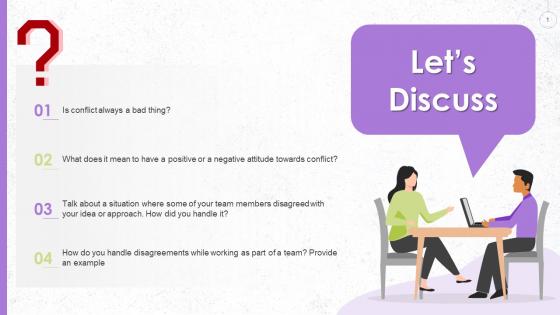
These slides contain discussion questions on Understanding Conflict, Conflict Management Styles, Preventing Conflict in the Workplace, Developing Conflict Resolution Skills, Emotional Intelligence in Conflict Management, and Conflict Management Policies for the Workplace. A trainer can use these to test knowledge and engage the audience in the training session.
Discussion Questions For Conflict Management Training Ppt with all 21 slides:
Use our Discussion Questions For Conflict Management Training Ppt to effectively help you save your valuable time. They are readymade to fit into any presentation structure.














FAQs for Discussion Questions For Conflict
Effective workplace conflict resolution strategies include active listening, collaborative problem-solving, mediation, clear communication protocols, and structured negotiation processes. These approaches enhance team dynamics by addressing root causes, fostering mutual understanding, and establishing preventive frameworks, with many organizations finding that early intervention and trained mediators significantly reduce workplace tensions while improving overall productivity.
Emotional intelligence helps manage conflicts by enabling better self-awareness, empathy, and emotional regulation during tense situations. Leaders with high emotional intelligence can identify underlying emotions driving disputes, communicate more effectively with conflicting parties, and find collaborative solutions that address both rational concerns and emotional needs, ultimately reducing workplace tension while improving team relationships and organizational productivity.
De-escalation techniques include active listening, acknowledging emotions, using calm body language, finding common ground, and reframing issues constructively. These approaches streamline conflict resolution by reducing defensive responses, encouraging collaborative dialogue, and maintaining professional relationships, with many organizations finding that structured de-escalation training ultimately enhances team productivity and workplace harmony.
Cultural diversity significantly influences conflict management by shaping communication styles, decision-making processes, power dynamics, and resolution preferences across different cultural backgrounds. While Western approaches often emphasize direct confrontation and individual accountability, many Asian and collectivist cultures prioritize harmony preservation, face-saving, and group consensus, ultimately requiring organizations to adopt flexible, culturally-sensitive strategies for effective conflict resolution.
Active listening plays a crucial role in conflict resolution by demonstrating respect, fostering understanding, and creating space for all parties to feel heard and validated. Through careful attention to verbal and non-verbal cues, mediators and participants can identify underlying concerns, clarify misunderstandings, and build trust, ultimately enabling more collaborative solutions and stronger working relationships.
Leaders foster open communication cultures by establishing regular feedback channels, implementing transparent decision-making processes, encouraging diverse perspectives, and modeling vulnerability through active listening. These approaches minimize conflicts by addressing issues early, building trust across teams, and creating psychological safety, with many organizations finding that proactive communication strategies ultimately deliver stronger collaboration, reduced workplace tensions, and enhanced operational efficiency.
**INPUT**: What are the common signs that indicate a conflict is brewing? **OUTPUT**: Common signs include decreased communication between team members, increased tension during meetings, passive-aggressive behaviors, missed deadlines, and withdrawal from collaborative activities. These indicators often manifest through reduced eye contact, shorter responses, and avoiding joint projects, with many organizations finding that early recognition enables proactive intervention, ultimately preventing escalation and maintaining productive workplace relationships. [Word count: 54 words]
Conflict management training enhances team dynamics by teaching effective communication techniques, active listening skills, and collaborative problem-solving methods. Through structured workshops and role-playing exercises, teams develop stronger interpersonal relationships, reduce workplace tensions, and streamline decision-making processes, ultimately delivering improved productivity and employee satisfaction across organizations.
Unresolved conflicts significantly impact organizational performance through decreased productivity, reduced employee engagement, increased turnover, and damaged team collaboration. These persistent tensions create inefficiencies that ripple throughout departments, with many organizations finding that unaddressed workplace disputes ultimately lead to higher operational costs, weakened morale, and compromised competitive advantage in increasingly collaborative business environments.
Technology assists conflict resolution through online mediation platforms, AI-powered sentiment analysis, video conferencing tools, digital case management systems, and automated scheduling solutions. These technologies streamline communication by enabling real-time collaboration, reducing geographical barriers, and providing data-driven insights into dispute patterns, with many organizations finding that virtual mediation delivers faster resolutions while minimizing costs.
Effective conflict mediation methods include active listening sessions, structured dialogue frameworks, neutral third-party facilitation, collaborative problem-solving workshops, and establishing clear communication protocols. These approaches streamline resolution by encouraging open communication, identifying root causes, and creating mutually acceptable solutions, with many organizations finding that structured mediation processes ultimately enhance team cohesion and productivity.
Personal biases significantly impact conflict resolution by influencing how we interpret information, assign blame, and evaluate potential solutions. These cognitive filters can lead to selective listening, unfair judgments, and resistance to compromise, with many organizations finding that bias-aware mediators and structured decision-making processes ultimately deliver more equitable outcomes and sustainable agreements.
Collaborative problem-solving enhances conflict management by fostering mutual understanding, encouraging creative solution development, building trust between parties, and transforming adversarial dynamics into cooperative partnerships. This approach enables organizations to address root causes rather than symptoms, while teams in healthcare, manufacturing, and financial services find that collaborative methods reduce recurring disputes, improve workplace relationships, and ultimately deliver stronger long-term outcomes.
A successful conflict resolution framework includes early identification, stakeholder engagement, root cause analysis, collaborative solution development, and implementation monitoring. These steps streamline organizational disputes by establishing clear communication channels, facilitating structured dialogue, and creating accountability measures, with many companies finding that systematic approaches reduce resolution time and enhance workplace relationships.
Constructive conflict feedback should be specific, timely, and focus on behaviors rather than personalities, using "I" statements and active listening techniques. Organizations can implement structured feedback frameworks like the SBI model (Situation-Behavior-Impact), enabling managers and teams to address workplace tensions objectively while fostering collaborative problem-solving and ultimately improving communication effectiveness.
-
Much better than the original! Thanks for the quick turnaround.
-
“Excellent service from the customer support team when I wanted a slide that was a bit different from those on their standard menu. Super helpful.”