

Diversity and inclusion management managing generational diversity in the workplace





Try Before you Buy Download Free Sample Product
 Impress Your
Audience
 100%
Editable
 Save Hours
of Time


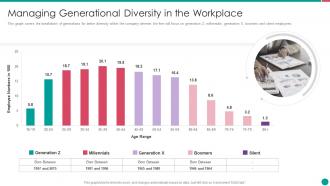
This graph covers the breakdown of generations for better diversity within the company wherein the firm will focus on generation Z, millennials, generation X, boomers and silent employees.
People who downloaded this PowerPoint presentation also viewed the following :
Diversity and inclusion management managing generational diversity in the workplace with all 7 slides:
Use our Diversity And Inclusion Management Managing Generational Diversity In The Workplace to effectively help you save your valuable time. They are readymade to fit into any presentation structure.






FAQs for Diversity and inclusion management managing generational diversity
**INPUT**: What are the main characteristics that define different generations in the workplace? **OUTPUT**: Different workplace generations are defined by distinct communication preferences, technology adoption rates, work-life balance priorities, career advancement expectations, and leadership styles shaped by their formative experiences. These generational characteristics influence collaboration approaches, with Baby Boomers valuing face-to-face interactions, Gen X emphasizing independence, Millennials seeking feedback and purpose, and Gen Z prioritizing flexibility, ultimately creating diverse perspectives that enhance organizational innovation and decision-making. [Word count: 60 words]
Organizations effectively bridge generational communication gaps by implementing flexible communication channels, providing cross-generational mentoring programs, offering communication style training, and creating inclusive meeting formats that accommodate different preferences. These strategies enable workplaces to leverage each generation's strengths while fostering mutual understanding, with many companies finding that structured intergenerational collaboration ultimately enhances innovation and organizational cohesion.
Technology bridges generational gaps by providing collaborative platforms, flexible communication channels, knowledge-sharing systems, and adaptive learning tools that accommodate different work preferences. These digital solutions enable cross-generational mentoring, streamline information transfer, and create inclusive environments where Baby Boomers, Gen X, Millennials, and Gen Z can collaborate effectively, ultimately enhancing team productivity and organizational innovation.
Training programs can be tailored through blended learning approaches, incorporating visual presentations for visual learners, interactive workshops for hands-on preferences, mentoring programs, and digital platforms with self-paced modules. Organizations across healthcare, financial services, and manufacturing find that combining traditional classroom sessions with online resources, peer-to-peer learning opportunities, and flexible scheduling accommodates diverse generational preferences while enhancing knowledge retention and employee engagement.
Leaders can create generational inclusivity through flexible communication channels, mentorship programs pairing different age groups, adaptable work arrangements, and recognition systems that value both innovation and experience. These strategies enable organizations to leverage diverse perspectives, enhance knowledge transfer between Baby Boomers and Gen Z employees, and streamline collaboration, with many companies finding that inclusive practices ultimately deliver improved retention, accelerated innovation, and competitive advantage in increasingly multigenerational workplaces.
Generational diversity impacts team dynamics through varied communication preferences, work styles, and technological comfort levels, creating both collaboration challenges and innovation opportunities. While differences in feedback expectations and decision-making approaches can initially cause friction, organizations increasingly find that blending perspectives from Baby Boomers, Gen X, Millennials, and Gen Z ultimately enhances problem-solving capabilities and delivers more comprehensive solutions.
Common generational stereotypes include Boomers being viewed as tech-resistant, Gen X as cynical loners, Millennials as entitled job-hoppers, and Gen Z as impatient digital natives. These misconceptions can be addressed through structured mentoring programs, cross-generational project teams, and individualized management approaches that focus on personal strengths rather than age-based assumptions, ultimately creating more inclusive workplaces where diverse perspectives enhance innovation and organizational performance.
Organizations embracing generational diversity gain enhanced innovation, improved problem-solving capabilities, expanded market insights, stronger mentorship networks, and increased employee engagement across age groups. This strategic combination enables companies to leverage varied perspectives, experiences, and skill sets, ultimately delivering better customer experiences, more comprehensive solutions, and sustainable competitive advantage in an increasingly multigenerational marketplace.
Effective mentoring programs can leverage generational strengths through reverse mentoring, cross-generational partnerships, skill-specific exchanges, and rotating mentor-mentee relationships based on expertise rather than seniority. These structured approaches enable organizations to harness digital fluency from younger employees, institutional knowledge from experienced workers, and diverse perspectives across all generations, ultimately creating comprehensive knowledge transfer and enhanced collaboration.
HR can implement flexible work arrangements, mentorship programs pairing different generations, customized benefits packages, varied communication channels, and inclusive training initiatives. These policies enhance workplace harmony by accommodating diverse work preferences, facilitating knowledge transfer, and leveraging generational strengths, with many organizations finding that strategic generational diversity management ultimately delivers improved retention and competitive advantage.
Companies can measure generational diversity initiative effectiveness through employee engagement surveys, retention rates across age groups, mentorship program participation, cross-generational collaboration metrics, and promotion patterns by generation. These assessments enable organizations to track workplace satisfaction, knowledge transfer success, and career advancement equity, with many finding that regular pulse surveys and exit interviews reveal specific generational needs, ultimately delivering improved retention and enhanced organizational culture.
Employee resource groups serve as vital platforms for cross-generational mentoring, knowledge sharing, reverse mentoring programs, and intergenerational collaboration initiatives that bridge workplace communication gaps. These groups enable organizations to leverage diverse generational perspectives through structured networking, skills exchange, and cultural understanding programs, with many companies finding that ERGs significantly enhance employee engagement, retention, and innovation across all age demographics.
Organizations can encourage knowledge sharing by implementing formal mentorship programs, creating cross-generational project teams, establishing reverse mentoring initiatives, and hosting regular knowledge transfer sessions. These approaches enable experienced employees to share institutional wisdom while younger workers contribute fresh perspectives and digital expertise, ultimately fostering innovation, reducing knowledge gaps, and enhancing organizational resilience across industries like healthcare, finance, and manufacturing.
Best practices for multigenerational conflict resolution include active listening across age groups, establishing common ground through shared organizational goals, implementing structured mediation processes, and creating neutral communication channels that accommodate different technological preferences. These approaches work effectively by fostering mutual understanding between generations, addressing underlying assumptions and biases, and emphasizing collaborative problem-solving, ultimately delivering stronger team cohesion and workplace harmony.
Employee expectations regarding work-life balance vary significantly across generations, with Baby Boomers often prioritizing job security and traditional boundaries, Generation X seeking flexibility for family responsibilities, and Millennials and Gen Z demanding remote work options, mental health support, and purpose-driven roles. Organizations increasingly find that addressing these diverse expectations through flexible policies, varied benefit packages, and personalized management approaches enhances retention and productivity across all age groups.
-
Design layout is very impressive.
-
Easily Editable.