

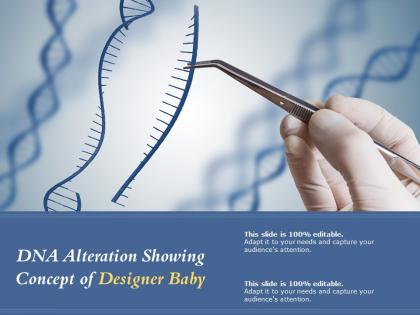
Dna alteration showing concept of designer baby




Try Before you Buy Download Free Sample Product
 Impress Your
Audience
 100%
Editable
 Save Hours
of Time


Crystallize your thoughts on our DNA Alteration Showing Concept Of Designer Baby. They will evolve into a definite plan.
People who downloaded this PowerPoint presentation also viewed the following :
Dna alteration showing concept of designer baby with all 6 slides:
Get your team out of their cubicles. Get them together with our DNA Alteration Showing Concept Of Designer Baby.


FAQs for Dna alteration showing concept
Designer babies raise significant ethical concerns including genetic equity and access, consent for future generations, potential societal pressure for enhancement, and the risk of reducing human diversity. While these technologies present opportunities for preventing serious genetic diseases, they also challenge our understanding of natural human variation, with many bioethicists finding that careful regulation balances medical benefits against broader social implications.
CRISPR and similar genetic editing technologies could significantly enhance precision in embryonic modifications, enabling targeted corrections of genetic disorders, optimization of physical traits, and potentially cognitive enhancements. These advances streamline the designer baby process by reducing off-target effects, accelerating development timelines, and improving success rates, with many fertility clinics and research institutions finding that enhanced genetic tools ultimately deliver more predictable outcomes and expanded therapeutic possibilities.
**INPUT**: What are the potential health risks associated with creating designer babies? **OUTPUT**: Potential health risks include unintended genetic mutations, immune system complications, chromosomal abnormalities, developmental disorders, and long-term hereditary effects that could impact future generations. While these technologies present challenges, many research institutions find that advancing precision medicine techniques, enhanced safety protocols, and rigorous clinical testing frameworks ultimately enable more targeted therapeutic applications with reduced risk profiles.
Public perceptions of designer babies vary significantly across cultures, with Western societies often emphasizing individual choice and medical advancement, while many Eastern cultures prioritize collective family benefits and genetic enhancement for societal good. These cultural frameworks shape regulatory approaches and acceptance levels, with some regions embracing genetic technologies for competitive advantage while others maintain traditional ethical boundaries, ultimately influencing how nations position themselves in biotechnology markets.
Government regulations serve as critical gatekeepers for designer baby technologies, establishing safety protocols, ethical boundaries, research guidelines, and clinical trial standards. While many countries currently restrict or ban germline editing, regulatory frameworks are evolving to balance scientific advancement with public safety, ultimately enabling controlled research progress while protecting against misuse in this increasingly complex biotechnology landscape.
Designer babies present both potential benefits and significant equity concerns, as genetic enhancement technologies could become accessible primarily to affluent families who can afford these procedures. This selective availability may create wider health and intelligence gaps between socioeconomic groups, with many ethicists finding that unequal access to genetic improvements could ultimately amplify existing societal disparities rather than reducing them.
Designer babies could significantly alter parent-child dynamics through heightened expectations, potential conditional love based on engineered traits, and reduced acceptance of natural variations. While some families may experience stronger bonds through shared genetic optimization goals, others might face increased pressure and disappointment when children don't meet predetermined specifications, ultimately challenging traditional unconditional parenting approaches.
Designer baby technologies could significantly reshape family planning by enabling parents to prevent genetic diseases, select desired traits, and reduce uncertainty about their children's health outcomes. While these advances offer unprecedented control over genetic inheritance, they also present complex ethical considerations and potential societal pressures, with many families finding that enhanced reproductive choices ultimately deliver greater confidence in family planning decisions.
Current designer baby research focuses on CRISPR gene editing, preimplantation genetic diagnosis, mitochondrial replacement therapy, and base editing techniques for disease prevention. While these technologies enable targeting genetic disorders like sickle cell disease and cystic fibrosis, regulatory frameworks vary globally, with many institutions finding that ethical considerations and safety protocols remain paramount concerns.
Defining enhanced traits in designer babies involves medical professionals, ethicists, and families collaborating to prioritize disease prevention over cosmetic modifications, focusing on eliminating genetic disorders like cystic fibrosis, sickle cell disease, and Huntington's disease. While consensus exists around preventing serious health conditions, decisions regarding cognitive or physical enhancements remain complex ethical considerations requiring careful regulatory frameworks.
Normalizing designer babies could reshape social structures through genetic stratification, widening inequality gaps, altering parental expectations, and changing human diversity concepts. While this technology enables families to prevent hereditary diseases and enhance capabilities, it presents challenges around access equity and social cohesion, with many ethicists finding that careful regulation balances innovation with societal values.
Designer babies challenge genetic diversity by potentially reducing the natural variation that strengthens human populations, as parents may favor similar "desirable" traits like intelligence or physical appearance. While genetic modifications could eliminate serious hereditary diseases, widespread selection for preferred characteristics might narrow the gene pool, ultimately reducing humanity's adaptive capacity and resilience against future environmental or biological challenges.
Parents considering designer babies bear significant ethical responsibilities including ensuring medical necessity over cosmetic preferences, understanding long-term genetic consequences, and considering their child's future autonomy and identity. These decisions require careful consultation with genetic counselors, medical ethicists, and healthcare professionals, with many families finding that focusing on preventing serious hereditary diseases rather than enhancement traits ultimately delivers better outcomes while respecting human dignity.
Religious and philosophical beliefs intersect with designer babies through fundamental questions about human nature, divine creation, and moral boundaries in genetic modification. While some religious perspectives emphasize stewardship and healing as aligned with faith values, others raise concerns about playing God, with many philosophical traditions finding that this technology challenges core beliefs about human dignity, natural law, and the sanctity of unaltered human life.
Designer babies may experience complex identity questions, including pressure to meet enhanced expectations, uncertainty about authentic versus engineered traits, and challenges in forming self-worth independent of genetic modifications. While some children might benefit from reduced health anxieties, many psychologists suggest that knowledge of genetic enhancement could create performance pressure and identity confusion, ultimately requiring new therapeutic approaches and family counseling strategies to support healthy psychological development.
No Reviews