Dress Code Policy At Workplace Induction Program For New Employees
Try Before you Buy Download Free Sample Product
Audience
Editable
of Time
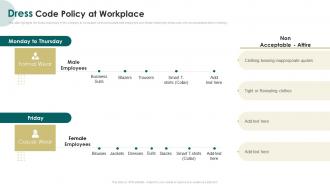
This slide highlights the dress code policy of the company at workplace which showcases male employees and female employees dress code with non acceptable attire or clothing.
People who downloaded this PowerPoint presentation also viewed the following :
Dress Code Policy At Workplace Induction Program For New Employees with all 6 slides:
Use our Dress Code Policy At Workplace Induction Program For New Employees to effectively help you save your valuable time. They are readymade to fit into any presentation structure.
FAQs for Dress Code Policy At Workplace Induction Program
Key components of an effective dress code policy include clear guidelines for business, casual, and formal attire, specific restrictions on inappropriate clothing, grooming standards, religious and cultural accommodations, and enforcement procedures. These elements streamline workplace professionalism by reducing confusion, enhancing brand image, and ensuring legal compliance, with many organizations finding that well-defined policies improve employee confidence and customer perceptions.
A dress code policy reflects company culture by communicating professionalism standards, brand identity, inclusivity commitments, and workplace expectations through specific guidelines and flexibility measures. Through thoughtful policy design, organizations demonstrate their values regarding employee expression, customer interactions, and business environment, with many companies finding that well-crafted dress codes enhance team cohesion while supporting strategic brand positioning.
Legal implications of enforcing dress code policies include discrimination claims, religious accommodation disputes, gender bias lawsuits, disability rights violations, and workplace harassment issues. These policies present both challenges and opportunities, with many organizations finding that clear, consistently applied guidelines minimize legal risks while enhancing professional standards, ultimately delivering workplace clarity and reduced liability exposure.
Businesses can ensure inclusive dress code policies by accommodating religious attire, cultural expressions, gender identity preferences, and physical disabilities while maintaining professional standards. Companies like Google and Microsoft have successfully implemented flexible policies that respect hijabs, traditional cultural dress, and diverse gender presentations, ultimately enhancing employee satisfaction, retention, and creating more welcoming workplace environments that attract top talent.
Employee feedback plays a crucial role in developing effective dress code policies by providing insights into comfort, practicality, cultural considerations, and workplace dynamics. Through surveys, focus groups, and open discussions, organizations can balance professional standards with employee preferences, ultimately creating policies that enhance workplace satisfaction, reduce compliance issues, and foster a more inclusive environment.
Flexible dress codes enhance employee comfort, boost morale, attract diverse talent, reduce costs, and improve retention, while strict codes ensure professional consistency, brand alignment, and client confidence. Many organizations find that strategic flexibility—formal client meetings with relaxed internal days—delivers competitive recruitment advantages and higher satisfaction, while maintaining professional standards when needed.
A dress code policy impacts employee morale and productivity by establishing professional standards, reducing workplace distractions, and creating visual unity across teams. When implemented thoughtfully, these policies enhance workplace confidence, streamline decision-making around daily attire choices, and foster team cohesion, with many organizations finding that clear guidelines ultimately deliver improved focus and stronger professional identity.
Effective dress code communication strategies include clear written policies with visual examples, comprehensive onboarding sessions, regular reminders through multiple channels, and consistent managerial reinforcement. These approaches work by eliminating ambiguity, setting clear expectations, and maintaining professional standards, with many organizations finding that visual guides and ongoing communication significantly reduce policy violations while enhancing workplace professionalism.
Dress code expectations vary significantly across industries, with financial services and law firms requiring formal business attire, healthcare mandating scrubs and uniforms, tech companies embracing casual wear, and creative industries allowing artistic expression. These variations reflect each sector's client interactions, safety requirements, and corporate culture, with many organizations finding that appropriate dress codes enhance professional credibility while supporting employee comfort and productivity.
Common pitfalls include inconsistent enforcement across departments, unclear policy language, failing to consider religious or cultural accommodations, and lack of manager training on implementation. These challenges often result in employee complaints, potential discrimination issues, and decreased morale, with many organizations finding that overly rigid policies without flexibility ultimately harm workplace culture and productivity.
Remote dress code policies should establish clear expectations for video calls, client meetings, and collaborative sessions, while allowing casual attire during non-video work time. These policies enhance professional image by requiring business appropriate tops for virtual meetings, maintaining brand standards, and ensuring team cohesion, with many organizations finding that flexible yet structured guidelines ultimately deliver improved remote work culture and client confidence.
Regularly reviewing dress code policies ensures alignment with evolving workplace cultures, legal requirements, and employee expectations while maintaining professional standards. This process enables organizations to address inclusivity concerns, accommodate remote work trends, and reflect contemporary business practices, ultimately enhancing employee satisfaction and reducing potential discrimination issues in increasingly diverse work environments.
Businesses can balance professionalism with personal expression through flexible dress code frameworks that define core standards while allowing individual choices in colors, accessories, and personal styling within professional boundaries. Many organizations implement "business casual plus" policies or designated casual days, enabling employees to showcase personality while maintaining client-facing credibility, ultimately enhancing workplace satisfaction and professional image.
Effective measures include establishing clear escalation procedures, documenting all violations consistently, providing verbal warnings before formal action, offering uniform allowances for financial hardships, and training managers on unbiased enforcement. These approaches streamline policy implementation by ensuring transparent communication, reducing workplace conflicts, and maintaining professional standards, with many organizations finding that supportive rather than punitive measures ultimately deliver better compliance and employee satisfaction.
Visual aids like presentation templates enhance dress code policy understanding by providing clear examples, standardized formatting, interactive elements, and memorable visual references that eliminate ambiguity. Through infographics, photo examples, and structured layouts, organizations streamline policy communication, reduce compliance questions, and ensure consistent interpretation across departments, ultimately delivering better adherence and fewer workplace misunderstandings.
-
“Excellent information with easy access.”
-
The design is very attractive, informative, and eye-catching, with bold colors that stand out against all the basic presentation templates.