

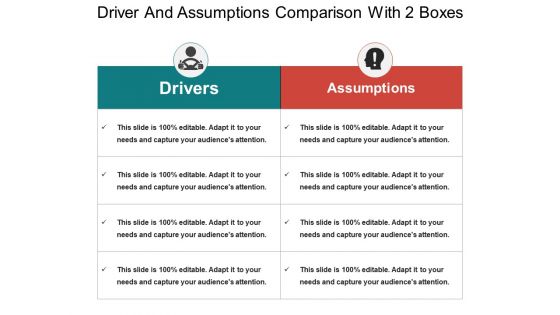
Driver and assumptions comparison with 2 boxes





Try Before you Buy Download Free Sample Product
 Impress Your
Audience
 100%
Editable
 Save Hours
of Time


Implement guidelines to calm things down with our Driver And Assumptions Comparison With 2 Boxes. Be able to identify flash points.
People who downloaded this PowerPoint presentation also viewed the following :
Driver and assumptions comparison with 2 boxes with all 5 slides:
Have a fruitful journey with our Driver And Assumptions Comparison With 2 Boxes. You are bound to celebrate a jubilee.


FAQs for Driver and assumptions comparison
Key business strategy drivers include market dynamics, competitive positioning, customer demands, financial performance, and technological disruption. These factors influence strategic decisions by shaping resource allocation, growth opportunities, and operational priorities, with many organizations finding that successful strategy requires balancing short-term performance metrics with long-term market positioning for sustained competitive advantage.
Assumptions shape organizational culture by establishing unspoken beliefs about success, collaboration, risk-taking, and decision-making that guide daily behaviors and interactions. These underlying beliefs influence how employees communicate, approach problems, and prioritize work, with many organizations finding that aligned assumptions enhance team cohesion, streamline operations, and ultimately deliver stronger performance outcomes.
Economic drivers impact market trends by influencing consumer spending patterns, investment flows, employment levels, and business expansion decisions across industries. Interest rates, inflation, GDP growth, and monetary policies directly shape how companies in retail, manufacturing, and financial services adjust their strategies, with many organizations finding that proactive economic monitoring enables better resource allocation and competitive positioning in volatile markets.
Technology fundamentally reshapes business assumptions by providing real-time data analytics, predictive modeling capabilities, artificial intelligence insights, and automated market analysis tools. Through these digital platforms, organizations can challenge traditional forecasts, validate customer behavior patterns, and adapt strategic planning processes more dynamically, ultimately enabling data-driven assumptions rather than intuition-based projections in an increasingly competitive landscape.
Businesses can differentiate between valid drivers and unfounded assumptions by implementing data validation processes, conducting market research, testing hypotheses through pilot programs, and analyzing historical performance metrics. Through systematic verification methods, organizations in sectors like retail and financial services can distinguish evidence-based factors from speculation, ultimately enabling more strategic decision-making and resource allocation.
Relying on outdated assumptions in strategic planning leads to misallocated resources, missed market opportunities, ineffective competitive positioning, and decreased organizational agility in rapidly changing environments. These outdated frameworks ultimately result in strategic misalignment, with many organizations finding that regular assumption validation through market research and data analytics delivers more accurate forecasting and sustainable competitive advantage.
Organizations effectively identify key drivers through comprehensive stakeholder interviews, historical data analysis, market research, competitive benchmarking, and financial performance reviews. These systematic approaches enable businesses to uncover revenue sources, cost factors, operational bottlenecks, and growth catalysts, with many companies finding that regular driver assessment enhances strategic planning and resource allocation decisions.
Tools for assessing assumption validity include Monte Carlo simulation software, sensitivity analysis platforms, expert judgment frameworks, historical data analysis systems, and assumption tracking matrices. These technologies streamline project risk management by quantifying uncertainty levels, validating critical assumptions through statistical modeling, and enabling proactive adjustments, with many project managers finding that systematic assumption validation ultimately delivers more accurate forecasting and improved project success rates.
Cultural drivers significantly influence consumer behavior through varying values, traditions, communication styles, social norms, and purchasing priorities across different markets. For instance, collectivist cultures like Japan prioritize group harmony and brand reputation, while individualistic markets such as the US emphasize personal expression and convenience, ultimately requiring businesses to adapt their strategies for enhanced market penetration and customer engagement.
Driver analyses improve risk management practices by identifying key variables that influence business outcomes, quantifying their impact on performance, and enabling proactive scenario planning for potential disruptions. Through systematic driver evaluation, organizations streamline risk assessment processes, enhance predictive capabilities, and develop more targeted mitigation strategies, with many financial institutions and healthcare systems finding that structured driver analysis delivers faster threat identification and ultimately stronger operational resilience.
Psychological assumptions significantly influence leadership styles by shaping how leaders perceive employee motivation, decision-making capacity, and organizational dynamics. Leaders with Theory X assumptions often adopt authoritative styles emphasizing control and supervision, while those with Theory Y beliefs embrace participative approaches that encourage autonomy and collaboration, ultimately delivering enhanced team performance and organizational effectiveness.
Common pitfalls include misaligning short-term metrics with long-term objectives, failing to validate underlying assumptions, inadequate stakeholder communication, and insufficient data quality for decision-making. Organizations across sectors like retail and healthcare often find that siloed departments create conflicting priorities, while weak feedback mechanisms prevent course correction, ultimately undermining strategic execution and competitive advantage.
Businesses can adapt their drivers by continuously monitoring market indicators, reassessing customer demand patterns, adjusting resource allocation strategies, and incorporating real-time data analytics into decision-making processes. Through flexible forecasting models and scenario planning, organizations in retail, manufacturing, and financial services streamline operations, minimize risks, and capitalize on emerging opportunities, ultimately delivering competitive advantage in increasingly dynamic markets.
Performance impact metrics include revenue growth rates, cost reduction percentages, operational efficiency ratios, customer satisfaction scores, and market share changes. These measurements enable organizations to quantify how strategic drivers influence bottom-line results, with many companies finding that tracking both leading and lagging indicators delivers comprehensive insights into competitive advantage and long-term sustainability.
Competitive drivers accelerate innovation by forcing companies to differentiate through superior products, enhanced customer experiences, and operational efficiency improvements. Industries like telecommunications, automotive, and financial services demonstrate this dynamic, with organizations investing heavily in emerging technologies, streamlined processes, and strategic partnerships to maintain market position, ultimately delivering faster innovation cycles and enhanced consumer value.
-
Great designs, really helpful.
-
Excellent design and quick turnaround.