

Drug Production Business Pitch Deck Ppt Template




Try Before you Buy Download Free Sample Product
 Impress Your
Audience
 100%
Editable
 Save Hours
of Time


Our Drug Production Business Pitch Deck Ppt Template are topically designed to provide an attractive backdrop to any subject. Use them to look like a presentation pro.
People who downloaded this PowerPoint presentation also viewed the following :
Content of this Powerpoint Presentation
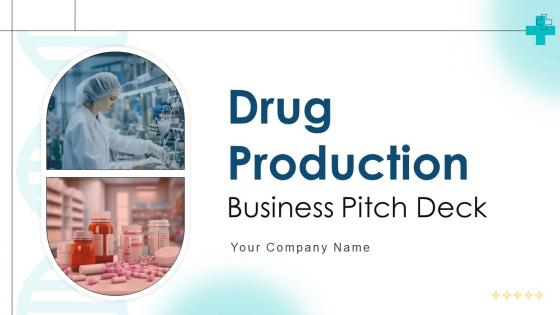
Slide 1: This slide introduces Drug Production Business Pitch Deck. State Your Company Name and begin.
Slide 2: This slide shows a Table of Contents for the presentation.
Slide 3: This slide address the problems faced by the prospects of our company.
Slide 4: This slide mentions the solutions provided by the biotechnological company to utilize their platform.
Slide 5: This slide provides the introduction to the pharmaceutical and biotechnological company.
Slide 6: This slide entails the key facts highlighting the culture and values of organizations employee.
Slide 7: This slide presents various products and application features offered by Cyclica's platform to users.
Slide 8: This slide represents various benefits user can gain by using Cyclica application.
Slide 9: This slide covers various accolades received by the company since its inception highlighting its achievements over the years.
Slide 10: This slide contains various testimonials from customers that use Cyclica products and services to their address user concerns.
Slide 11: This slide highlights various existing clients that use Cyclica products and services.
Slide 12: This slide elucidates market share and growth driver of biotechnology market in which Cyclica operates.
Slide 13: This slide denotes various business model canvas of Cyclica technology highlighting how the business operates.
Slide 14: This slide demarcates various methods offered by Cyclica technology highlighting how the business earns revenue.
Slide 15: This slide mentions various competitors of Cyclica that cater to drug discovery concerns within the biotechnology industry.
Slide 16: This slide covers financial performance of Cyclica in the recent years.
Slide 17: This slide presents the financial projections for Cyclica showcasing company's anticipated growth, cost and funding forecasted.
Slide 18: This slide marks the various reasons why potential investors should be investing with the company.
Slide 19: This slide puts the investment funding required by the company from potential investors and corresponding fund allocation areas.
Slide 20: This slide outlines how the investment capital will be utilized across key areas to maximize the company's potential.
Slide 21: This slide covers Cyclica company investor funding round details.
Slide 22: This slide showcases Cyclica exit strategy providing investors with a clear understanding of potential events and return on their investment opportunities.
Slide 23: This slide shows various members that constitute a part of founding team of Cyclica.
Slide 24: This slide includes organizational structure of Cyclica to understand authority-responsibility flow.
Slide 25: This slide provides an overview of the shareholding pattern of Cyclica showcasing investors detail and distribution of equity among key stakeholders.
Slide 26: This is a Contact Us slide. Add your Email Address, Contact, Social Media Handles, and Address.
Slide 27: This slide shows all the icons included in the presentation.
Slide 28: This slide is titled Additional Slides for moving forward.
Slide 29: This slide shows SWOT describing- Strength, Weakness, Opportunity, and Threat.
Slide 30: This slide provides a 30-60-90-day plan with text boxes.
Slide 31: This slide is a Timeline slide. Show data related to time intervals here.
Slide 32: This slide presents a Roadmap with additional text boxes.
Slide 33: This slide shows Post-It Notes. Post your important notes here.
Slide 34: This slide depicts a Venn diagram with text boxes.
Slide 35: This slide is a thank-you slide with address, contact numbers, and email address.
Drug Production Business Pitch Deck Ppt Template with all 43 slides:
Use our Drug Production Business Pitch Deck Ppt Template to effectively help you save your valuable time. They are readymade to fit into any presentation structure.










FAQs for Drug Production Business Pitch
Latest pharmaceutical R&D trends include personalized medicine, AI-driven drug discovery, gene and cell therapies, digital therapeutics, and precision oncology treatments. These innovations streamline development timelines, enhance treatment efficacy, and reduce costs, with many biotech companies finding that AI accelerates molecule identification by years, ultimately delivering more targeted therapies and competitive advantages.
Regulatory changes streamline drug approval processes by harmonizing international standards, implementing risk-based assessments, and enabling accelerated pathways for critical therapies. Through adaptive frameworks, pharmaceutical companies navigate varying requirements more efficiently across markets like the US, EU, and Asia, while maintaining safety standards, ultimately reducing time-to-market and enhancing global patient access.
Artificial intelligence accelerates drug discovery by analyzing molecular structures, predicting compound efficacy, identifying potential targets, and optimizing clinical trial designs. Through machine learning algorithms, pharmaceutical companies streamline research timelines, reduce development costs, and enhance success rates, with major firms like Pfizer and Roche finding that AI-driven approaches deliver faster, more precise therapeutic solutions.
Pharmaceutical companies are addressing drug pricing through patient assistance programs, tiered pricing models, generic drug development, and value-based pricing agreements with insurers. Many companies partner with governments and NGOs to expand access in developing markets, while investing in biosimilars and establishing regional manufacturing facilities, ultimately balancing profitability with broader healthcare accessibility.
**INPUT**: What are the ethical considerations in clinical trials for new medications? **OUTPUT**: Ethical considerations in clinical trials include informed consent, patient safety monitoring, risk-benefit assessment, equitable participant selection, and data transparency protocols. These frameworks ensure participant welfare while advancing medical research, with pharmaceutical companies and research institutions finding that robust ethical oversight ultimately enhances trial credibility, regulatory approval processes, and public trust in new medications. **Word count: 54 words**
Generic drugs significantly reduce medication costs by 80-90%, increase market competition, and expand patient access through affordable alternatives to brand-name pharmaceuticals. While pharmaceutical companies face revenue challenges from patent expirations, healthcare systems, insurance providers, and patients benefit from substantial cost savings, with generic medications enabling broader treatment accessibility across diverse economic populations, ultimately delivering enhanced healthcare affordability and improved therapeutic outcomes.
Personalized medicine challenges traditional pharmaceutical approaches by shifting focus from broad population treatments to individualized therapies based on genetic, environmental, and lifestyle factors. This transformation requires pharmaceutical companies to redesign clinical trials, develop targeted drug formulations, and create companion diagnostics, ultimately delivering more effective treatments while reducing adverse reactions and healthcare costs.
The COVID-19 pandemic is accelerating digital transformation, remote clinical trials, and supply chain diversification across pharmaceutical companies. Through telemedicine integration, AI-driven drug discovery, and distributed manufacturing strategies, organizations are delivering faster vaccine development, enhanced regulatory collaboration, and improved patient access, while building resilient operations that ultimately strengthen competitive positioning in an increasingly complex global healthcare landscape.
Pharmaceutical manufacturing faces challenges including regulatory compliance complexities, contamination risks, supply chain vulnerabilities, equipment validation requirements, and maintaining consistent product quality across global facilities. These challenges require stringent protocols, advanced monitoring systems, and continuous quality assurance processes, with many pharmaceutical companies finding that integrated quality management systems and real-time analytics ultimately deliver enhanced safety standards and regulatory confidence.
Pharmaceutical marketing influences prescribing through educational programs, clinical data presentations, samples, and relationship-building with healthcare professionals. While these practices provide valuable drug information and research updates, they also present potential conflicts of interest, with many hospitals and clinics implementing disclosure policies and evidence-based prescribing protocols to ensure patient-centered decision-making.
Biologics advancements include personalized gene therapies, monoclonal antibodies, cell-based treatments, advanced protein engineering, and AI-driven drug discovery platforms. These innovations streamline development timelines, reduce manufacturing costs, and enhance patient outcomes, while biosimilars increasingly provide cost-effective alternatives, with pharmaceutical companies finding that strategic combinations of both approaches deliver competitive advantages and broader market access.
Patient engagement is being integrated through advisory boards, co-design sessions, patient-reported outcome measures, digital health platforms, and regulatory consultation processes. These collaborative approaches enable pharmaceutical companies to develop more targeted therapies, improve clinical trial design, and enhance treatment adherence, with many organizations finding that direct patient input accelerates development timelines while delivering more effective, patient-centered solutions.
Telemedicine significantly transforms pharmaceutical sales through enhanced patient access, remote consultations, prescription management, and digital health monitoring capabilities. This technology streamlines medication adherence, accelerates treatment decisions, and expands market reach for pharmaceutical companies, while ultimately delivering improved patient outcomes and more efficient healthcare delivery systems across diverse geographic regions.
Pharmaceutical companies leverage big data through predictive analytics for drug discovery, real-time patient monitoring systems, clinical trial optimization, and personalized medicine development. These technologies streamline research timelines by identifying promising compounds faster, enhancing patient safety through continuous health tracking, and ultimately delivering more targeted treatments, with many healthcare organizations finding that data-driven approaches significantly reduce development costs while improving therapeutic effectiveness.
Pharmaceutical production and disposal present significant environmental concerns, including water contamination from antibiotic manufacturing, toxic waste generation during chemical synthesis, and pharmaceutical residues entering ecosystems through improper disposal. These issues affect aquatic life and drinking water quality, with pharmaceutical companies increasingly investing in green chemistry processes, waste reduction technologies, and sustainable disposal methods to minimize environmental impact while maintaining regulatory compliance.
-
If you have visited their site and failed to find the products, try reaching the customer service because it will be the case that you didn't use the search bar well.
-
Great designs, Easily Editable.