

Due Diligence Process In M And A Transactions Powerpoint Presentation Slides





Try Before you Buy Download Free Sample Product
 Impress Your
 Audience
 100%
100% Editable
 Save Hours
 of Time


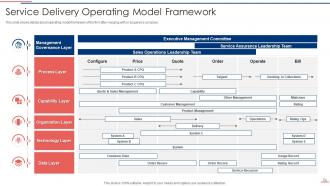
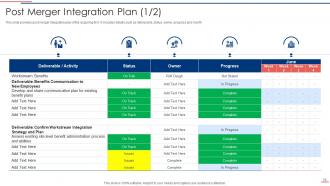
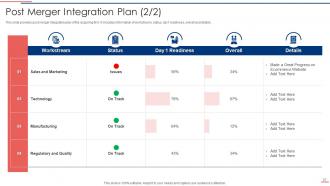
Grab our efficiently designed Due Diligence Process in M and A Transactions template that will be helpful to the company to introduce its existing product in the new market by merging with or acquiring a company. Due diligence refers to an investigating process used by a buying company to understand better the pertinent information. At first, the company can use a performance glimpse of the firm section to highlight its valuable information such as key financials, financial ratios, etc. The M and A lifecycle overview section will help the company illustrate the activities related to its pre-deal, pre-announcement, and post-announcement stages. The due diligence process section covers financial, IT, intellectual property, legal, commercial, human resource, EHS, and tax diligence information. The service delivery operating model framework will illustrate the companys functioning post-merger and integration. The company can implement its integration plan with the post-merger integration plan section. Finally, the company can show the possible challenges during the M And A process and the proper measures to overcome them. Customize this 100 percentage editable template now.
People who downloaded this PowerPoint presentation also viewed the following :
Content of this Powerpoint Presentation
Slide 1: This slide introduces Due Diligence Process in M&A Transactions. State Your Company Name and begin.
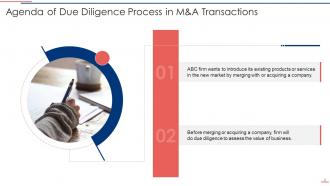
Slide 2: This slide states Agenda of the presentation.
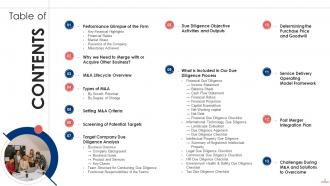
Slide 3: This slide presents Table of Content for the presentation.
Slide 4: This slide shows title for topics that are to be covered next in the template.
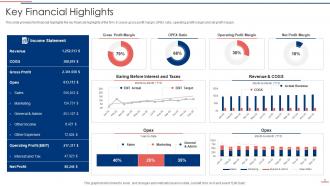
Slide 5: This slide provides the financial highlights covering gross profit margin, OPEX ratio, etc.
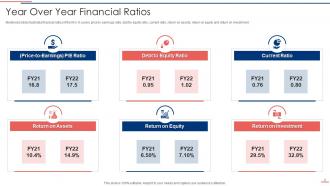
Slide 6: This slide displays financial ratios of the firm covering price to earnings ratio, debt to equity ratio, etc.
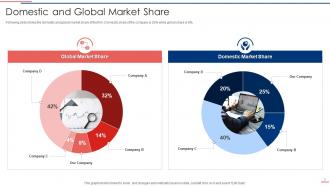
Slide 7: This slide presents domestic and global market share of the firm.
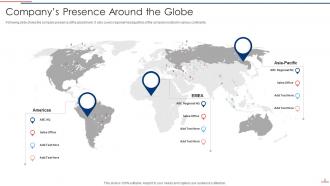
Slide 8: This slide showcases company presence at the global level.
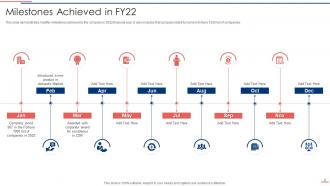
Slide 9: This slide demonstrates monthly milestones achieved by the company in 2022 financial year.
Slide 10: This slide presents Table of Content for the presentation.
Slide 11: This slide presents importance of merging with or acquiring any other business.
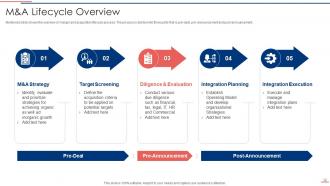
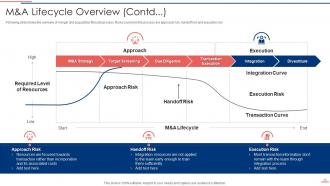
Slide 12: This slide represents overview of merger and acquisition lifecycle process.
Slide 13: This slide displays overview of merger and acquisition lifecycle process.
Slide 14: This slide presents Table of Content for the presentation.
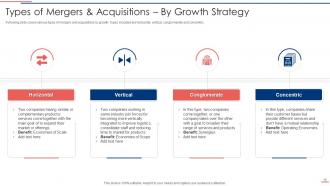
Slide 15: This slide represents various types of mergers and acquisitions by growth.
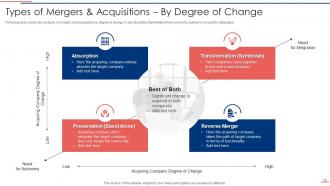
Slide 16: This slide showcases various types of mergers and acquisitions by degree of change.
Slide 17: This slide presents Table of Content for the presentation.
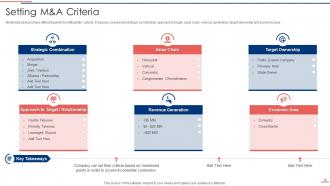
Slide 18: This slide shows different points for setting M&A criteria.
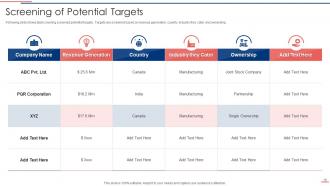
Slide 19: This slide displays table covering screened potential targets.
Slide 20: This slide shows title for topics that are to be covered next in the template.
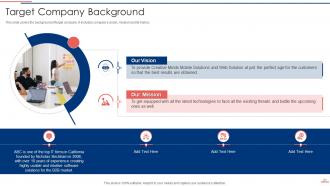
Slide 21: This slide covers the background of target company including company’s vision, mission and its history.
Slide 22: Following slide illustrates business goals of the target firm.
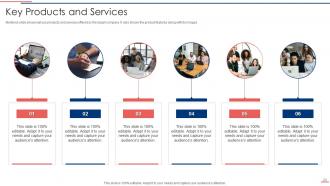
Slide 23: Mentions slide shows various products and services offered by the target company.
Slide 24: This slide shows information about major key clients catered by the target company.
Slide 25: This slide shows title for topics that are to be covered next in the template.
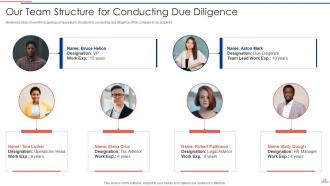
Slide 26: Mentioned slide shows the acquiring company team structure for conducting due diligence of the company.
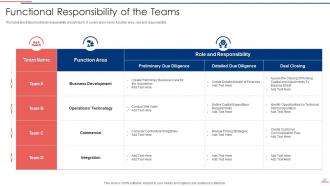
Slide 27: This table illustrates functional responsibility of each team.
Slide 28: This slide shows title for topics that are to be covered next in the template.
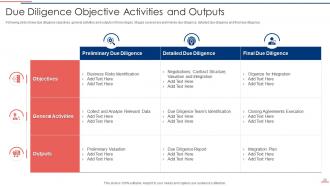
Slide 29: Following slide shows due diligence objectives, general activities and outputs in three stages.
Slide 30: This slide shows title for topics that are to be covered next in the template.
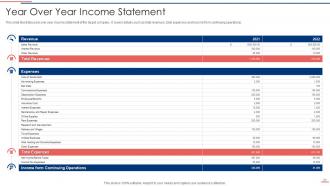
Slide 31: This slide illustrates year over year income statement of the target company.
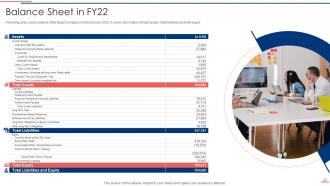
Slide 32: Following slide covers balance of the target company in financial year 2022.
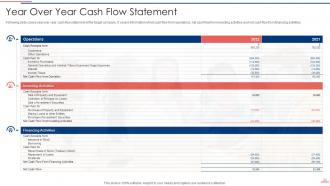
Slide 33: Following slide covers year over year cash flow statement of the target company.
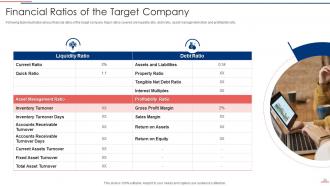
Slide 34: Following table illustrates various financial ratios of the target company.
Slide 35: This slide shows title for topics that are to be covered next in the template.
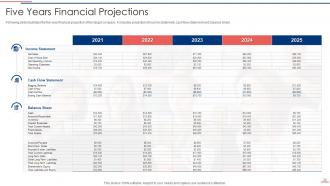
Slide 36: Following slide illustrates the five-year financial projection of the target company.
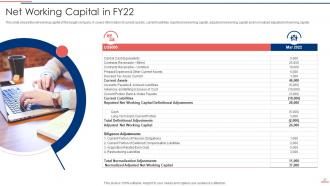
Slide 37: This slide shows the net working capital of the target company.
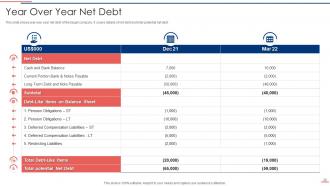
Slide 38: This slide shows year over year net debt of the target company.
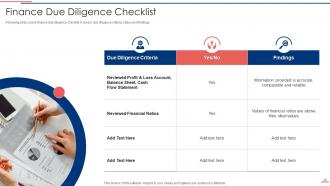
Slide 39: Following slide covers finance due diligence checklist covering due diligence criteria, status and findings.
Slide 40: This slide shows title for topics that are to be covered next in the template.
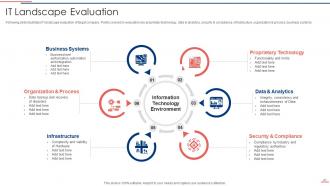
Slide 41: Following slide illustrates IT landscape evaluation of target company.
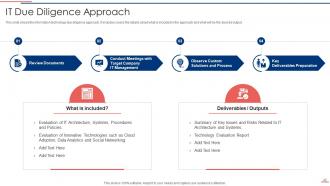
Slide 42: This slide shows the information technology due diligence approach.
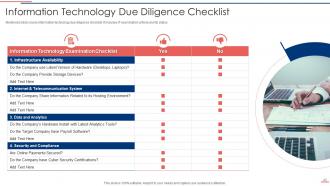
Slide 43: Mentioned slide covers information technology due diligence checklist.
Slide 44: This slide shows title for topics that are to be covered next in the template.
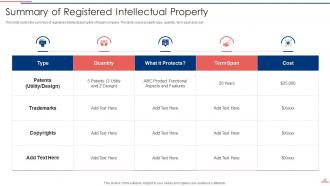
Slide 45: This slide covers the summary of registered intellectual property of target company.
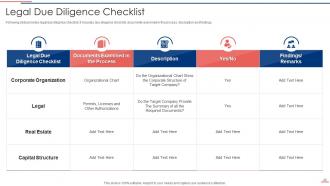
Slide 46: Following slide provides legal due diligence checklist.
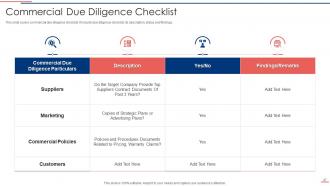
Slide 47: This slide covers commercial due diligence checklist including due diligence checklist, its description, status and findings.
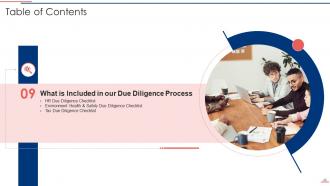
Slide 48: This slide shows title for topics that are to be covered next in the template.
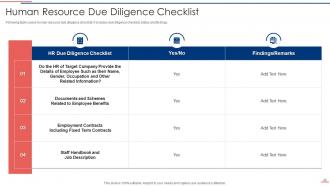
Slide 49: Following table covers human resource due diligence checklist.
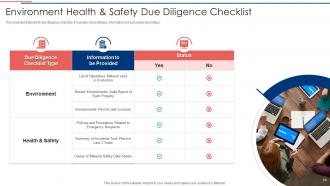
Slide 50: This slide illustrates EHS due diligence checklist including checklist type, information to be provided and status.
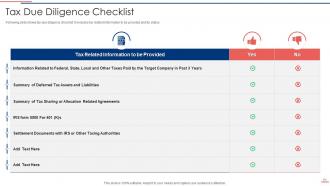
Slide 51: This slide presents tax related information to be provided and its status.
Slide 52: This slide shows title for topics that are to be covered next in the template.
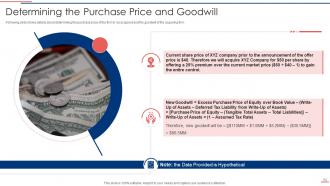
Slide 53: Following slide shows details about determining the purchase price of the firm to be acquired.
Slide 54: This slide shows details about operating model framework of the firm.
Slide 55: This slide shows title for topics that are to be covered next in the template.
Slide 56: This slide provides post merger integration plan of the acquiring firm.
Slide 57: This is another slide continuing post merger integration plan of the acquiring firm.
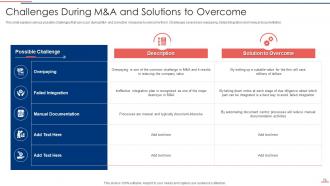
Slide 58: This slide explains various possible challenges that can occur during M&A.
Slide 59: This slide displays Icons for Due Diligence Process in M&A Transactions.
Slide 60: This slide is titled as Additional Slides for moving forward.
Slide 61: This is Our Team slide with names and designation.
Slide 62: This is a Timeline slide. Show data related to time intervals here.
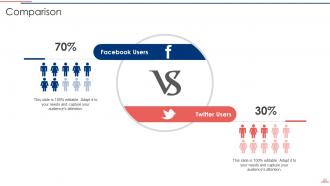
Slide 63: This is a Comparison slide to state comparison between commodities, entities etc.
Slide 64: This slide contains Puzzle with related icons and text.
Slide 65: This slide shows Post It Notes. Post your important notes here.
Slide 66: This slide depicts Venn diagram with text boxes.
Slide 67: This slide showcases Roadmap for Process Flow.
Slide 68: This is a Thank You slide with address, contact numbers and email address.
Due Diligence Process In M And A Transactions Powerpoint Presentation Slides with all 73 slides:
Use our Due Diligence Process In M And A Transactions Powerpoint Presentation Slides to effectively help you save your valuable time. They are readymade to fit into any presentation structure.


















FAQs for Due Diligence Process In M And A Transactions
Key due diligence components in M&A transactions include financial audits, legal compliance reviews, operational assessments, market analysis, and technology evaluations. These comprehensive examinations enable acquirers to identify risks, validate valuations, and uncover synergy opportunities, with many organizations finding that thorough due diligence ultimately streamlines integration processes and enhances deal success rates.
Assessing financial health involves analyzing audited financial statements, cash flow patterns, revenue quality, debt obligations, and working capital management. Investment banks and private equity firms examine profitability trends, debt-to-equity ratios, and operational metrics across sectors like manufacturing and technology, ultimately delivering transparency that enables informed valuations and strategic decisions.
Legal considerations in M&A due diligence include contract reviews, regulatory compliance assessments, intellectual property audits, litigation analysis, and employment law evaluations. These comprehensive legal examinations streamline transaction processes by identifying potential liabilities, ensuring regulatory adherence, and protecting asset values, with many organizations finding that thorough legal due diligence ultimately delivers reduced transaction risks and enhanced deal confidence.
Cultural fit between merging organizations can be evaluated through employee surveys, leadership interviews, values assessments, communication style analysis, and organizational behavior studies. These evaluation methods streamline integration planning by identifying potential friction points, aligning management approaches, and preserving talent retention, with many financial services and technology companies finding that thorough cultural assessment ultimately delivers smoother transitions and enhanced operational synergies.
Technology streamlines M&A due diligence through virtual data rooms, AI-powered document analysis, automated compliance checking, and real-time collaboration platforms. These digital tools enhance efficiency by accelerating document review, identifying potential risks faster, and enabling seamless communication between deal teams, with investment banks and private equity firms finding significantly reduced transaction timelines and costs.
Risk identification involves comprehensive financial audits, legal compliance reviews, operational assessments, market position analysis, and cultural compatibility evaluations. Through systematic due diligence processes, acquirers can uncover liabilities, regulatory issues, and integration challenges early, enabling strategic risk mitigation plans, adjusted valuations, and deal structure modifications that ultimately protect investment value.
Key operational metrics in due diligence include revenue growth rates, profit margins, customer acquisition costs, employee productivity ratios, and operational efficiency indicators like inventory turnover and cash conversion cycles. These metrics help acquirers assess scalability and integration potential, with manufacturing and retail sectors particularly focusing on supply chain efficiency and customer retention rates to determine long-term competitive advantage.
Intellectual property assessment in due diligence involves comprehensive IP portfolio audits, ownership verification, valuation analysis, freedom-to-operate reviews, and competitive landscape mapping. Through systematic evaluation of patents, trademarks, copyrights, and trade secrets, organizations can identify potential liabilities, licensing opportunities, and strategic value drivers, ultimately ensuring informed acquisition decisions and maximizing post-merger IP integration benefits.
Effective due diligence strategies include establishing comprehensive checklists, assembling cross-functional expert teams, implementing phased review processes, utilizing data rooms for document management, and conducting management interviews. These approaches streamline evaluation by ensuring systematic coverage, identifying risks early, and facilitating stakeholder collaboration, with many organizations finding that structured methodologies ultimately deliver faster deal closure and reduced post-transaction surprises.
Vendor and customer due diligence is critical for M&A success, as it reveals revenue concentration risks, contract stability, supplier dependencies, and relationship quality that directly impact valuation and integration planning. Through comprehensive stakeholder analysis, acquirers can identify potential customer churn, negotiate better deal terms, and develop targeted retention strategies, ultimately minimizing post-acquisition surprises while maximizing strategic value creation.
Common pitfalls include inadequate financial analysis, overlooking cultural integration challenges, insufficient legal compliance review, underestimating operational synergies, and rushed timeline execution. These oversights can derail transactions by creating unexpected liabilities, integration difficulties, and valuation discrepancies, with many acquirers finding that thorough cross-functional due diligence ultimately delivers more accurate pricing and smoother post-merger success.
Regulatory and compliance issues significantly impact due diligence by requiring comprehensive reviews of licenses, permits, environmental compliance, data privacy protocols, and industry-specific regulations across all target company operations. These assessments often extend transaction timelines and costs, with acquirers in sectors like financial services, healthcare, and manufacturing finding that thorough compliance review ultimately protects against future liabilities, regulatory penalties, and integration challenges.
Due diligence significantly impacts post-merger integration planning by identifying operational synergies, cultural compatibility issues, technology infrastructure gaps, and regulatory compliance requirements that directly inform integration strategies. Through comprehensive due diligence, companies can develop targeted integration roadmaps, prioritize critical systems migrations, and address potential cultural conflicts early, ultimately enabling smoother transitions and faster realization of merger benefits.
Stakeholders can effectively communicate due diligence findings through structured reports, executive summaries, visual dashboards, and targeted presentations tailored to different audience levels. These communication methods streamline complex financial, legal, and operational insights by categorizing risks, highlighting critical issues, and providing actionable recommendations, with many M&A teams finding that clear, concise reporting accelerates decision-making and deal closure.
Third-party due diligence advisors provide specialized expertise in financial, legal, operational, and technical assessments that internal teams may lack, ensuring comprehensive risk evaluation and deal validation. These experts streamline the process by conducting independent valuations, identifying hidden liabilities, and delivering objective insights, with many organizations finding that professional advisors ultimately minimize transaction risks while accelerating deal timelines and enhancing negotiation positions.
-
Visually stunning presentation, love the content.
-
Use of icon with content is very relateable, informative and appealing.