

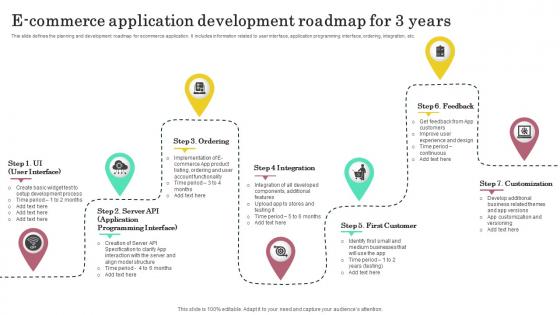
E Commerce Application Development Roadmap For 3 Years




Try Before you Buy Download Free Sample Product
 Impress Your
 Audience
 100%
100% Editable
 Save Hours
 of Time


This slide defines the planning and development roadmap for ecommerce application. It includes information related to user interface, application programming interface, ordering, integration, etc.
People who downloaded this PowerPoint presentation also viewed the following :
E Commerce Application Development Roadmap For 3 Years with all 6 slides:
Use our E Commerce Application Development Roadmap For 3 Years to effectively help you save your valuable time. They are readymade to fit into any presentation structure.





FAQs for E Commerce Application Development Roadmap
The key stages in e-commerce development include market research and planning, platform selection, design and user experience optimization, development and integration, testing and quality assurance, and launch with ongoing maintenance. These stages streamline the process by ensuring strategic foundation, seamless functionality, and scalable infrastructure, with many retailers finding that comprehensive planning ultimately delivers faster time-to-market and enhanced customer experiences.
Businesses should evaluate their specific requirements, budget constraints, technical capabilities, scalability needs, and timeline expectations when choosing between custom and off-the-shelf e-commerce solutions. Custom solutions deliver unique functionality and competitive differentiation while off-the-shelf platforms offer faster deployment and lower initial costs, with many growing retailers finding that hybrid approaches ultimately provide the best balance of customization and efficiency.
UX design fundamentally shapes e-commerce success by creating intuitive navigation, streamlined checkout processes, mobile responsiveness, and personalized customer journeys that directly impact conversion rates and customer retention. Through strategic UX implementation, retailers enhance product discovery, minimize cart abandonment, and build brand loyalty, with many e-commerce platforms finding that optimized user experiences ultimately deliver increased sales and competitive advantage in increasingly crowded digital marketplaces.
Businesses can integrate payment gateways by implementing SSL certificates, PCI DSS compliance protocols, tokenization systems, multi-factor authentication, and encrypted data transmission methods. Through platforms like Stripe, PayPal, and Square, retailers streamline checkout processes, reduce cart abandonment, and build customer trust, while financial institutions and online marketplaces find that robust security measures ultimately deliver competitive advantage and increased conversion rates.
E-commerce SEO best practices include optimizing product descriptions with relevant keywords, implementing structured data markup, creating user-friendly URLs, ensuring fast page load speeds, and building high-quality backlinks. These strategies enhance visibility by improving search rankings, increasing organic traffic, and delivering better user experiences, with many online retailers finding that comprehensive SEO optimization ultimately drives significantly higher conversion rates and sustainable competitive advantage.
Mobile optimization is critically important in e-commerce development roadmaps, as mobile commerce now accounts for over 50% of online sales, with consumers increasingly expecting seamless mobile experiences. Through responsive design, fast loading speeds, and intuitive navigation, retailers streamline checkout processes, reduce cart abandonment rates, and enhance customer satisfaction, ultimately delivering competitive advantage and increased revenue in an increasingly mobile-first marketplace.
Critical e-commerce features include secure payment processing, mobile-responsive design, intuitive navigation, robust search functionality, customer reviews, and streamlined checkout processes. These elements enhance user experience by reducing cart abandonment, building customer trust, and increasing conversion rates, with many retail businesses finding that strategic implementation of these features delivers significantly higher sales and competitive advantage in increasingly crowded digital marketplaces.
Businesses leverage data analytics to inform e-commerce strategy by analyzing customer behavior patterns, identifying conversion bottlenecks, optimizing product recommendations, and tracking performance metrics across touchpoints. Through predictive analytics and real-time insights, retailers enhance personalization, streamline inventory management, and improve user experience design, ultimately delivering higher conversion rates and competitive advantage in digital markets.
Common pitfalls include inadequate mobile optimization, poor user experience design, insufficient security measures, lack of scalability planning, and inadequate payment gateway integration. These challenges can significantly impact conversion rates and customer trust, with many retailers finding that addressing these issues early through strategic planning, comprehensive testing, and phased implementation ultimately delivers higher sales performance and competitive advantage.
Social media integration enhances e-commerce platforms by enabling social login, facilitating user-generated content sharing, implementing social proof through reviews, and streamlining social commerce capabilities. Through these integrations, retailers can reduce checkout friction, amplify brand reach organically, and leverage social validation to drive conversions, with many e-commerce businesses finding that social features increase customer engagement and sales significantly.
Smooth e-commerce supply chain management requires implementing inventory tracking systems, establishing reliable supplier relationships, optimizing warehouse operations, integrating real-time logistics monitoring, and developing contingency protocols for disruptions. These strategies streamline order fulfillment by reducing stockouts, accelerating delivery times, and enhancing customer satisfaction, with many retailers finding that automated systems ultimately deliver significant cost reductions and competitive advantages.
Businesses determine their target audience through market research, customer surveys, competitor analysis, demographic studies, and behavioral data examination. These strategic approaches enable companies to identify customer pain points, purchasing patterns, and preferences across different segments, with many e-commerce platforms finding that detailed audience profiling ultimately delivers higher conversion rates and more effective marketing strategies.
Technologies transforming e-commerce include artificial intelligence for personalization, headless commerce architectures, progressive web apps, voice commerce integration, and augmented reality shopping experiences. These innovations enhance customer engagement by delivering faster load times, seamless mobile experiences, and interactive product visualization, with many retailers finding that strategic implementation ultimately drives higher conversion rates and competitive differentiation.
E-commerce businesses can utilize chatbots and AI to enhance customer service by providing 24/7 instant support, automating order tracking, handling returns processing, and delivering personalized product recommendations. These technologies streamline operations by reducing response times, minimizing human workload, and improving customer satisfaction, with many retailers finding that AI-powered support ultimately delivers faster resolutions and significantly enhanced shopping experiences.
E-commerce platform development requires addressing data protection compliance, consumer rights regulations, payment security standards, accessibility requirements, and international trade laws. These legal frameworks ensure customer trust and operational legitimacy, with many businesses finding that proactive compliance streamlines market entry, reduces regulatory risks, and ultimately delivers competitive advantage in increasingly regulated digital commerce environments.
-
Unique design & color.
-
SlideTeam is my one-stop destination for templates. Highly recommended!