

Ecommerce Platform Setup Weekly Timeline Strategy To Setup An E Commerce Strategy SS




Try Before you Buy Download Free Sample Product
 Impress Your
 Audience
 100%
100% Editable
 Save Hours
 of Time


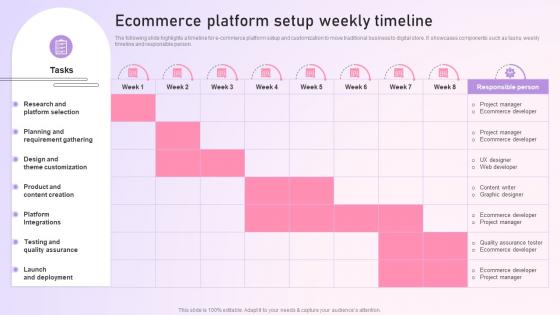
The following slide highlights a timeline for e commerce platform setup and customization to move traditional business to digital store. It showcases components such as tasks, weekly timeline and responsible person.
People who downloaded this PowerPoint presentation also viewed the following :
Ecommerce Platform Setup Weekly Timeline Strategy To Setup An E Commerce Strategy SS with all 6 slides:
Use our Ecommerce Platform Setup Weekly Timeline Strategy To Setup An E Commerce Strategy SS to effectively help you save your valuable time. They are readymade to fit into any presentation structure.





FAQs for Ecommerce Platform Setup Weekly Timeline Strategy To Setup An E
Essential ecommerce platform features include mobile responsiveness, secure payment processing, inventory management, SEO optimization, and scalable hosting capabilities. These functionalities streamline operations by automating order processing, enhancing customer experiences, and supporting business growth, with many retailers finding that integrated analytics and multi-channel selling capabilities ultimately deliver competitive advantages and increased revenue.
Ensuring user-friendly ecommerce navigation requires intuitive menu structures, clear product categorization, prominent search functionality, streamlined checkout processes, and mobile-responsive design. These elements work together by reducing friction points, minimizing cart abandonment, and enhancing customer experience, with many retailers finding that simplified navigation increases conversion rates and customer satisfaction significantly.
Popular payment gateways include PayPal, Stripe, Square, Amazon Pay, and Apple Pay, each offering different transaction fees, security features, and integration capabilities. These gateways significantly impact sales by streamlining checkout processes, reducing cart abandonment, and building customer trust through secure transactions, with many retailers finding that multiple payment options increase conversion rates by 20-30%.
Mobile optimization involves implementing responsive design, fast loading speeds, simplified navigation, touch-friendly interfaces, and streamlined checkout processes. Through mobile-first design approaches, ecommerce businesses enhance user experiences, reduce cart abandonment rates, and capture the growing mobile commerce market, with many retailers finding that optimized mobile platforms significantly boost conversion rates and customer satisfaction.
SEO serves as the foundation for ecommerce visibility, driving organic traffic through keyword optimization, technical site structure, product page optimization, and content marketing strategies. Effective SEO implementation enables online retailers to capture high-intent shoppers, reduce customer acquisition costs, and compete with larger platforms, with many ecommerce businesses finding that strong SEO delivers sustainable growth and improved conversion rates.
Social media integrates with ecommerce platforms through social commerce features, automated posting tools, customer service chatbots, influencer collaboration systems, and cross-platform analytics dashboards. These integrations streamline marketing workflows, enable direct purchasing from social posts, and enhance customer engagement, with many retailers finding that strategic social integration increases conversion rates and builds stronger community connections.
Best practices for managing inventory within ecommerce systems include real-time tracking, automated reorder points, demand forecasting, multi-channel synchronization, and ABC analysis for prioritizing high-value items. These approaches streamline operations by reducing stockouts, minimizing carrying costs, and enhancing customer satisfaction, with many retailers finding that integrated inventory management ultimately delivers improved cash flow and competitive advantage.
Analytics enhances ecommerce performance by tracking customer behavior, identifying conversion bottlenecks, monitoring product performance, and measuring marketing effectiveness across channels. Through detailed insights into user journeys, inventory trends, and campaign ROI, retailers can optimize pricing strategies, streamline checkout processes, and personalize customer experiences, ultimately delivering higher conversion rates and increased revenue growth.
SaaS platforms offer hosted solutions with subscription pricing, automatic updates, built-in security, and technical support, while self-hosted platforms provide complete customization control, one-time licensing costs, and server management responsibility. Many retailers find that SaaS delivers faster deployment and scalability, whereas self-hosted enables deeper integration and brand customization, ultimately depending on technical resources and growth strategy.
Ecommerce platforms handle shipping through integrated carrier networks, automated rate calculations, real-time tracking systems, inventory management tools, and customizable delivery options. These solutions streamline operations by connecting with major carriers like FedEx and UPS, automating label generation, and optimizing route planning, ultimately reducing shipping costs while enhancing customer experiences and operational efficiency.
Essential security measures include SSL certificates, PCI DSS compliance, two-factor authentication, regular security audits, and encrypted payment processing. These protocols work together to safeguard sensitive information like credit card details and personal data, with many ecommerce businesses finding that robust security builds customer trust while reducing fraud risks and ensuring regulatory compliance.
Creating a seamless checkout process involves minimizing form fields, offering guest checkout options, displaying transparent pricing with taxes and shipping costs, and providing multiple payment methods including digital wallets. Through streamlined page design and progress indicators, ecommerce businesses reduce friction points, accelerate transaction completion, and ultimately decrease cart abandonment rates while enhancing customer satisfaction and conversion optimization.
CRM tools for ecommerce include Salesforce Commerce Cloud, HubSpot, Klaviyo, Mailchimp, and Zendesk, which integrate seamlessly with platforms like Shopify and Magento. These solutions enhance customer engagement through automated email campaigns, personalized product recommendations, and comprehensive analytics, with many retailers finding that strategic CRM implementation increases customer lifetime value and conversion rates significantly.
Email marketing enhances ecommerce strategy by automating customer journeys, segmenting audiences based on purchase behavior, and delivering personalized product recommendations. Through targeted campaigns like abandoned cart recovery, post-purchase follow-ups, and seasonal promotions, retailers streamline customer retention, increase average order values, and drive repeat purchases, ultimately delivering measurable revenue growth and stronger customer relationships.
International selling considerations include currency conversion, shipping logistics, tax compliance, payment gateway integration, and localized customer support. These elements require strategic planning by researching target markets, partnering with regional fulfillment centers, and implementing multi-language interfaces, with many ecommerce businesses finding that early international expansion delivers competitive advantage and significantly broader revenue streams.
-
It saves your time and decrease your efforts in half.
-
SlideTeam is my one-stop destination for templates. Highly recommended!