

Ecommerce seo checklist powerpoint presentation slides




Try Before you Buy Download Free Sample Product
 Impress Your
 Audience
 100%
100% Editable
 Save Hours
 of Time


Help the visitor and search engines in finding relevant information with the help of eCommerce SEO Checklist PowerPoint Presentation Slides. Discuss the ways to build the foundation for strong eCommerce using SEO for eCommerce business PPT slideshow. Get to know your industry and target audience by creating a buyers persona and outlining the buyer’s journey. Take the assistance of Ebusiness SEO checklist PowerPoint layouts to research keywords for your SEO strategy. Discuss the ways to optimize each page of your on-site content with the help of our attention-grabbing eCommerce SEO audit checklist. Showcase the methods by which you can build authority for your site and brand. The electronic business SEO checklist helps to check your site for SEO problems and errors by mentioning the ways for the same. Our eCommerce SEO checklist presentation contains various high-quality icons and pictures that will make it look attractive and eye-catching. Drive traffic to your eCommerce website by downloading our ready-to-use eCommerce business SEO PowerPoint slide deck.
People who downloaded this PowerPoint presentation also viewed the following :
Content of this Powerpoint Presentation
Slide 1: This slide introduces ECOMMERCE SEO Checklist.
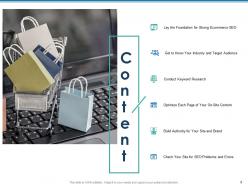
Slide 2: This slide displays Content of the presentation.
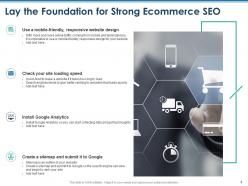
Slide 3: This slide displaying information about Laying the Foundation for Strong Ecommerce SEO
Slide 4: This slide is about Get to Know Your Industry and Target Audience
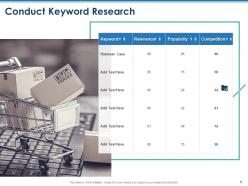
Slide 5: This slide describes about Conducting Keyword Research
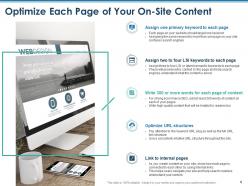
Slide 6: This slide will help users navigate your site and help search crawlers understand your content
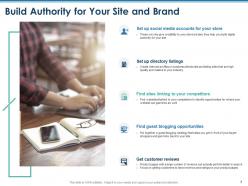
Slide 7: This slide shows information about Building Authority for Your Site and Brand
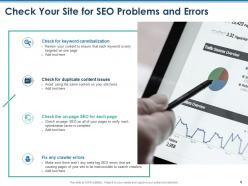
Slide 8: This slide shows about Checking Your Site for SEO Problems and Errors
Slide 9: This is Ecommerce SEO Checklist Icons Slide.
Slide 10: This slide is titled as Additional Slides for moving forward.
Slide 11: This is 30 60 90 Days Plan slide.
Slide 12: This slide displays Roadmap process.
Slide 13: This slide displays Mission, Vision and Goals.
Slide 14: This is Our Team slide with Names and Designations.
Slide 15: This is About Us slide to showcase Company specifications.
Slide 16: This slide shows Our Goal
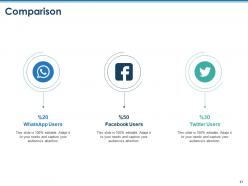
Slide 17: This is Comparison slide between Whatsapp and Facebook users.
Slide 18: This slide shows Finanace related stuff.
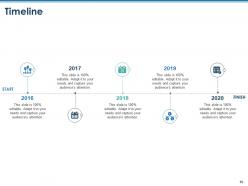
Slide 19: This slide depicts Timeline process.
Slide 20: This is Thank You slide with Contact detail.
Ecommerce seo checklist powerpoint presentation slides with all 20 slides:
Use our Ecommerce SEO Checklist Powerpoint Presentation Slides to effectively help you save your valuable time. They are readymade to fit into any presentation structure.






FAQs for Ecommerce seo checklist
Key SEO factors for eCommerce websites include optimized product descriptions, strategic keyword integration, fast page loading speeds, mobile responsiveness, and structured data markup. These elements enhance search visibility by improving user experience, increasing organic traffic, and boosting conversion rates, with many online retailers finding that comprehensive SEO strategies ultimately deliver higher rankings and sustained revenue growth.
Keyword research for product categories enhances search visibility by identifying high-volume category terms, analyzing competitor positioning, and mapping search intent to product hierarchies. This strategic approach enables retailers to optimize category pages with relevant long-tail keywords, improve internal linking structures, and capture broader search traffic, ultimately delivering increased organic rankings and customer discovery across product lines.
Site speed significantly impacts eCommerce SEO rankings and user experience, with search engines prioritizing faster-loading pages and customers abandoning slow sites within seconds. Optimization strategies include compressing images, minimizing code, leveraging content delivery networks, and reducing server response times, with many online retailers finding that improved site speed delivers higher search rankings, reduced bounce rates, and increased conversions.
Product descriptions are crucial for eCommerce SEO, serving as primary content for search engines while influencing conversion rates and user engagement. They should include targeted keywords, unique value propositions, detailed specifications, benefits-focused language, and structured data markup, with many retailers finding that comprehensive descriptions improve both search rankings and customer decision-making, ultimately delivering higher organic traffic and sales conversions.
Effective on-page SEO for eCommerce product pages includes optimizing title tags with target keywords, crafting compelling meta descriptions, using structured data markup, optimizing product images with alt text, and creating detailed product descriptions. These strategies enhance search visibility by improving keyword relevance, increasing click-through rates, and enabling rich snippets, with many online retailers finding that strategic on-page optimization ultimately delivers higher organic rankings and increased conversion rates.
User-generated content enhances SEO performance by creating fresh, keyword-rich content, improving search rankings through natural language patterns, and increasing page engagement metrics that signal quality to search engines. Reviews and Q&A sections generate long-tail keyword opportunities, build trust signals that reduce bounce rates, and provide authentic content that search algorithms increasingly prioritize, ultimately delivering improved organic visibility and higher conversion rates.
Best practices for eCommerce URL structuring include using descriptive keywords, maintaining short and readable paths, implementing logical category hierarchies, avoiding dynamic parameters, and including product names rather than numbers. These approaches enhance search engine crawlability by creating clear site architecture, improving user experience through intuitive navigation, and boosting ranking potential, with many online retailers finding that clean URL structures significantly increase organic traffic and conversion rates.
ECommerce businesses should approach image optimization through compressed file formats, descriptive alt text, strategic filename conventions, proper sizing for fast loading, and structured schema markup. These techniques enhance search visibility by improving page speed, accessibility, and crawlability, with many online retailers finding that optimized product images significantly boost organic traffic and conversion rates while delivering better user experiences.
Mobile optimization is crucial for eCommerce SEO because it directly impacts search rankings, user experience, and conversion rates, with Google's mobile-first indexing prioritizing mobile-responsive sites. Through faster loading speeds, intuitive navigation, and seamless checkout processes, retailers streamline customer journeys, reduce bounce rates, and ultimately deliver higher search visibility and sales conversions in an increasingly mobile-driven marketplace.
Backlinks significantly enhance eCommerce SEO by improving domain authority, search rankings, and organic traffic through external site validation of your content quality. Effective acquisition methods include guest posting on industry blogs, partnering with complementary brands, creating shareable product guides, and leveraging customer testimonials, ultimately delivering increased visibility and competitive advantage in search results.
XML sitemaps boost eCommerce SEO by improving crawl efficiency, ensuring product page indexation, communicating page priorities, and providing metadata about content freshness and update frequency. Through strategic sitemap optimization, online retailers streamline search engine discovery of seasonal products, new inventory, and category changes, while reducing crawl budget waste, ultimately delivering faster indexation and improved organic visibility in competitive markets.
Schema markup for product listings delivers enhanced search visibility through rich snippets displaying prices, ratings, availability, and reviews directly in search results. These structured data elements significantly improve click-through rates, help search engines understand product information more effectively, and enable features like Google Shopping integration, ultimately providing eCommerce sites with competitive advantage in crowded marketplaces.
Effective internal linking in eCommerce requires strategic connections between product pages, category pages, and content through descriptive anchor text, breadcrumb navigation, related product suggestions, and cross-selling opportunities within product descriptions. This approach distributes page authority throughout the site, improves user navigation pathways, and helps search engines discover deeper product pages, with many online retailers finding that strategic internal linking increases both organic rankings and average session duration.
Multi-vendor marketplaces face unique SEO challenges including duplicate product listings, competing vendor content, inconsistent product descriptions, and complex site architecture that can dilute search authority. These platforms can tackle these issues by implementing canonical tags, creating vendor content guidelines, optimizing category structures, and developing centralized product data management, with many successful marketplaces like Amazon and eBay finding that strategic SEO coordination ultimately enhances visibility while maintaining vendor autonomy.
eCommerce businesses leverage social media for indirect SEO benefits by increasing brand visibility, driving website traffic, and generating valuable backlinks through shareable content. Platforms like Instagram, Facebook, and TikTok enable retailers to showcase products, engage customers, and build community trust, with many brands finding that social signals enhance search rankings while delivering improved brand recognition and customer loyalty.
-
Informative presentations that are easily editable.
-
Helpful product design for delivering presentation.
-
Excellent products for quick understanding.