

Educational technology investor funding elevator pitch deck ppt template





Try Before you Buy Download Free Sample Product
 Impress Your
 Audience
 100%
100% Editable
 Save Hours
 of Time


Education technology provides accelerated learning, fun opportunities to practice, easy to access information, and whatnot. It enables students to deepen their understanding of complex concepts and explore new subjects, particularly in STEM. Here is a professionally designed pitch deck on Education Technology Investor Funding to promote the education systems effectiveness as a whole. The purpose of this is to present the several technology services related to education, company problems, proposed solutions, and the need for funding. The phases involved provide a glimpse of the Educational Technology framework based on various features. In the pitch deck, one can display scope areas of the education sector, audience, go to market strategy, launch plan, costs, revenues, etc. Firms can showcase their targets, goals, and designs using yearly timelines and line charts along with strategic partnerships, NGOs, academic press, and more. The template exhibits a glimpse of the reasons that why people should choose your company over others. One can showcase clustered bar graphs, area charts, and other charts for yearly and monthly sales of different products, both in percentage and figures. Talk to our experts for all your queries and get access to the markets best pitch deck on Educational Technology Investor Funding. Download the template now.
People who downloaded this PowerPoint presentation also viewed the following :
Content of this Powerpoint Presentation
Slide 1: This slide displays the title i.e. 'Educational Technology Investor Funding Elevator Pitch Deck' and your Company Name.
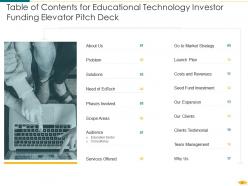
Slide 2: This slide presents the table of contents for the pitch deck.
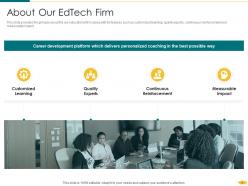
Slide 3: This slide exhibits the our educational firm along with its features such as customized learning, quality experts, continuous reinforcement and measurable impact.
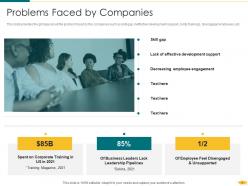
Slide 4: This slide showcases the problem faced by the companies such as skill gap, ineffective development support, costly trainings, disengaged employees, etc.
Slide 5: This slide provides the glimpse about the solutions offered by our firm such as accessibility and transparency, simplicity and flexibility etc.
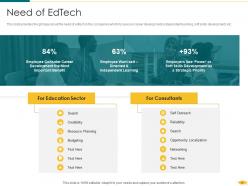
Slide 6: This slide provides the glimpse about the need of edtech in the companies which focuses on career development, independent learning, soft skills development, etc.
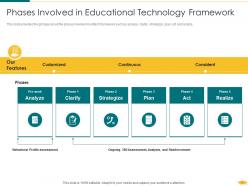
Slide 7: This slide provides the glimpse about the phases involved in edtech framework such as analyze, clarify, strategize, plan, act and realize.
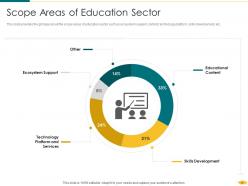
Slide 8: This slide provides the glimpse about the scope areas of education sector such as ecosystem support, content, technology platform, skills development, etc.
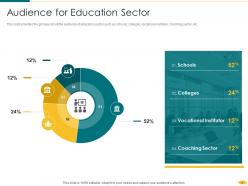
Slide 9: This slide provides the glimpse about the audience of education sector such as schools, colleges, vocational institutor, coaching sector, etc.
Slide 10: This slide provides the glimpse about the audience of consultancy sector such as training, supplies, IT, furniture, assessment, teaching, etc.
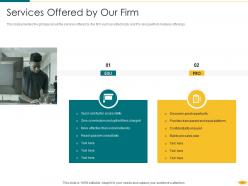
Slide 11: This slide provides the glimpse about the services offered by the firm such as edtech Edu and Pro along with its features offerings.
Slide 12: This slide displays the go to market strategy planned by our firm for education sector and consultants such as salesforce implementation, SEM, SMM, etc.
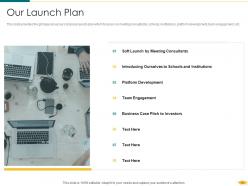
Slide 13: This slide provides the glimpse about our company launch plan which focuses on meeting consultants, schools, institutions, platform development, team engagement, etc.
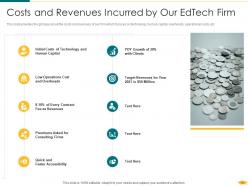
Slide 14: This slide provides the glimpse about the costs and revenues of our firm which focuses on technology, human capital, overheads, operational costs, etc.
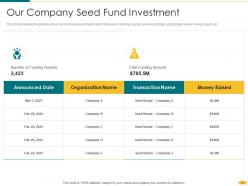
Slide 15: This slide provides the glimpse about our company investments which focuses on funding rounds, announced date, organization name, money raised, etc.
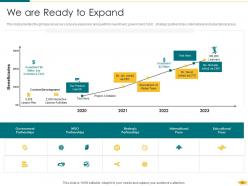
Slide 16: This slide provides the glimpse about our company expansion along with its investment, government, NGO , strategic partnerships, international and educational press.
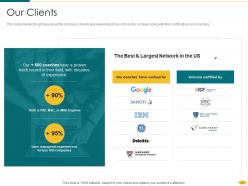
Slide 17: This slide provides the glimpse about the company’s clients and networking done so far by the company along with their certifications and coaching.
Slide 18: This slide provides the glimpse about the company’s clients testimonials along with their names, and designations.
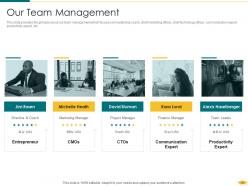
Slide 19: This slide presents our team management which focuses on leadership coach, chief marketing officer, communication expert, productivity expert, etc.
Slide 20: This slide provides the glimpse about why people should choose our company over others along with the specialties offered by our firm.
Slide 21: This slide presents the title for additional slides.
Slide 22: This is the icons slide for the project.
Slide 23: This slide displays about the company, target audience and its client's values.
Slide 24: This slide displays the vision, mission and goals of the company.
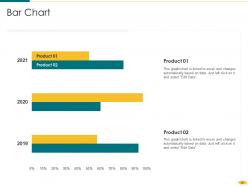
Slide 25: This slide presents the bar graph for products. The graphs are linked to Excel.
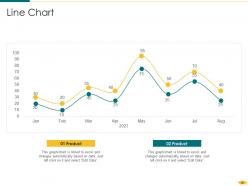
Slide 26: This slide presents the line charts for products. The charts are linked to Excel.
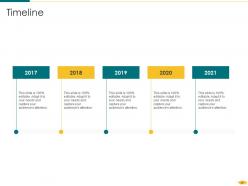
Slide 27: This slide presents the yearly timeline of the company.
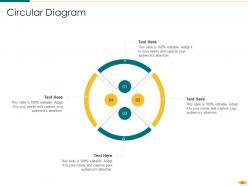
Slide 28: This slide presents the circular diagram of the project.
Slide 29: This slide displays the goals of the company.
Slide 30: This slide exhibits the 30-60-90 days plan of the project.
Slide 31: This slide displays the posts for past experiences of the clients.
Slide 32: This is the thank you slide and contains contact details of the company like address, phone no., etc. "
Educational technology investor funding elevator pitch deck ppt template with all 32 slides:
Use our Educational Technology Investor Funding Elevator Pitch Deck Ppt Template to effectively help you save your valuable time. They are readymade to fit into any presentation structure.










FAQs for Educational technology investor funding elevator pitch
Educational technology investments should prioritize adaptive learning algorithms, gamification elements, collaborative virtual environments, real-time analytics dashboards, and immersive multimedia content. These features streamline personalized instruction while enhancing engagement through interactive experiences, with many schools finding that strategic combinations of these technologies ultimately deliver improved learning outcomes, higher retention rates, and measurable academic performance gains.
Schools measure EdTech ROI through student performance metrics, cost reduction analysis, operational efficiency gains, teacher productivity improvements, and engagement tracking systems. These assessments combine quantitative data like test score improvements and attendance rates with qualitative measures, enabling administrators to demonstrate measurable learning outcomes while optimizing resource allocation for sustained competitive advantage.
Professional development ensures educators effectively integrate educational technology by providing training on new platforms, pedagogical strategies for digital learning, and ongoing support for implementation challenges. Through comprehensive training programs, schools enable teachers to leverage technology for personalized instruction, data-driven decision making, and enhanced student engagement, ultimately delivering improved learning outcomes and maximizing their technology investments.
Institutions can ensure equitable access by providing device lending programs, expanding Wi-Fi infrastructure, offering digital literacy training, partnering with community organizations, and implementing flexible learning platforms. Through strategic resource allocation and targeted support programs, schools and universities enable all students to participate in digital learning environments, ultimately reducing educational disparities while enhancing learning outcomes across diverse populations.
Key indicators of successful classroom technology integration include improved student engagement and participation, enhanced collaborative learning experiences, increased personalized instruction capabilities, measurable academic performance gains, and seamless incorporation into daily lesson plans. These indicators demonstrate that technology becomes a natural learning tool rather than a distraction, with many educational institutions finding that successful integration ultimately delivers more interactive classrooms and better preparation for students' digital futures.
Different age groups demonstrate distinct preferences and adaptation patterns with educational technology, with younger students embracing gamified platforms and interactive apps, while older learners often prefer structured online courses and video-based content. Through strategic technology selection, educational institutions enhance engagement across demographics by combining visual learning tools for younger users with self-paced modules for adults, ultimately delivering personalized experiences that improve learning outcomes and retention rates across all age segments.
**INPUT**: What strategies can be employed to involve parents and guardians in the educational technology landscape? **OUTPUT**: Effective parent engagement strategies include digital literacy workshops, regular communication platforms, home learning resource access, progress tracking portals, and collaborative goal-setting sessions. These approaches streamline family-school partnerships by enhancing transparency, enabling consistent support, and delivering improved student outcomes, with many educational institutions finding that active parent involvement significantly accelerates technology adoption and academic success. [Word count: 58 words]
Educators face challenges including limited budgets, insufficient technical training, resistance to change, inadequate infrastructure, and time constraints for curriculum integration. These obstacles often result in underutilized technologies and inconsistent implementation, though many institutions find that strategic planning, comprehensive training programs, and phased rollouts ultimately deliver enhanced learning outcomes and improved student engagement.
Data analytics from educational technology informs teaching practices by identifying learning gaps, tracking student progress, and revealing engagement patterns across different content areas. Through real-time dashboards and performance metrics, educators can personalize instruction, adjust pacing, and redesign curriculum modules based on actual learning outcomes, ultimately enhancing student achievement and institutional effectiveness.
Emerging technologies like AI and VR present both transformative opportunities and strategic considerations for educational investments, requiring institutions to balance innovation costs with long-term learning outcomes. These technologies enable personalized learning experiences, immersive skill training, and scalable content delivery, with universities and corporate training programs increasingly finding that strategic technology integration delivers enhanced student engagement, reduced operational costs, and competitive differentiation in an increasingly digital education landscape.
Educational technology facilitates personalized learning through adaptive learning platforms, AI-powered content recommendations, individualized pacing systems, customized assessment tools, and data-driven learning analytics. These technologies streamline instruction by adjusting difficulty levels, identifying knowledge gaps, and delivering targeted content, with many schools finding that students achieve better outcomes while teachers enhance instructional efficiency.
Educational technology investments raise concerns including student data privacy, algorithmic bias in learning platforms, digital equity across socioeconomic groups, and transparency in automated assessment systems. These considerations present both challenges and opportunities, with many educational institutions finding that proactive ethical frameworks enhance trust, ensure regulatory compliance, and ultimately deliver more inclusive learning experiences while maintaining competitive advantage in an increasingly digital education landscape.
Institutions can balance technology costs with educational quality by prioritizing scalable solutions, leveraging cloud-based platforms to reduce infrastructure expenses, and forming strategic partnerships with technology providers for volume discounts. Many universities and schools find that investing in versatile, multi-purpose educational technologies ultimately delivers cost savings while enhancing learning outcomes and operational efficiency.
Educational technology impacts student mental health through personalized learning platforms, digital wellness tools, social connection features, and stress management applications. These technologies enhance well-being by reducing academic anxiety, enabling flexible learning schedules, and providing mental health resources, with many schools finding that strategic edtech implementation ultimately delivers improved student engagement and emotional support systems.
Schools can assess ed-tech effectiveness through student performance analytics, engagement metrics, teacher feedback surveys, and learning outcome comparisons with pre-implementation baselines. Through systematic data collection, educational institutions track academic progress improvements, usage patterns, and cost-per-student benefits, while gathering qualitative insights from educators, ultimately enabling evidence-based decisions for future technology investments.
-
Innovative and attractive designs.
-
Very unique and reliable designs.
-
Great product with highly impressive and engaging designs.
-
Editable templates with innovative design and color combination.
-
Professional and unique presentations.