

Effective communication skills workplace ppt powerpoint presentation inspiration cpb




Try Before you Buy Download Free Sample Product
 Impress Your
 Audience
 100%
100% Editable
 Save Hours
 of Time


Our Effective Communication Skills Workplace Ppt Powerpoint Presentation Inspiration Cpb go beyond the obvious. Unearth their true worth with your probing thoughts.
People who downloaded this PowerPoint presentation also viewed the following :
Content of this Powerpoint Presentation
Description:
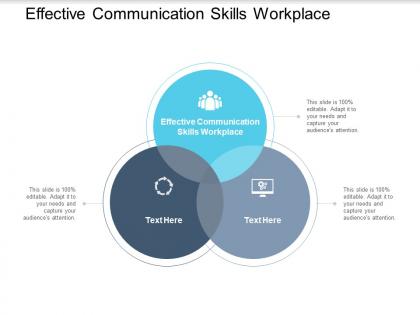
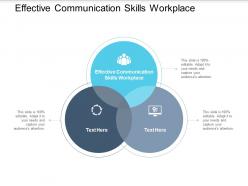
The image is of a PowerPoint slide titled "Effective Communication Skills Workplace," which is designed to be used as a visual aid in a presentation about workplace communication skills. The slide features a Venn diagram with three overlapping circles, each circle accompanied by a symbol representing different aspects of communication within a workplace environment.
The leftmost circle has an icon suggesting a group or team, implying that this segment of the diagram could represent team communication dynamics. The top circle features a cogwheel, which might symbolize processes or systems in place for effective communication. The rightmost circle contains an icon that looks like a presentation screen or a media projector, possibly representing the tools and technologies that facilitate communication.
Each circle has a placeholder text "Text Here," indicating that the presenter can customize these sections with specific details relevant to their topic. The overlapping areas of the circles could be used to describe how these elements intersect and influence each other, which is a common purpose of a Venn diagram.
Use Cases:
Presentation slides are versatile tools for conveying complex concepts succinctly. Here are seven industries that could benefit from such slides:
1. Non-Profit:
Use: Explaining volunteer coordination communication strategies.
Presenter: Volunteer Manager.
Audience: New Volunteers, Staff Members.
2. Information Technology:
Use: Outlining effective IT project communication flows.
Presenter: IT Project Manager.
Audience: Project Teams, Stakeholders.
3. Education:
Use: Discussing collaboration methods between academic departments.
Presenter: School Principal.
Audience: Teachers, Administrative Staff.
4. Hospitality:
Use: Demonstrating communication standards for guest services.
Presenter: Customer Service Trainer.
Audience: Front Desk, Concierge, Housekeeping Staff.
5. Healthcare:
Use: Addressing interdepartmental communication for patient care.
Presenter: Clinical Operations Director.
Audience: Doctors, Nurses, Administrative Staff.
6. Construction:
Use: Detailing communication protocols for site safety.
Presenter: Safety Officer.
Audience: Construction Workers, Site Managers.
7. Event Planning:
Use: Coordinating team roles and information dissemination.
Presenter: Event Coordinator.
Audience: Event Staff, Vendors, Venue Managers
Effective communication skills workplace ppt powerpoint presentation inspiration cpb with all 2 slides:
Get on board the winners bus. Our Effective Communication Skills Workplace Ppt Powerpoint Presentation Inspiration Cpb will open the doors.
FAQs for Effective communication skills workplace ppt powerpoint
Key components of effective verbal communication in presentations include clear articulation, appropriate pace and volume, strategic pauses, confident tone, and purposeful emphasis on critical points. These elements work together by enhancing audience engagement, improving message retention, and building speaker credibility, with many professionals finding that mastering these techniques significantly elevates their presentation impact and career advancement opportunities.
Non-verbal communication significantly shapes message perception by conveying confidence, credibility, and engagement through body language, facial expressions, eye contact, and vocal tone. These elements can either reinforce or undermine your verbal content, with many presenters finding that strong posture, purposeful gestures, and consistent eye contact enhance audience trust and message retention.
Effective audience tailoring strategies include demographic analysis, cultural sensitivity assessments, communication channel optimization, language adaptation, and stakeholder mapping. These approaches enhance engagement by adjusting tone, complexity, and delivery methods for specific groups, with organizations like healthcare systems and multinational corporations finding that customized messaging significantly improves comprehension, response rates, and ultimately delivers stronger stakeholder relationships and competitive advantage.
Active listening enhances team communication by fostering deeper understanding, reducing misinterpretations, and building stronger collaborative relationships among members. Through attentive engagement and thoughtful responses, teams experience improved problem-solving capabilities, faster conflict resolution, and increased psychological safety, with many organizations finding that active listening practices ultimately deliver higher productivity and more innovative outcomes.
Body language significantly impacts confidence perception through upright posture, steady eye contact, purposeful gestures, and controlled facial expressions. These nonverbal cues reinforce verbal messages by establishing credibility, engaging audiences, and projecting authority, with many presenters finding that confident body language enhances audience trust, improves message retention, and ultimately delivers more persuasive, memorable presentations across professional settings.
Visual aids improve communication clarity by simplifying complex information, highlighting key points, enhancing audience retention, and accommodating different learning styles through charts, graphs, and infographics. These tools enable presenters to streamline their message delivery while reducing cognitive load, with many organizations finding that strategic visual integration ultimately delivers more engaging presentations and significantly improved audience comprehension rates.
Techniques include deep breathing exercises, thorough preparation, visualization methods, progressive muscle relaxation, and structured practice sessions. These approaches enhance delivery by reducing physical tension, improving vocal clarity, and building confidence, with many professionals finding that combining mindfulness techniques with strategic rehearsal ultimately delivers more engaging presentations and stronger audience connection.
Storytelling is crucial for presentation engagement as it transforms abstract concepts into memorable narratives, creates emotional connections with audiences, and helps complex information stick through relatable examples and scenarios. Through strategic storytelling, presenters enhance audience retention, build trust and credibility, and deliver more persuasive messages, with many organizations finding that narrative-driven presentations generate significantly higher engagement rates and actionable outcomes.
Cross-cultural communication challenges in international presentations include language barriers, nonverbal misinterpretations, cultural context differences, varying presentation expectations, and diverse time perceptions. These obstacles can be addressed by researching audience cultural norms, using clear visual aids, incorporating local examples, allowing extra time for questions, and partnering with cultural liaisons, ultimately delivering more engaging experiences and stronger global business relationships.
Feedback can be solicited through regular one-on-ones with supervisors, peer reviews, customer surveys, and 360-degree assessments that evaluate clarity, listening abilities, and message effectiveness. Organizations increasingly implement structured feedback systems, with many finding that combining formal evaluations with real-time input from colleagues and clients delivers measurable improvements in presentation skills, conflict resolution, and overall professional communication competency.
Effective presentation structure includes opening with a compelling hook, organizing content into 3-5 main points, using the "tell them what you'll tell them" framework, incorporating storytelling elements, and ending with a strong call-to-action. These practices enhance audience engagement by creating logical flow, maintaining attention through varied content delivery, and reinforcing key messages, with many organizations finding that structured presentations significantly improve information retention and decision-making outcomes.
Developing persuasive communication involves mastering storytelling techniques, using data-driven evidence, practicing active listening, employing strategic body language, and tailoring messages to audience needs. These approaches enhance presenter credibility by building emotional connections, supporting arguments with concrete facts, and adapting delivery styles, with many professionals finding that combining logical reasoning with compelling narratives ultimately delivers stronger audience engagement and business outcomes.
Technology facilitates better presentations through interactive polling systems, real-time collaboration tools, multimedia integration, virtual reality experiences, and AI-powered analytics. These technologies streamline audience engagement by enabling instant feedback, seamless content sharing, and dynamic visual storytelling, with many organizations finding that strategic technology adoption ultimately delivers more compelling presentations and stronger stakeholder connections.
Rhetorical questions enhance audience engagement by creating mental participation, establishing emotional connections, and encouraging active listening throughout presentations. These strategic pauses prompt audiences to reflect internally while maintaining focus, with many speakers finding that well-timed questions break monotony, emphasize key points, and create memorable moments that ultimately deliver stronger audience retention and more impactful messaging.
Methods to ensure clarity and accessibility include structured storytelling, visual hierarchy, simplified language, interactive elements, and consistent formatting throughout presentations. These approaches streamline comprehension by reducing cognitive load, enhancing visual flow, and accommodating diverse learning styles, with many organizations finding that strategic presentation design ultimately delivers stronger audience engagement and more effective knowledge transfer across all business communications.
No Reviews