

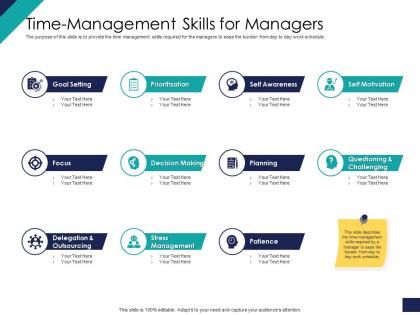
Effective leadership management styles approaches time management skills for managers ppt model




Try Before you Buy Download Free Sample Product
 Impress Your
 Audience
 100%
100% Editable
 Save Hours
 of Time


Our Effective Leadership Management Styles Approaches Time Management Skills For Managers Ppt Model are topically designed to provide an attractive backdrop to any subject. Use them to look like a presentation pro.
People who downloaded this PowerPoint presentation also viewed the following :
Effective leadership management styles approaches time management skills for managers ppt model with all 2 slides:
Use our Effective Leadership Management Styles Approaches Time Management Skills For Managers Ppt Model to effectively help you save your valuable time. They are readymade to fit into any presentation structure.

FAQs for Effective leadership management styles approaches time management skills for
Transformational leadership emphasizes inspiring vision, individualized consideration, intellectual stimulation, and idealized influence to motivate teams beyond basic expectations. These characteristics enable managers to foster innovation, build stronger employee engagement, and drive organizational change by encouraging creative problem-solving, providing personalized mentoring, and modeling ethical behavior, ultimately delivering higher performance and competitive advantage.
Servant leadership prioritizes employee development, empowerment, and well-being over hierarchical authority, focusing on serving team members rather than commanding them. This approach enhances employee engagement by building trust, fostering collaboration, and creating psychological safety, with organizations like Southwest Airlines and Starbucks finding that servant leaders deliver higher retention rates, increased innovation, and stronger organizational performance.
Emotional intelligence enables effective leadership by enhancing self-awareness, empathy, communication, and relationship management, allowing leaders to navigate complex team dynamics and organizational challenges. Leaders can cultivate this skill through regular self-reflection, seeking feedback, practicing active listening, and engaging in mindfulness training, ultimately delivering stronger team performance and organizational resilience.
Leaders can effectively balance authoritative and democratic styles by adopting situational leadership, using authoritative approaches during crisis management or tight deadlines, while implementing democratic methods for strategic planning, team development, and innovation initiatives. This strategic combination enables organizations to maintain operational efficiency and employee engagement simultaneously, with many corporations finding that flexible leadership adaptation ultimately delivers faster decision-making and higher team satisfaction.
Strategies include cultural intelligence development, flexible communication approaches, individualized motivation techniques, inclusive decision-making processes, and regular feedback mechanisms tailored to cultural preferences. Through adaptive leadership frameworks, organizations can bridge cultural gaps by recognizing diverse work styles, communication patterns, and hierarchy expectations, ultimately enhancing team cohesion and productivity across multicultural environments.
Situational leadership enables leaders to adapt their management approach by assessing team members' competence levels, adjusting communication styles, and modifying delegation strategies based on specific circumstances and individual needs. Through this flexible framework, leaders can seamlessly transition between directing, coaching, supporting, and delegating modes, ultimately delivering improved team performance and employee development while maintaining operational efficiency in increasingly dynamic business environments.
Leaders can leverage strategic planning by conducting comprehensive organizational assessments, identifying key performance indicators that match their natural management approach, and creating flexible frameworks that adapt their style to specific team needs and business objectives. Through regular strategic reviews, leaders in sectors like technology and healthcare find that aligning their management style with long-term goals enhances team performance, improves resource allocation, and ultimately delivers sustained competitive advantage.
Adaptive leadership significantly enhances team innovation by encouraging experimentation, embracing diverse perspectives, and creating psychological safety for creative risk-taking. Through flexible decision-making approaches and responsive feedback mechanisms, organizations like tech startups and research institutions find that adaptive leaders foster breakthrough solutions, accelerate product development cycles, and ultimately deliver sustained competitive advantage in dynamic markets.
Coaching and mentoring leadership styles enhance team development by providing personalized guidance, building individual strengths, fostering continuous learning, and creating supportive feedback loops that accelerate skill acquisition. These approaches enable leaders to unlock potential across diverse teams, with organizations in sectors like technology and healthcare finding that strategic development conversations ultimately deliver improved performance metrics, higher employee engagement, and stronger succession planning capabilities.
Collaborative leadership faces challenges including slower decision-making processes, potential for groupthink, difficulty managing conflicting opinions, and increased time requirements for consensus building. These obstacles can be overcome through structured facilitation techniques, clear role definitions, and establishing decision-making frameworks that balance input with efficiency, ultimately delivering enhanced team engagement and innovative solutions.
Leaders can measure their leadership effectiveness through 360-degree feedback assessments, employee engagement surveys, performance metrics analysis, and regular one-on-one discussions with team members. These measurement approaches enable organizations to track productivity improvements, retention rates, and goal achievement while identifying areas for leadership development, with many companies finding that data-driven leadership evaluation ultimately enhances team performance and competitive advantage.
Transitioning to inclusive leadership involves gradually delegating decision-making authority, actively soliciting input through regular team meetings and feedback sessions, and implementing collaborative problem-solving processes. Leaders can start by sharing context behind decisions, asking for perspectives before finalizing plans, and recognizing team contributions publicly, with many organizations finding that this measured approach builds trust while maintaining operational efficiency and ultimately delivers improved team engagement and innovation.
A manager's leadership style fundamentally shapes organizational culture by influencing communication patterns, decision-making processes, employee autonomy, and performance expectations. Transformational leaders foster innovation and engagement through mentoring and vision-sharing, while collaborative managers build trust and transparency, ultimately delivering higher retention rates, improved productivity, and stronger workplace satisfaction across diverse organizational environments.
Feedback serves as a critical mirror for leaders, enabling them to identify blind spots, understand their impact on team dynamics, and adapt their approach to diverse situations and personalities. Effective implementation requires establishing regular 360-degree feedback cycles, creating psychological safety for honest input, and demonstrating responsive changes, with many organizations finding that leaders who actively seek and act on feedback ultimately deliver stronger team performance and employee engagement.
Leaders develop team resilience during crisis through transformational leadership that emphasizes clear communication, adaptive decision-making, and psychological safety, while servant leadership focuses on supporting individual team members' well-being and growth. These approaches enable teams to navigate uncertainty more effectively, with many organizations finding that leaders who combine empathetic guidance with strategic transparency ultimately deliver stronger team cohesion and improved crisis response capabilities.
-
Great quality product.
-
Informative presentations that are easily editable.
-
Topic best represented with attractive design.
-
Content of slide is easy to understand and edit.
-
Best Representation of topics, really appreciable.
-
Enough space for editing and adding your own content.
-
Out of the box and creative design.