

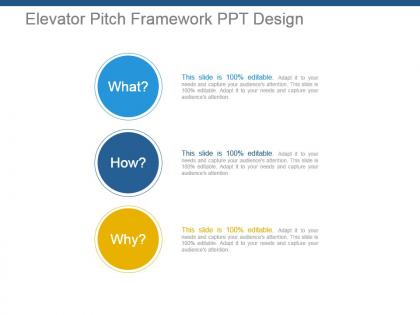
Elevator pitch framework ppt design




Try Before you Buy Download Free Sample Product
 Impress Your
Audience
 100%
Editable
 Save Hours
of Time


Advise folks about intelligent banking with our Elevator Pitch Framework Ppt Design. Elaborate on joint accounts.
People who downloaded this PowerPoint presentation also viewed the following :
Elevator pitch framework ppt design with all 5 slides:
Generate cohesive forces with our Elevator Pitch Framework Ppt Design. Forge connections that bind the group.


FAQs for Elevator pitch
Key components of an effective elevator pitch include a compelling hook, clear problem identification, concise solution presentation, unique value proposition, and strong call-to-action. These elements work together by capturing attention immediately, demonstrating market understanding, and articulating competitive advantages, with many entrepreneurs finding that structured frameworks ultimately deliver more memorable presentations and increased investor engagement.
Tailoring your elevator pitch requires understanding each audience's priorities, pain points, and decision-making criteria, then adjusting your value proposition, language, and examples accordingly. For investors, emphasize ROI and market opportunity, while for customers, focus on specific benefits and solutions, with technical teams appreciating detailed functionality, ultimately ensuring your message resonates and drives engagement across diverse stakeholder groups.
Common elevator pitch mistakes include being too lengthy, focusing solely on features rather than benefits, lacking a clear call-to-action, using excessive jargon, and failing to tailor the message to your audience. These pitfalls undermine effectiveness by confusing listeners, diminishing engagement, and missing connection opportunities, with successful entrepreneurs finding that concise, benefit-focused messaging ultimately delivers stronger relationships and business outcomes.
The ideal elevator pitch length depends on your audience and context, typically ranging from 30 seconds for networking events to 2 minutes for formal presentations, with consideration for speaking pace and engagement level. Most professionals find that 60-90 seconds works effectively across industries like consulting, sales, and startups, allowing sufficient time to cover key value propositions while maintaining listener attention and enabling natural conversation flow.
Storytelling transforms elevator pitches by creating emotional connections, making messages memorable, and demonstrating value through relatable scenarios rather than abstract claims. Through narrative techniques, professionals can illustrate problem-solving capabilities, showcase results in specific contexts like client transformations or market challenges, and ultimately engage listeners more effectively than traditional feature-focused presentations.
Visual aids enhance elevator pitches by increasing engagement, simplifying complex concepts, and improving message retention through memorable demonstrations or graphics. Strategic props, infographics, or quick visual summaries help presenters communicate value propositions more effectively, especially in crowded networking environments, with many entrepreneurs finding that well-designed visual elements significantly boost audience interest and follow-up conversations.
**INPUT**: What techniques can help you practice and refine your elevator pitch? **OUTPUT**: Effective elevator pitch refinement techniques include recording yourself, practicing with trusted colleagues, timing delivery, rehearsing in front of mirrors, and testing with different audiences. These methods enhance clarity, confidence, and natural delivery by identifying weak points, refining messaging flow, and ensuring consistent timing, with many professionals finding that regular practice in varied settings ultimately delivers more compelling presentations and stronger networking outcomes. [Word count: 60]
Incorporating feedback into your elevator pitch involves actively seeking input from trusted colleagues, mentors, and target audiences, then systematically refining your message, delivery, and timing based on their responses. Successful professionals practice their pitches with diverse stakeholders, analyze which elements resonate most effectively, and continuously adjust their value propositions, ultimately delivering more compelling and targeted presentations that drive meaningful business conversations.
Successful elevator pitches include Airbnb's "web platform where users can rent out their space to host travelers," Uber's "push a button and get a ride," and Warby Parker's "designer eyewear at revolutionary prices." These pitches work by identifying clear problems, presenting simple solutions, and demonstrating scalability, with many startups finding that concise value propositions resonate across industries from hospitality to transportation.
Key psychological principles include the primacy effect, social proof, reciprocity, scarcity, and emotional resonance through storytelling. These principles enhance pitch effectiveness by creating memorable first impressions, establishing credibility through relevant examples, and triggering decision-making responses, with many professionals finding that combining concrete achievements with future-focused benefits ultimately delivers stronger engagement and increased follow-up opportunities.
Handle difficult questions by acknowledging the concern, providing honest and specific responses, and redirecting to your value proposition when appropriate. This approach demonstrates confidence and expertise while maintaining dialogue momentum, with many successful entrepreneurs finding that addressing objections directly actually strengthens their credibility and builds investor trust ultimately.
Maintaining confidence during your elevator pitch involves thorough preparation, positive body language, strategic breathing techniques, focused eye contact, and regular practice sessions. These strategies enhance delivery by reducing anxiety, improving vocal clarity, and ensuring message consistency, with many professionals finding that rehearsing in front of mirrors or trusted colleagues ultimately delivers more compelling presentations and stronger audience engagement.
Understanding your value proposition enables you to craft focused, compelling elevator pitches by clearly articulating what makes your offering unique, relevant, and beneficial to your specific audience. This strategic foundation helps you eliminate unnecessary details, emphasize key differentiators, and connect directly with listener needs, ultimately delivering more memorable interactions and stronger business outcomes.
Tools for creating compelling elevator pitch presentations include PowerPoint, Canva, Prezi, Google Slides, and specialized pitch deck platforms like Pitch or Beautiful.AI. These resources enable entrepreneurs to craft professional presentations through customizable templates, visual elements, and interactive features, while many startups find that combining strong design tools with clear messaging frameworks ultimately delivers more engaging investor meetings and networking opportunities.
Networking opportunities provide natural practice environments for your elevator pitch through industry events, professional meetups, conference mixers, and even casual business interactions. These settings enable you to refine your message delivery, gauge audience reactions, and adapt your pitch based on real-time feedback, while building genuine connections that ultimately enhance both your presentation skills and professional network expansion.
-
Very unique, user-friendly presentation interface.
-
Very unique and reliable designs.