

Email Marketing Campaign Kpis Tracking Dashboard Snapshot





Try Before you Buy Download Free Sample Product
 Impress Your
Audience
 100%
Editable
 Save Hours
of Time


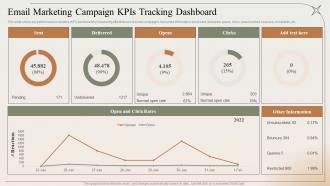
This slide shows key performance indicators KPI dashboard snapshot for measuring effectiveness of email campaigns. It provides information about sent, delivered, opens, clicks, unsubscribed, bounces, complaints, etc.
People who downloaded this PowerPoint presentation also viewed the following :
Email Marketing Campaign Kpis Tracking Dashboard Snapshot with all 7 slides:
Use our Email Marketing Campaign KPIS Tracking Dashboard Snapshot to effectively help you save your valuable time. They are readymade to fit into any presentation structure.






FAQs for Email Marketing Campaign Kpis
Critical email marketing KPIs include open rates, click-through rates, conversion rates, bounce rates, and unsubscribe rates, alongside revenue per email and list growth metrics. These measurements enable marketers to optimize campaign performance by identifying engagement patterns, deliverability issues, and audience preferences, with many organizations finding that tracking these KPIs together delivers improved ROI and stronger customer relationships.
Open rates can be effectively improved through strategic subject line optimization, audience segmentation, send time testing, mobile-responsive design, and sender reputation management. These approaches streamline engagement by delivering personalized content to targeted segments, optimizing delivery timing, and ensuring seamless mobile experiences, with many organizations finding that A/B testing subject lines and strategic segmentation ultimately delivers significantly higher engagement rates and competitive advantage.
Click-through rates serve as a critical performance indicator, measuring subscriber engagement beyond email opens by tracking actual clicks on links, buttons, and calls-to-action within campaigns. This metric enables marketers to assess content relevance, optimize subject lines and messaging, and identify high-performing segments, with many organizations finding that strong CTRs directly correlate with increased conversions and revenue generation.
Conversion rates directly measure email marketing effectiveness by tracking how many recipients complete desired actions like purchases, sign-ups, or downloads after engaging with campaigns. High conversion rates indicate strong audience targeting, compelling content, and strategic timing, with many retail and e-commerce businesses finding that even small conversion improvements significantly boost revenue, customer acquisition, and overall ROI.
Bounce rates directly indicate email deliverability health by measuring undelivered messages, with hard bounces signaling permanent issues like invalid addresses and soft bounces indicating temporary problems like full inboxes. High bounce rates damage sender reputation with email providers, ultimately reducing inbox placement rates and campaign effectiveness, with many organizations finding that maintaining bounce rates below 2% significantly enhances overall deliverability performance.
Segmentation significantly enhances email marketing KPIs by delivering more targeted content, improving open rates by 15-25%, and increasing click-through rates through personalized messaging. By categorizing audiences based on demographics, purchase history, and engagement patterns, businesses in retail, healthcare, and financial services achieve higher conversion rates, reduced unsubscribe rates, and ultimately stronger customer retention and revenue growth.
A/B testing enhances email marketing KPIs by optimizing subject lines, send times, content formats, call-to-action placement, and personalization strategies through systematic comparison of variations. These tests enable marketers to increase open rates, click-through rates, and conversion rates by identifying high-performing elements, with many organizations finding that data-driven optimization delivers significantly improved engagement and ROI.
**INPUT**: What metrics should be tracked to assess subscriber engagement over time? **OUTPUT**: Key subscriber engagement metrics include open rates, click-through rates, time spent reading, forward rates, and unsubscribe patterns over monthly quarters. These indicators help organizations assess content relevance, delivery timing effectiveness, and audience retention strategies, with many marketing teams finding that combining behavioral data with preference tracking ultimately delivers deeper customer insights and improved campaign performance.
Unsubscribe rates directly impact list health by indicating content relevance, audience engagement, and sender reputation quality. While rates between 0.2-0.5% are considered healthy, consistently higher rates signal misaligned messaging or frequency issues, ultimately affecting deliverability, engagement metrics, and campaign ROI, with many organizations finding that monitoring this metric enables strategic content optimization.
Email marketing ROI optimization involves segmenting audiences for targeted messaging, personalizing content based on customer behavior, testing subject lines and send times, automating drip campaigns, and tracking comprehensive metrics beyond open rates. These strategies streamline campaign effectiveness by increasing engagement rates, reducing unsubscribe rates, and driving higher conversion rates, with many businesses finding that strategic segmentation and automation ultimately deliver 300-400% higher ROI than generic broadcast emails.
Businesses can benchmark their email marketing KPIs by utilizing industry reports from platforms like Mailchimp, Campaign Monitor, and HubSpot, joining industry associations for peer data, and leveraging analytics tools that provide comparative metrics. These resources enable companies to compare open rates, click-through rates, and conversion rates against sector-specific benchmarks, ultimately identifying performance gaps and optimization opportunities for competitive advantage.
Email marketing KPI tracking tools include Mailchimp, Constant Contact, HubSpot, Campaign Monitor, and Klaviyo, alongside analytics platforms like Google Analytics and specialized dashboard solutions. These technologies streamline performance monitoring by automating data collection, providing real-time reporting, and enabling advanced segmentation analysis, with many marketing teams finding that integrated platforms ultimately deliver enhanced campaign optimization and measurable ROI improvements.
Email timing significantly influences open and click rates by aligning with recipient behavior patterns, timezone considerations, and industry-specific engagement windows. Strategic timing optimization, combined with A/B testing across different send times, enables marketers to increase open rates by 20-30% and click rates by 15-25%, with many organizations finding that mid-week sends and optimal hour targeting deliver substantially better campaign performance.
E-commerce businesses should focus on conversion rate, revenue per email, click-to-purchase rate, average order value from campaigns, and customer lifetime value growth. These KPIs enable retailers to track actual sales impact, optimize product recommendations and promotional strategies, while measuring long-term customer engagement, ultimately delivering measurable ROI and sustainable revenue growth.
User feedback improves email marketing KPIs by enabling marketers to refine subject lines, content relevance, segmentation strategies, and send timing based on subscriber preferences and behaviors. Through surveys, reply tracking, and engagement analytics, organizations enhance open rates, click-through rates, and conversion metrics while reducing unsubscribe rates, ultimately delivering more personalized campaigns and stronger customer relationships.
-
A big thanks to SlideTeam! An incredible and diverse library of templates helped me with my business project presentation.
-
Enough space for editing and adding your own content.