

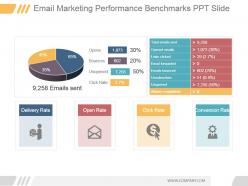
Email marketing performance benchmarks ppt slide





Try Before you Buy Download Free Sample Product
 Impress Your
Audience
 100%
Editable
 Save Hours
of Time


Our Email Marketing Performance Benchmarks Ppt Slide encourage good habits. They will believe in the benefits of correct conduct.
People who downloaded this PowerPoint presentation also viewed the following :
Email marketing performance benchmarks ppt slide with all 5 slides:
Gatherings become joyful due to our Email Marketing Performance Benchmarks Ppt Slide. Folks happily agree to join hands.


FAQs for Email marketing performance
Key email marketing metrics include open rates, click-through rates, conversion rates, bounce rates, and unsubscribe rates, along with revenue per email and list growth metrics. These indicators enable marketers to optimize campaign performance by identifying engagement patterns, deliverability issues, and ROI outcomes, with many organizations finding that tracking multiple metrics together delivers comprehensive insights for strategic email optimization.
Open rates can be optimized through compelling subject lines, sender name recognition, strategic send timing, audience segmentation, and mobile-friendly formatting. By testing different subject line approaches, personalizing content based on subscriber behavior, and analyzing engagement patterns across industries like retail and healthcare, marketers achieve higher visibility, increased click-through rates, and ultimately stronger campaign ROI.
Segmentation significantly improves email marketing benchmarks by enabling targeted messaging, personalized content delivery, and precise audience targeting based on demographics, behavior, and preferences. Through strategic segmentation, organizations achieve higher open rates, increased click-through rates, and reduced unsubscribe rates, with many retail and e-commerce businesses finding that segmented campaigns deliver substantially better conversion rates and customer engagement.
Email marketing click-through rates vary significantly across industries, with nonprofit organizations leading at approximately 3.7%, followed by agriculture and food services at 3.6%, and media and publishing at 3.0%. Meanwhile, retail averages 2.7%, financial services reaches 2.6%, and technology sectors typically see around 2.4%, with many organizations finding that personalized content and strategic segmentation can improve these benchmarks substantially.
A/B testing enhances email marketing strategies by comparing subject lines, send times, content formats, call-to-action buttons, and personalization approaches to identify what resonates with audiences. Through systematic testing of these elements, marketers can optimize open rates, click-through rates, and conversion performance, while reducing unsubscribe rates, ultimately delivering measurable improvements in campaign ROI and customer engagement.
Subject lines significantly impact email marketing performance by influencing open rates, click-through rates, and overall campaign effectiveness through personalization, urgency cues, and clear value propositions. Strategic subject line optimization can improve open rates by 20-30%, with retail brands and financial services finding that A/B testing different approaches, incorporating recipient names, and maintaining optimal character counts ultimately delivers higher engagement and better ROI across campaigns.
Automation significantly enhances email marketing benchmarks by improving targeting precision, timing optimization, and personalization at scale, typically increasing open rates by 20-30% and click-through rates by 50-100%. Through automated workflows, businesses streamline customer journeys, reduce manual errors, and deliver timely, relevant content, with many organizations finding that strategic automation ultimately drives higher engagement and conversion rates.
**INPUT**: What factors contribute to higher conversion rates in email marketing? **OUTPUT**: Higher email conversion rates stem from personalized subject lines, segmented audience targeting, mobile-optimized designs, compelling calls-to-action, and strategic timing based on subscriber behavior patterns. These elements work together by delivering relevant content to specific demographics, streamlining user experience across devices, and minimizing friction in the conversion process, with many retail and e-commerce brands finding that combining behavioral triggers with personalized recommendations ultimately delivers significantly improved ROI and customer engagement. [Word count: 60 words]
Mobile viewership trends significantly influence email design benchmarks by prioritizing responsive layouts, single-column formats, larger touch-friendly buttons, and concise subject lines optimized for smaller screens. With over 60% of emails now opened on mobile devices, marketers are adopting mobile-first design approaches, larger font sizes, and streamlined content structures, ultimately delivering improved engagement rates and better user experiences across all devices.
Email list best practices include regular list cleaning, double opt-in verification, segmentation by engagement levels, preference center management, and consistent re-engagement campaigns. These strategies enhance deliverability, open rates, and click-through performance by removing inactive subscribers, targeting relevant content, and maintaining sender reputation, with many organizations finding that clean, engaged lists deliver significantly higher conversion rates and revenue per email.
Email timing significantly affects open and click rates by aligning with recipient behavior patterns, time zones, and industry-specific schedules. Optimal send times typically fall between 10-11 AM and 1-3 PM on weekdays, with many organizations finding that Tuesday through Thursday delivers higher engagement, while avoiding Monday mornings and Friday afternoons ultimately maximizes campaign performance.
GDPR and privacy regulations significantly impact email marketing metrics by reducing list sizes, improving engagement rates, and requiring enhanced consent tracking and data management protocols. While compliance initially decreases subscriber volumes, many organizations find that permission-based lists deliver higher open rates, click-through rates, and conversions, ultimately enhancing targeting precision and customer trust in increasingly regulated markets.
Bounce rates directly indicate email deliverability health and sender reputation, with high bounce rates damaging future campaign performance by signaling poor list quality to internet service providers. Organizations maintaining bounce rates below 2% typically see improved inbox placement, higher engagement rates, and stronger long-term deliverability, while excessive bounces ultimately compromise campaign effectiveness and revenue generation potential.
Email marketing performance tracking tools include Google Analytics, Mailchimp Analytics, HubSpot, Constant Contact, Campaign Monitor, and specialized platforms like Litmus and Email on Acid. These technologies streamline benchmark analysis by monitoring open rates, click-through rates, and conversion metrics across campaigns, with many marketing teams finding that integrated analytics ultimately deliver deeper customer insights and significantly enhanced campaign optimization for competitive advantage.
Customer engagement over time significantly influences email marketing success by establishing trust, improving deliverability, and increasing conversion rates through consistent, valuable interactions. Engaged subscribers who regularly open, click, and respond to emails demonstrate higher lifetime value and purchase intent, with many organizations finding that nurturing long-term relationships through personalized content ultimately delivers better ROI than focusing solely on acquisition metrics.
-
Illustrative design with editable content. Exceptional value for money. Highly pleased with the product.
-
Qualitative and comprehensive slides.