

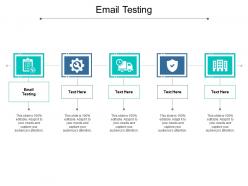
Email testing ppt powerpoint presentation outline demonstration cpb





Try Before you Buy Download Free Sample Product
 Impress Your
 Audience
 100%
100% Editable
 Save Hours
 of Time


Our Email Testing Ppt Powerpoint Presentation Outline Demonstration Cpb are topically designed to provide an attractive backdrop to any subject. Use them to look like a presentation pro.
People who downloaded this PowerPoint presentation also viewed the following :
Email testing ppt powerpoint presentation outline demonstration cpb with all 2 slides:
Use our Email Testing Ppt Powerpoint Presentation Outline Demonstration Cpb to effectively help you save your valuable time. They are readymade to fit into any presentation structure.
FAQs for Email testing ppt powerpoint presentation
Key elements include responsive design compatibility, image rendering consistency, font fallbacks, button functionality, and loading speed optimization across platforms. Testing should cover major email clients like Outlook, Gmail, and Apple Mail on both desktop and mobile devices, ensuring consistent user experiences while accounting for varying CSS support and display capabilities that ultimately enhance deliverability and engagement rates.
A/B testing optimizes email conversion rates by systematically comparing subject lines, send times, content formats, call-to-action buttons, and personalization elements across different audience segments. Through strategic testing of these variables, marketers can identify high-performing combinations that drive engagement, with many e-commerce and SaaS companies finding conversion rate improvements of 15-25% through data-driven optimization.
**INPUT**: What tools or software are recommended for automating the email testing process? **OUTPUT**: Email testing automation tools include Litmus, Email on Acid, Mailtrap, SendGrid, Mailgun, and Campaign Monitor's testing features. These platforms streamline testing by enabling cross-client compatibility checks, spam filter analysis, and A/B performance optimization, with many organizations finding that automated testing delivers faster campaign deployment and enhanced deliverability rates.
Email rendering varies significantly across clients like Outlook, Gmail, Apple Mail, and mobile platforms due to different HTML/CSS support, image handling, and font compatibility standards. These inconsistencies can cause broken layouts, missing images, and poor readability, making comprehensive testing crucial for ensuring consistent brand presentation, maximizing engagement rates, and delivering professional customer experiences across all devices and platforms.
Spam testing evaluates email content, sender reputation, and technical configurations to identify deliverability issues before campaigns launch, using tools like SpamAssassin, Mail Tester, and authentication protocols. Through systematic testing across multiple spam filters, organizations streamline inbox placement, enhance sender credibility, and minimize bounce rates, with many marketing teams finding that proactive spam testing ultimately delivers higher engagement rates and stronger campaign performance.
Marketers can ensure email accessibility by testing with screen readers, validating alt text for images, checking color contrast ratios, and verifying keyboard navigation functionality. These accessibility audits enable organizations to reach broader audiences while meeting compliance standards, with many financial services and healthcare companies finding that inclusive design ultimately enhances user experience and engagement across all demographics.
Email personalization testing best practices include A/B testing subject lines, segmenting audiences by demographics and behavior, testing dynamic content blocks, validating merge tags across platforms, and measuring engagement metrics. Financial services and retail companies find that systematic testing of personalized product recommendations, location-based offers, and customer lifecycle messaging significantly improves open rates and conversions, ultimately delivering stronger customer relationships.
Subject line effectiveness can be assessed through A/B testing different variations, analyzing open rates across segments, monitoring click-through rates, and tracking spam folder placement. These testing methods enable marketers to optimize engagement by comparing performance metrics, identifying audience preferences, and refining messaging strategies, ultimately delivering higher open rates and improved campaign ROI across diverse customer segments.
Key metrics include open rates, click-through rates, conversion rates, bounce rates, unsubscribe rates, and engagement timing patterns. These analytics enable organizations to refine targeting strategies, optimize send times, and enhance content relevance, with many companies finding that systematic monitoring ultimately delivers improved customer engagement and significantly higher ROI.
Email list segmentation significantly enhances test accuracy by creating homogeneous audience groups that respond more predictably to specific variables, enabling cleaner data interpretation and more reliable results. Through targeted segments based on demographics, behavior, or purchase history, marketers can identify which messaging resonates with distinct customer groups, ultimately delivering higher engagement rates and more actionable insights for campaign optimization.
Common email testing pitfalls include testing only one email client, ignoring mobile responsiveness, skipping subject line variations, inadequate sample sizes, and rushing test timelines. These oversights often result in poor deliverability, broken formatting across devices, and missed optimization opportunities, with many marketing teams finding that comprehensive testing protocols ultimately deliver higher engagement rates and better campaign performance.
Feedback from email testing can be incorporated by analyzing performance metrics, A/B test results, subscriber responses, and engagement patterns to identify successful elements and areas for improvement. These insights enable marketers to refine subject lines, optimize design layouts, and enhance content strategies, with many organizations finding that systematic testing cycles ultimately deliver higher open rates, improved click-through performance, and stronger subscriber retention.
Industry standards recommend testing emails 24-48 hours before campaign launches, with A/B tests running for at least 4-6 hours to gather statistically significant data across different audience segments. Many organizations find that testing frequency varies by campaign complexity and audience size, with retail brands often conducting daily tests during peak seasons while B2B companies typically test weekly, ultimately delivering higher engagement rates and improved campaign performance.
Email testing enhances customer engagement by optimizing subject lines, content personalization, send times, call-to-action placement, and message frequency through A/B testing methodologies. These strategic experiments enable organizations to deliver more relevant communications, reduce unsubscribe rates, and increase click-through rates, with many companies finding that data-driven email optimization ultimately strengthens customer relationships and long-term retention.
Analyzing bounce rates during email testing reveals deliverability issues, list quality problems, sender reputation challenges, authentication failures, and content filtering triggers. Through iterative testing, organizations can identify which subject lines, sender domains, or email formats cause bounces, enabling marketers to refine campaigns, improve inbox placement, and ultimately enhance delivery rates while protecting sender credibility.
-
Great product with highly impressive and engaging designs.
-
Perfect template with attractive color combination.
-
Excellent products for quick understanding.
-
Enough space for editing and adding your own content.