

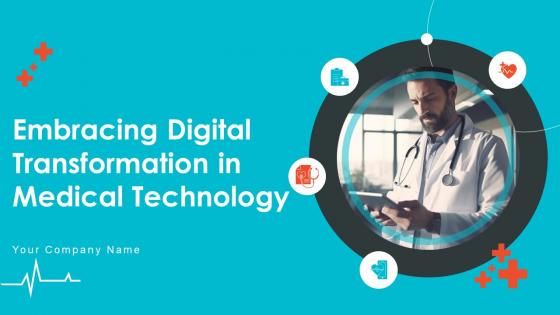
Embracing Digital Transformation In Medical Technology TC CD




Try Before you Buy Download Free Sample Product
 Impress Your
 Audience
 100%
100% Editable
 Save Hours
 of Time


Grab our Embracing Digital Transformation in Medical Technology PowerPoint presentation. This meticulously curated PPT template offers a thorough examination of the constantly changing field of medical technology. The PPT slides provide an in-depth overview, outlining the numerous benefits, exploring diverse types, and underscoring the critical need to embrace digital transformation in the healthcare sector. Additionally, the Telehealth Solutions PPT templates present the latest Market Trends. It also presents the profound impact of cutting-edge technologies like Artificial Intelligence, the Internet of Things IoT, Telehealth, Nanomedicine, Predictive Analytics, 5G, AR or VR, and 3D Printing on the medical landscape. Moreover, the AI in Healthcare PPT templates showcases the seamless integration of AI in medical facilities. Furthermore, it presents insights from compelling case studies on data access in healthcare organizations. Download our 100 percent editable and customizable PowerPoint, compatible with Google Slides, to streamline your presentation process.
People who downloaded this PowerPoint presentation also viewed the following :
Content of this Powerpoint Presentation
Slide 1: Embracing Digital Transformation in Medical Technology
Slide 2: This is an Agenda slide. State your agendas here.
Slide 3: This slide shows Table of Content for the presentation.
Slide 4: This slide shows title for topics that are to be covered next in the template.
Slide 5: This slide represents information pertaining to medical technology. It includes various components such as overview, major players and its advantages.
Slide 6: This slide contains challenges that impede growth of healthcare technology and factors resisting scaling of technological advancements.
Slide 7: This slide highlights effects of technological advancements in healthcare sector. This slide explain tools that are changing day-to-day medical operations and practices.
Slide 8: This slide showcase evolution of medical technology over the past years. It includes major evolution stages such as of year 1960, 1970, 1971, 1975, 1982 etc.
Slide 9: This slide shows Table of Content for the presentation.
Slide 10: This slide represents global market size of medical technology to indicate potential for new businesses or services.
Slide 11: This slide present insights of medical technology to keep stakeholders informed about industry trends.
Slide 12: This slide shows Table of Content for the presentation.
Slide 13: This slide showcase process of establishing technology in medical institution to enhance patient care and improve workflows.
Slide 14: This slide contains major factors that needs to be considered for implementation of healthcare technology.
Slide 15: This slide represent key tactics to incorporate technology in healthcare institutions. It includes various practices such as assessing needs, involving stakeholders etc.
Slide 16: This slide shows Table of Content for the presentation.
Slide 17: This slide showcase various types of medical technologies used in healthcare to improve patient experience.
Slide 18: This slide displays various types of medical technologies used in healthcare to improve patient experience. It includes various technologies such as telehealth, robotic surgery etc.
Slide 19: This slide shows Table of Content for the presentation.
Slide 20: This slide represent information pertaining to artificial intelligence in healthcare. It includes various components such as overview, major applications and statistics.
Slide 21: This slide contains various uses cases of AI in medical industry that enhances workflows and patient care.
Slide 22: This slide represents global market size of AI in medical industry to indicate potential for new businesses or services.
Slide 23: This slide present benefits of implementing artificial intelligence in healthcare operations. It includes various advantages such as administrative workflow, virtual nursing assistants etc.
Slide 24: This slide showcase technologies behind AI developments in medical innovations. It includes various technologies such as machine learning, deep learning, computer vision etc.
Slide 25: This slide highlights challenges that impede growth of AI technology in medical sectors. It includes various challenges such as lack of quality medical data etc.
Slide 26: This slide showcase good practices for establishing artificial intelligence in medical sector to enhance productivity and patient care.
Slide 27: This slide shows Table of Content for the presentation.
Slide 28: This slide represent information pertaining to IoT in healthcare. It includes various components such as overview, top IoT applications and devices and software used.
Slide 29: This slide showcase use cases of IoT in medical industry. It includes various applications such as activity trackers for cancer treatment, heart monitors with reporting etc.
Slide 30: This slide showcases worldwide market share of global market size of IoT in medical industry to indicate potential for new businesses or services.
Slide 31: This slide represent benefits using IoT in medical industry to enhance patient experience. It includes various advantages such as simultaneous reporting and monitoring etc.
Slide 32: The slide contains various IoT devices that are currently in use in healthcare departments and sectors. It includes various devices such as Philips remote patient monitoring system etc.
Slide 33: This slide highlight challenges that impede growth of IoT technology in medical sector. It includes various challenges such as data security and privacy, integration etc.
Slide 34: This slide shows Table of Content for the presentation.
Slide 35: This slide contains information pertaining to use of 5G technology in healthcare Industry. It includes various components such as introduction, major applications and advantages.
Slide 36: This slide contains various uses cases of 5G in medical industry that enhances patient experience. It includes various applications such as high definition virtual consultations etc.
Slide 37: This slide showcases global market size of 5G technology in medical industry. This slide indicate potential for new businesses or services.
Slide 38: This slide contains benefits of using 5G in medical industry to convey potential of this technology. It includes various advantages such as enhanced patient care etc.
Slide 39: The purpose of examining challenges of 5G technology in healthcare is to analyze factors that impede growth and find innovative solutions.
Slide 40: This slide shows Table of Content for the presentation.
Slide 41: This slide consists intel related to use of predictive analytics technology in healthcare sector. It includes various components such as overview, major applications and statistics.
Slide 42: This slide represent real life applications of medical technology to understand functioning and processes involved in it.
Slide 43: This slide presents market size of predictive analytics in medical sector. This slide indicate potential for new businesses or services.
Slide 44: This slide showcases key benefits of implementing medical technology in healthcare institutions. It includes various advantages such as chronic disease management etc.
Slide 45: The purpose of examining challenges of predictive analytics technology in healthcare is to analyze factors that impede growth.
Slide 46: This slide shows Table of Content for the presentation.
Slide 47: This slide consists intel related to use of predictive analytics technology in healthcare sector. It includes various components such as overview, major applications and statistics.
Slide 48: This slide highlights real life applications of nanotechnology in healthcare sector to understand working and processes involved in it.
Slide 49: This slide represents market size of nanomedicine in medical sector. This slide indicate potential for new businesses or services.
Slide 50: This slide elaborates advantages of nanotechnology in medical facilities to optimize workflows. It includes various advantages such as cancer and nanobots etc.
Slide 51: This slide contains major risks involved in utilization of nanotechnology in healthcare sector. It includes various risks related to size and mobility, solubility and presence etc.
Slide 52: This slide shows Table of Content for the presentation.
Slide 53: This slide represent information pertaining to AR/VR in healthcare. It includes various components such as overview key market players and technologies being used.
Slide 54: This slide highlight industry use cases of AR/VR technology in medical industry. It includes various applications such as training and medical learning, training for skill development etc.
Slide 55: This slide represent global market size of AR/VR in medical industry. It includes global value from year 2022 to 2032, compound annual growth rate and key insights.
Slide 56: This slide elaborates advantages of VR in medical facilities to enhance workflow and patient care. It includes various advantages such as pain management, rehabilitation etc.
Slide 57: This slide highlights various AR/VR technologies being utilized in medical industry. It includes various tools such as AED4EU, AccuVein, HoloAnatomy and AIRA smart glasses.
Slide 58: The slide contains stages involved in integration of virtual reality technology in medical institutions. It includes various steps such as establishing goal, creating a concept etc.
Slide 59: This slide shows Table of Content for the presentation.
Slide 60: This slide showcase information pertaining to telehealth services. It includes various components such as overview, key market players and services being offered.
Slide 61: This slide contains various types of telehealth services used in medical industry. It includes various types such as interactive, remote patient monitoring, store and forward and mobile.
Slide 62: This slide contains industry applications of telehealth in healthcare industry. It includes various applications such as wellness visits and general healthcare, nursing etc.
Slide 63: This slide represents global market size of telehealth technology to indicate potential for new businesses or services.
Slide 64: This slide contains various benefits of telehealth in healthcare facilities to enhance remote patient care and monitoring.
Slide 65: This slide represents various limitations of using telehealth technology in healthcare industry. It includes various disadvantages such as High production cost, data privacy risks etc.
Slide 66: The slide highlights process involved in launching a successful telehealth program for medical institutions. It includes various steps such as defining program’s objective etc.
Slide 67: This slide shows Table of Content for the presentation.
Slide 68: This slide showcase intel pertaining to use of 3D printing in healthcare sector. It includes various components such as overview, key players and materials used in 3D printing.
Slide 69: This slide showcase industry use cases of 3D printing technology in medical facilities. It includes various applications such as patient-specific surgical models etc.
Slide 70: This slide highlight global market size of 3D printing technology in healthcare industry. It includes global value from year 2022 to 2032, compound annual growth rate and key insights.
Slide 71: This slide highlights benefits of 3D printing technology in health sector to ease up various tasks. It includes various advantages such as personalized healthcare etc.
Slide 72: This slide shows Table of Content for the presentation.
Slide 73: This slide showcase information about robotic surgery in medical industry. It includes various components such as overview, key players and major applications.
Slide 74: This slide contains industry applications of robotic surgery in healthcare industry. It includes various applications such as gynecology, general surgery etc.
Slide 75: This slide contains global market size robotics surgery in medical industry. It includes global value from year 2023 to 2032, compound annual growth rate and key insights.
Slide 76: This slide indicates various benefits of robotics surgery in health sector to ease up various surgical operations. It includes various advantages such as greater precision etc.
Slide 77: This slide represents various demerits of robotics surgery in medical industry. It includes various disadvantages such as robotic malfunction, improper input of information etc.
Slide 78: This slide presents challenges of robotics surgery in healthcare industry is to analyze factors that impede growth. Add text here
Slide 79: This slide shows Table of Content for the presentation.
Slide 80: This slide contains intel related to wearable healthcare gadgets and it’s various aspects and working.
Slide 81: This slide contains global market size wearable healthcare technology in medical industry. It includes global value from year 2023 to 2038, compound annual growth rate and key insights.
Slide 82: This slide showcase key advantages of utilizing wearable healthcare gadgets. It includes various advantages such as promoting proactive healthcare, boosting patient engagement etc.
Slide 83: This slide highlight various wearable healthcare devices used to track health conditions of patients and wearers. It includes various devices such as blood pressure monitors etc.
Slide 84: This slide showcase survey questionnaire to identify significant components of healthcare wearable devices. It includes various elements such as objective, location, demographics etc.
Slide 85: This slide contains key outcomes of survey assessing significant factors of wearable healthcare devices.
Slide 86: This slide represents various demerits of wearable healthcare technology in medical industry. It includes various disadvantages such as technical issues, data accuracy etc.
Slide 87: This slide shows Table of Content for the presentation.
Slide 88: This slide showcases case study for utilization of AI in healthcare facilities. It includes various components such as company details, company name, location, number of employees etc.
Slide 89: This slide showcase case study for data access healthcare facility. It includes various components such as company details, company name, headquarters, number of employees etc.
Slide 90: This slide shows Table of Content for the presentation.
Slide 91: This slide showcase dashboard to remotely monitor patient’s health conditions and get updates. It includes various KPIs such as blood pressure, blood glucose, blood cholesterol etc.
Slide 92: This slide displays dashboard to track healthcare operations. It includes various KPIs such as patients by specialization, admitted patients, readmitted patients, bed occupancy rate etc.
Slide 93: This slide shows all the icons included in the presentation.
Slide 94: This is a Thank You slide with address, contact numbers and email address.
Embracing Digital Transformation In Medical Technology TC CD with all 102 slides:
Use our Embracing Digital Transformation In Medical Technology TC CD to effectively help you save your valuable time. They are readymade to fit into any presentation structure.










FAQs for Embracing Digital Transformation In Medical
Artificial intelligence optimizes patient outcomes by enabling predictive diagnostics, personalized treatment protocols, automated medical imaging analysis, and real-time patient monitoring systems. Through machine learning algorithms, healthcare providers can identify potential complications earlier, reduce diagnostic errors, and streamline care delivery, with hospitals finding that AI-powered solutions significantly enhance treatment accuracy while reducing operational costs.
Telemedicine platforms are revolutionizing patient-provider relationships by enabling real-time virtual consultations, continuous remote monitoring, and seamless digital health record integration. Through these technologies, healthcare providers deliver more personalized care, reduce appointment wait times, and enhance patient engagement, while patients gain convenient access to specialists and routine care, ultimately strengthening the therapeutic relationship through increased communication frequency and improved health outcomes.
Essential security measures include end-to-end encryption, multi-factor authentication, role-based access controls, regular security audits, and HIPAA-compliant data storage systems. These technologies streamline patient data protection by minimizing unauthorized access, enhancing regulatory compliance, and automating threat detection, with many healthcare institutions finding that comprehensive security frameworks ultimately deliver improved patient trust and operational efficiency.
IoT enhances real-time patient monitoring by enabling continuous data collection through wearable devices, smart sensors, and connected medical equipment that transmit vital signs, medication adherence, and health metrics instantly to healthcare providers. These technologies streamline patient care by reducing hospital readmissions, enabling early intervention for chronic conditions, and delivering personalized treatment plans, with many hospitals finding significantly improved patient outcomes and operational efficiency.
AR and VR revolutionize medical training through immersive surgical simulations, 3D anatomical visualizations, patient interaction scenarios, and risk-free procedural practice. These technologies enable medical institutions to enhance learning outcomes, reduce training costs, and accelerate skill development, with many hospitals and universities finding that students achieve proficiency faster while improving patient safety.
EHR adoption has revolutionized patient information management by centralizing data storage, enabling real-time access across departments, streamlining clinical workflows, and eliminating paper-based inefficiencies. Healthcare organizations now deliver faster diagnoses, reduce medical errors, and enhance care coordination, with hospitals and clinics finding that integrated systems ultimately improve patient outcomes while significantly reducing administrative costs.
Healthcare providers face integration challenges including staff resistance to new technologies, interoperability issues between systems, data security concerns, workflow disruptions, and significant training requirements. While these obstacles can initially slow adoption, many hospitals and clinics find that strategic implementation with phased rollouts ultimately streamlines operations, enhances patient care, and delivers competitive advantages in an increasingly digital healthcare landscape.
Big data analytics transforms clinical decision-making by analyzing patient records, treatment outcomes, and population health trends to identify optimal care pathways. Through predictive algorithms and real-time data processing, hospitals streamline diagnosis accuracy, reduce treatment delays, and personalize patient care plans, with many healthcare systems finding that data-driven insights ultimately enhance patient outcomes while reducing operational costs.
Mobile health applications for chronic disease management offer real-time monitoring, medication reminders, symptom tracking, personalized care plans, and enhanced patient-provider communication. While these tools streamline healthcare delivery and improve patient engagement, they also present challenges around data privacy, digital literacy barriers, and integration with existing healthcare systems, with many hospitals finding that successful implementation requires comprehensive staff training and patient education programs.
Blockchain technology improves medical supply chain transparency and security by creating immutable tracking records, enabling real-time verification of pharmaceuticals, and providing decentralized authentication systems that prevent counterfeiting. Through distributed ledgers, hospitals and pharmaceutical companies streamline inventory management, enhance regulatory compliance, and ultimately deliver safer patient outcomes while reducing costs.
Organizations can foster digital innovation in healthcare through strategic leadership commitment, cross-functional collaboration between IT and clinical teams, continuous staff training on emerging technologies, and establishing innovation labs for pilot programs. By creating psychological safety for experimentation, investing in change management, and partnering with tech startups, healthcare institutions successfully accelerate adoption while delivering improved patient outcomes and operational efficiency.
Regulatory frameworks adapt to medical technology advancements through accelerated approval pathways, real-world evidence integration, and adaptive regulatory models that allow iterative updates. While traditional processes emphasized extensive pre-market testing, modern approaches enable faster patient access through conditional approvals and post-market surveillance, with agencies like FDA increasingly collaborating with innovators to balance safety with technological progress.
Digital transformation significantly enhances patient engagement by enabling real-time health monitoring, personalized treatment plans, telemedicine consultations, and direct access to medical records through patient portals. These technologies empower patients by streamlining communication with healthcare providers, facilitating informed decision-making, and ultimately delivering more personalized care experiences and improved health outcomes.
Healthcare organizations can ensure equitable access by implementing multilingual interfaces, culturally sensitive design approaches, affordable pricing models, and community-based outreach programs that address specific demographic needs. Through strategic partnerships with community health centers, telehealth platforms, and local organizations, hospitals and clinics streamline care delivery while minimizing digital divides, ultimately delivering inclusive healthcare experiences and broader population health improvements.
Future trends in digital transformation for medical technology include artificial intelligence-driven diagnostics, telemedicine expansion, wearable health monitoring, blockchain for patient data security, and IoT-enabled medical devices. These technologies are revolutionizing patient care by enabling remote consultations, real-time health tracking, and predictive analytics, with many healthcare institutions finding that strategic adoption delivers improved patient outcomes, reduced operational costs, and enhanced competitive positioning.
-
The best part about SlideTeam is their meticulously prepared presentations (complete-decks and single-slides both), infused with high-quality graphics and easy to edit. All-in-all worthy products.
-
Keep doing the good work guys. Surpass the needs and expectations always!!