

Emergency Action Plan Checklist For Community





Try Before you Buy Download Free Sample Product
 Impress Your
Audience
 100%
Editable
 Save Hours
of Time


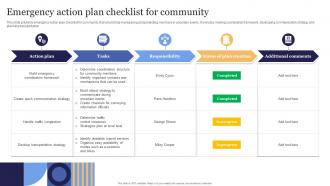
This slide presents emergency action plan checklist for community, that would help in preparing and protecting members in uncertain events. It includes making coordination framework, developing communication strategy and planning transportation.
People who downloaded this PowerPoint presentation also viewed the following :
Emergency Action Plan Checklist For Community with all 6 slides:
Use our Emergency Action Plan Checklist For Community to effectively help you save your valuable time. They are readymade to fit into any presentation structure.





FAQs for Emergency Action Plan
An Emergency Action Plan Checklist should include evacuation procedures, emergency contact information, roles and responsibilities, communication protocols, and resource inventory management. These comprehensive elements streamline crisis response by establishing clear command structures, defining escape routes, and coordinating emergency services, with many organizations finding that structured checklists significantly reduce response time and enhance employee safety during critical incidents.
Organizations can evaluate their Emergency Action Plan effectiveness through regular drills, post-incident reviews, employee feedback surveys, and compliance audits against safety regulations. These assessment methods enable companies to identify response gaps, measure evacuation times, and refine procedures, with many finding that quarterly evaluations significantly enhance workplace safety and regulatory compliance.
Critical roles in an Emergency Action Plan include emergency coordinators, evacuation wardens, first aid responders, communication liaisons, and facility shutdown specialists. These designated personnel streamline emergency response by directing evacuations, providing medical assistance, and coordinating with emergency services, with many organizations finding that clear role assignments significantly reduce response times and enhance overall safety outcomes.
Emergency Action Plans should be reviewed quarterly and updated immediately after any incident, personnel changes, facility modifications, or regulatory updates. Many organizations find that regular quarterly assessments, combined with post-incident evaluations and annual comprehensive reviews, ensure their emergency protocols remain current and effective, ultimately minimizing response times and enhancing workplace safety.
Employee awareness of Emergency Action Plans requires comprehensive training programs, regular drills, visual reminders throughout facilities, digital communications, and clear role assignments for each team member. Many organizations enhance effectiveness by conducting quarterly evacuation exercises, posting emergency procedures in break rooms and hallways, and integrating EAP training into onboarding processes, ultimately ensuring faster response times and improved workplace safety.
Technology enhances emergency communication through mobile alert systems, digital signage displays, automated voice announcements, real-time messaging platforms, and GPS-enabled notifications that reach specific locations instantly. These systems streamline information delivery by bypassing traditional communication bottlenecks, enabling simultaneous multi-channel alerts, and providing real-time updates, ultimately ensuring faster response times and improved safety coordination across organizations.
Essential resources for training staff on Emergency Action Plans include comprehensive training materials, interactive simulations, evacuation route maps, communication systems, and regular drill schedules. These resources enhance preparedness by ensuring clear understanding of procedures, building muscle memory through practice, and establishing effective coordination protocols, with many organizations finding that consistent training significantly reduces response times and improves safety outcomes during actual emergencies.
Organizations should tailor Emergency Action Plans by conducting comprehensive risk assessments, establishing specific response protocols for each threat type, and creating flexible communication systems that adapt to various scenarios. Different emergencies require distinct approaches, with fire evacuations emphasizing speed and designated routes, medical emergencies focusing on rapid response teams, and natural disasters requiring shelter-in-place or evacuation decisions based on severity.
Risk assessment serves as the foundation for developing an Emergency Action Plan Checklist by identifying potential hazards, evaluating their likelihood and impact, and determining appropriate response protocols for each scenario. Through comprehensive risk analysis, organizations can prioritize critical procedures, allocate resources effectively, and establish targeted evacuation routes, ultimately ensuring their emergency checklist addresses the most probable threats while delivering enhanced workplace safety and regulatory compliance.
Businesses can create compliant Emergency Action Plans by conducting thorough hazard assessments, establishing clear evacuation procedures, designating trained emergency coordinators, and implementing regular communication protocols that meet OSHA and local regulatory standards. These comprehensive plans streamline emergency response by defining roles, mapping evacuation routes, and scheduling mandatory drills, with many organizations finding that structured compliance frameworks ultimately deliver enhanced workplace safety and reduced liability exposure.
Common pitfalls include insufficient stakeholder input, outdated contact information, unclear evacuation routes, inadequate training protocols, and lack of regular updates. Organizations often overlook accessibility considerations for disabled employees, fail to designate backup coordinators, or create overly complex procedures that hinder quick decision-making during actual emergencies, ultimately compromising employee safety and operational continuity.
Organizations can incorporate employee feedback through regular safety surveys, post-drill debriefs, anonymous suggestion systems, and cross-departmental review committees that capture frontline insights. This collaborative approach enhances plan effectiveness by identifying overlooked vulnerabilities, improving evacuation routes, and strengthening communication protocols, with many companies finding that employee-driven improvements significantly boost emergency response confidence and compliance.
Organizations should conduct regular drills with realistic scenarios, ensure clear communication protocols, designate trained personnel as drill coordinators, and establish comprehensive evaluation criteria for performance assessment. Following each simulation, teams should document lessons learned, update procedures based on identified gaps, and schedule follow-up training, with many companies finding that quarterly drills significantly enhance response times and employee confidence during actual emergencies.
Emergency action plans for remote and hybrid environments require digital communication protocols, virtual assembly points, home safety assessments, and clear escalation procedures for various emergency types. These adaptations streamline emergency response by establishing remote check-in systems, leveraging collaboration tools for real-time updates, and designating local emergency contacts, with many organizations finding that hybrid emergency protocols ultimately enhance overall workforce safety and operational resilience.
Involving local emergency services in Emergency Action Plan development delivers enhanced response coordination, realistic scenario planning, resource identification, regulatory compliance, and specialized expertise access. Through direct collaboration, organizations streamline communication protocols, reduce response times, and ensure seamless integration with municipal emergency systems, with many businesses finding that this partnership ultimately enhances employee safety and operational continuity.
-
Wonderful ideas and visuals. I'm really pleased with the templates, which are unique and up to date.
-
SlideTeam was so customer-centric and quick service-provider that I doubted the amount I was paying and literally re-checked the transaction.