Employee job competency mapping dashboard

Rating:
95%
Employee job competency mapping dashboard
Slide 1 of 2

or

Favourites Favourites

Try Before you Buy Download Free Sample Product

Audience Impress Your
Audience
Editable 100%
Editable
Time Save Hours
of Time
The Biggest Sale is ending soon in
0
0
:
0
0
:
0
0
Rating:
95%
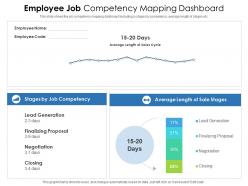
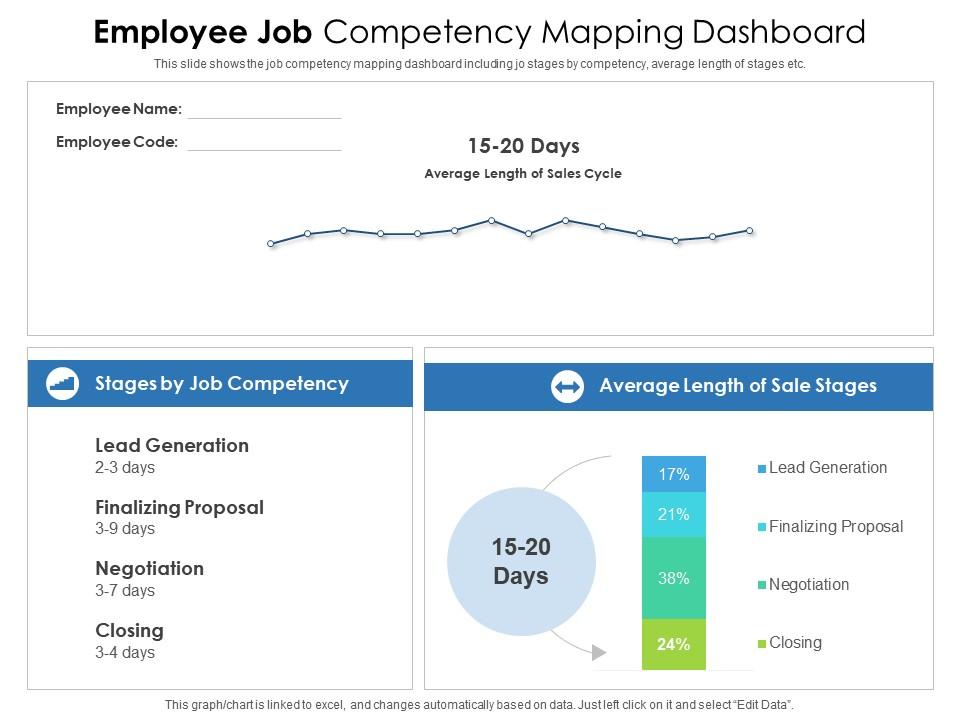
This slide shows the job competency mapping dashboard including jo stages by competency, average length of stages etc. Presenting our well-structured Employee Job Competency Mapping Dashboard. The topics discussed in this slide are Employee Job Competency Mapping Dashboard. This is an instantly available PowerPoint presentation that can be edited conveniently. Download it right away and captivate your audience.
FAQs for Employee job

Effective employee competency mapping frameworks include technical skills assessment, behavioral competency evaluation, performance metrics alignment, career progression pathways, and gap analysis tools. These components work together by identifying current capabilities, benchmarking against role requirements, and creating development roadmaps, with many organizations finding that this strategic approach enhances talent retention and operational efficiency.

Organizations identify core competencies by analyzing industry standards, competitive benchmarks, customer requirements, regulatory frameworks, and emerging market trends. Through stakeholder interviews, job analysis, and performance data review, companies can map critical skills across departments, with sectors like healthcare focusing on clinical expertise and compliance, while technology firms prioritize innovation capabilities, ultimately delivering strategic workforce alignment.

Competency mapping serves as the foundational framework for employee performance appraisal systems by establishing clear, measurable criteria for evaluating skills, behaviors, and knowledge against specific job requirements. This strategic approach enables organizations to conduct objective assessments, identify development gaps, and align individual performance with business objectives, ultimately delivering more accurate evaluations and targeted career development pathways.

Organizations ensure alignment between competencies and business goals by conducting strategic skills gap analyses, mapping current capabilities against future needs, and implementing targeted development programs that directly support strategic objectives. Through competency frameworks, companies can identify critical skill requirements for growth initiatives, align talent development with market demands, and create clear pathways for employee advancement, ultimately delivering enhanced organizational agility and competitive advantage.

Employee competency assessment methods include performance evaluations, 360-degree feedback, behavioral interviews, skills testing, and competency-based assessments. These approaches streamline talent evaluation by combining manager observations, peer insights, and objective measurements, with many organizations finding that strategic combinations deliver enhanced accuracy, better development targeting, and improved workforce planning capabilities.

Competency mapping enhances talent development by identifying specific skill gaps, aligning training with strategic objectives, and creating personalized development pathways for employees. Through targeted assessments and competency frameworks, organizations streamline resource allocation, accelerate skill acquisition, and improve training ROI, with many companies finding that structured competency programs deliver faster promotions and enhanced performance outcomes.

Companies face challenges including defining relevant competencies, ensuring assessment accuracy, managing employee resistance to evaluation, integrating mapping with existing HR systems, and maintaining data consistency across departments. While implementation requires significant time investment and training, organizations increasingly find that addressing these challenges through clear communication, stakeholder involvement, and phased rollouts ultimately delivers improved talent allocation, targeted development programs, and enhanced workforce planning capabilities.

Technology facilitates competency mapping through AI-powered assessment platforms, automated skill gap analysis, data analytics dashboards, mobile evaluation tools, and integrated performance management systems. These technologies streamline the process by eliminating manual paperwork, providing real-time insights, and enabling continuous monitoring, with many organizations finding that automated competency mapping reduces administrative time while delivering more accurate, actionable workforce development strategies.

Employee feedback can be incorporated into competency mapping through 360-degree reviews, self-assessments, peer evaluations, manager observations, and continuous performance dialogues. This multi-source approach enables organizations to create more accurate competency profiles, identify skill gaps with greater precision, and develop targeted training programs, while employees gain clearer career development pathways and enhanced engagement in their professional growth.

Best practices for updating competency profiles include conducting regular performance reviews, gathering 360-degree feedback, tracking skill development progress, aligning with evolving job requirements, and incorporating industry benchmarks. These approaches streamline talent management by ensuring accurate skill assessments, identifying development gaps, and supporting strategic workforce planning, with many organizations finding that quarterly updates enhance employee engagement and optimize resource allocation.

Competency mapping supports succession planning by identifying critical skills gaps, assessing high-potential employees against leadership requirements, and creating targeted development pathways for key roles. Through systematic competency analysis, organizations can strategically prepare internal talent for executive positions, reduce external recruitment costs, and ensure business continuity, with many companies finding this approach accelerates leadership readiness while minimizing succession risks.

Competency mapping enhances employee engagement by clearly defining career paths, identifying skill gaps for targeted development, and aligning individual strengths with organizational goals. Through transparent competency frameworks, employees gain clarity on advancement opportunities and receive personalized training, while managers can provide more meaningful feedback and recognition, ultimately creating a culture of continuous growth and professional fulfillment.

**INPUT**: What metrics can be used to measure the effectiveness of competency mapping initiatives? **OUTPUT**: Effectiveness metrics include skill gap closure rates, employee performance improvements, training ROI, promotion readiness scores, and retention rates across mapped competencies. These measurements enable organizations to track workforce development progress, optimize resource allocation, and demonstrate tangible business outcomes, with many companies finding that comprehensive competency tracking ultimately delivers enhanced productivity and strategic talent management advantages. *[Word count: 58 words]*

Leaders can be trained through structured workshops covering competency identification, assessment techniques, and development planning methodologies, combined with hands-on practice using digital mapping tools and real team scenarios. Through role-playing exercises and mentorship programs, managers learn to conduct effective competency conversations, create targeted development plans, and align individual strengths with organizational objectives, ultimately enhancing team performance and employee engagement.

Cultural diversity significantly enhances competency mapping by bringing varied perspectives, problem-solving approaches, communication styles, and cultural competencies that broaden skill assessments. While creating complexity in evaluation methods, diverse teams ultimately deliver more comprehensive competency frameworks, with organizations finding that multicultural insights reveal hidden talents, improve global market understanding, and strengthen collaborative capabilities across different business environments.

Ratings and Reviews

95% of 100
Review Form
Write a review
Most Relevant Reviews
  1. 100%

    by Jack Johnson

    Great designs, really helpful.
  2. 100%

    by Cliff Jimenez

    Very unique, user-friendly presentation interface.
  3. 100%

    by Connor Lopez

    It saves your time and decrease your efforts in half.
  4. 80%

    by Walsh Turner

    Out of the box and creative design.

4 Item(s)

per page: