

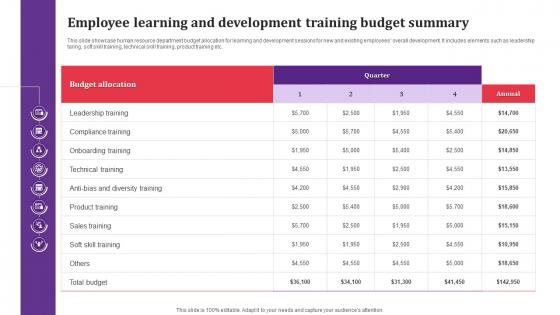
Employee Learning And Development Training Budget Summary




Try Before you Buy Download Free Sample Product
 Impress Your
Audience
 100%
Editable
 Save Hours
of Time


This slide showcase human resource department budget allocation for learning and development sessions for new and existing employees overall development. It includes elements such as leadership taring, soft skill training, technical skill training, product training etc.
People who downloaded this PowerPoint presentation also viewed the following :
Employee Learning And Development Training Budget Summary with all 6 slides:
Use our Employee Learning And Development Training Budget Summary to effectively help you save your valuable time. They are readymade to fit into any presentation structure.






FAQs for Employee Learning And Development
Key components when creating an employee training budget include training materials and resources, instructor fees or external vendor costs, technology platforms and software licenses, venue and logistics expenses, and employee time allocation costs. These elements work together to ensure comprehensive workforce development, with many organizations finding that strategic investment in skills enhancement, leadership development, and compliance training ultimately delivers improved productivity and competitive advantage.
Organizations assess training ROI by measuring performance improvements, productivity gains, employee retention rates, skill acquisition metrics, and revenue impact against program costs. Through pre-and-post training evaluations, many companies track reduced error rates, faster task completion, and decreased turnover expenses, ultimately delivering quantifiable business value and enhanced competitive advantage.
Employee training costs vary significantly based on industry complexity, regulatory requirements, technology infrastructure needs, training delivery methods, and employee skill levels. Industries like healthcare, finance, and manufacturing typically invest more due to compliance demands and technical specialization, while organizations increasingly find that strategic training investments deliver enhanced productivity, reduced turnover, and competitive advantage through improved workforce capabilities.
Businesses can effectively allocate training budgets by conducting skills gap analyses, prioritizing high-impact competencies, diversifying delivery methods between digital and instructor-led formats, and implementing tiered approaches based on role criticality. This strategic combination enables organizations to maximize ROI while addressing individual development needs, with many companies finding that data-driven allocation decisions ultimately deliver enhanced performance and employee satisfaction across departments.
Technology significantly reduces employee training costs by enabling scalable digital learning platforms, eliminating travel expenses, automating content delivery, and providing reusable training modules. Through e-learning systems and virtual reality simulations, organizations streamline training processes while delivering consistent experiences across multiple locations, with many companies finding that technology-driven approaches reduce training expenses by up to 70% annually.
Organizations can prioritize limited training budgets by focusing on skills directly tied to business objectives, conducting thorough needs assessments, and leveraging cost-effective methods like internal mentoring and digital platforms. Many companies find that concentrating resources on high-impact areas like leadership development and technical certifications delivers measurable ROI, ultimately enhancing productivity and employee retention.
Methods include performance metrics analysis, ROI calculations, skill assessments, employee feedback surveys, and productivity measurements before and after training. Organizations track these through learning management systems, performance dashboards, and competency evaluations, with many companies finding that combining quantitative data with qualitative insights delivers clearer visibility into training impact and enables more strategic resource allocation decisions.
External training providers impact employee training budgets by offering specialized expertise, scalable programs, and cost-effective alternatives to in-house development. While they require upfront investment, many organizations find that external providers deliver higher-quality training, reduce internal resource strain, and provide access to cutting-edge methodologies, ultimately enhancing workforce capabilities and competitive advantage.
In-house training offers lower per-employee costs, customized content alignment, and retained institutional knowledge, while outsourced training provides specialized expertise, reduced administrative burden, and access to latest methodologies. Many organizations find that a strategic combination delivers optimal results, with in-house programs handling core competencies and external providers addressing specialized skills, ultimately balancing budget constraints with comprehensive development needs.
Companies can incorporate employee feedback through surveys, focus groups, performance reviews, and training evaluations to identify skill gaps and learning preferences. This strategic approach enables organizations to allocate resources more effectively, prioritize high-impact programs, and enhance engagement, with many finding that employee-driven training initiatives deliver better retention rates and improved performance outcomes.
Emerging training trends include AI-powered personalized learning platforms, virtual reality simulations, microlearning modules, continuous upskilling programs, and remote collaboration tools. These technologies streamline training delivery, reduce travel costs, and enhance engagement across diverse workforces, with many organizations finding that strategic investment in adaptive learning ultimately delivers faster skill development and improved employee retention.
Organizations can leverage government grants by researching federal, state, and local workforce development programs, tax credits for skills training, and sector-specific incentives targeting emerging technologies or underserved populations. These funding mechanisms help reduce training costs while enhancing employee capabilities, with many companies in manufacturing, healthcare, and technology finding that grant-funded programs deliver improved retention, productivity, and competitive advantage.
Regulatory compliance significantly increases employee training budgets through mandatory certification programs, specialized skill development, ongoing education requirements, and documentation systems. Organizations across sectors like healthcare, finance, and manufacturing find that while compliance training represents substantial investment, it ultimately delivers risk mitigation, operational efficiency, and competitive advantage through enhanced workforce capabilities.
Small businesses can balance quality training with limited budgets by leveraging free online resources, implementing peer-to-peer mentoring programs, partnering with local educational institutions, and utilizing government-funded training initiatives. These strategic approaches enable cost-effective skill development while maximizing resource allocation, with many small organizations finding that creative combinations of internal expertise and external partnerships deliver comprehensive training outcomes without compromising quality.
Organizations can foster continuous learning through mentorship programs, cross-departmental knowledge sharing, leveraging free online resources, implementing peer-to-peer training sessions, and creating internal learning communities. These cost-effective approaches enable companies to enhance skill development while minimizing expenses, with many finding that employee-led initiatives and strategic partnerships with educational platforms deliver significant professional growth and improved retention rates.
-
Innovative and creative templates with high-quality designs. Helped me with my presentation as the slides were easy to edit.
-
SlideTeam is a great place for PPT templates. They have many templates on a single topic. It has made my life a lot easier.