

Employee Recognition And Appreciation Dashboard Employee Engagement Action Plan




Try Before you Buy Download Free Sample Product
 Impress Your
 Audience
 100%
100% Editable
 Save Hours
 of Time


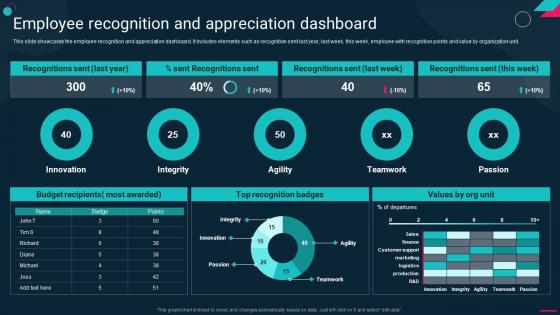
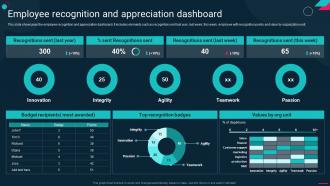
This slide showcases the employee recognition and appreciation dashboard. It includes elements such as recognition sent last year, last week, this week, employee with recognition points and value by organization unit.
People who downloaded this PowerPoint presentation also viewed the following :
Employee Recognition And Appreciation Dashboard Employee Engagement Action Plan with all 7 slides:
Use our Employee Recognition And Appreciation Dashboard Employee Engagement Action Plan to effectively help you save your valuable time. They are readymade to fit into any presentation structure.





FAQs for Employee Recognition And Appreciation Dashboard Employee
Key drivers of employee engagement include meaningful work, clear communication, growth opportunities, recognition programs, and flexible work arrangements. These elements enhance workplace satisfaction by fostering purpose, building trust, enabling career advancement, and supporting work-life balance, with many organizations finding that engaged employees deliver higher productivity, reduced turnover, and improved customer experiences.
Leadership influences employee engagement by establishing clear vision, providing regular feedback, recognizing achievements, fostering open communication, and investing in professional development. Through transparent decision-making and authentic relationships, leaders create environments where employees feel valued and motivated, with many organizations finding that engaged leadership directly correlates with improved retention, productivity, and overall workplace satisfaction.
Company culture significantly influences employee engagement by establishing shared values, communication practices, recognition systems, and workplace environment standards that directly impact job satisfaction and commitment. A positive culture fosters trust, collaboration, and purpose-driven work, with organizations like Google and Salesforce demonstrating how strong cultural foundations enhance retention, productivity, and overall employee experience, ultimately delivering competitive advantage through higher workforce engagement levels.
Organizations can implement pulse surveys, stay interviews, 360-degree feedback systems, employee Net Promoter Scores, and engagement analytics platforms to measure employee engagement effectively. These strategies streamline assessment by capturing real-time sentiment, identifying retention risks, and tracking behavioral patterns, with many companies finding that regular measurement ultimately delivers improved productivity, reduced turnover, and enhanced workplace satisfaction.
Employee engagement significantly impacts company performance by increasing productivity, reducing turnover, improving customer satisfaction, and driving innovation across all business functions. Engaged employees deliver 23% higher profitability and 18% higher productivity, with companies like Google and Microsoft finding that strategic engagement initiatives streamline operations, enhance collaboration, and ultimately create sustainable competitive advantages in increasingly talent-driven markets.
Common barriers to employee engagement include lack of recognition, limited growth opportunities, poor communication, insufficient work-life balance, and unclear role expectations. Organizations overcome these challenges by implementing regular feedback systems, creating structured career development paths, fostering transparent communication channels, and offering flexible work arrangements, with many companies finding that addressing these barriers simultaneously delivers higher retention rates, improved productivity, and enhanced workplace satisfaction.
Technology boosts employee engagement through digital recognition platforms, mobile feedback apps, collaboration tools, virtual learning systems, and AI-powered pulse surveys. These solutions streamline communication, enhance professional development opportunities, and enable real-time performance tracking, with many organizations finding that integrated tech approaches deliver higher retention rates, improved productivity, and stronger workplace culture.
Best practices for fostering open communication include regular one-on-one meetings, transparent feedback systems, open-door policies, team collaboration platforms, and anonymous suggestion channels. These approaches enhance engagement by building trust, encouraging idea sharing, and creating psychological safety, with many organizations finding that employees feel more valued and connected, ultimately delivering higher productivity and reduced turnover rates.
Employee recognition contributes to higher engagement levels by fostering emotional connection, reinforcing desired behaviors, and demonstrating organizational appreciation for individual contributions. When companies implement structured recognition programs, employees experience increased motivation, stronger workplace relationships, and enhanced job satisfaction, with many organizations finding that regular acknowledgment ultimately drives productivity, reduces turnover, and creates competitive advantage through improved team performance.
Professional development serves as a cornerstone of employee engagement by providing growth opportunities, skill enhancement, career advancement pathways, and increased job satisfaction. Through strategic training programs, mentorship initiatives, and educational support, organizations across industries like healthcare, technology, and financial services enhance retention rates, boost productivity, and cultivate loyalty, ultimately delivering competitive advantage in talent retention.
Remote work presents both challenges and opportunities for employee engagement, potentially reducing face-to-face collaboration and spontaneous interactions while enabling greater flexibility and work-life balance. Organizations enhance remote engagement through regular virtual check-ins, digital collaboration platforms, structured feedback systems, and virtual team-building activities, with many companies finding that intentional communication strategies and flexible scheduling ultimately deliver higher satisfaction and retention rates.
Generational engagement strategies differ significantly across Baby Boomers, Generation X, Millennials, and Generation Z, with each cohort responding to distinct motivational factors, communication preferences, and career development approaches. While Boomers value recognition and stability, younger generations prioritize flexibility and purpose-driven work, with many organizations finding that tailored engagement programs combining traditional mentorship with digital collaboration tools ultimately deliver higher retention and productivity across all age groups.
Feedback from employee engagement surveys can be effectively utilized by analyzing data for patterns, prioritizing high-impact areas, creating targeted action plans, and communicating changes transparently to staff. Organizations enhance engagement by implementing specific improvements like flexible work arrangements, enhanced recognition programs, and improved manager training, with many companies finding that consistent follow-through and regular progress updates significantly boost morale and retention.
Work-life balance significantly enhances employee engagement and retention by reducing burnout, increasing job satisfaction, and fostering loyalty through flexible scheduling, remote work options, and mental health support. Organizations prioritizing balance, particularly in demanding sectors like consulting and healthcare, experience lower turnover rates, higher productivity, and stronger talent attraction, ultimately delivering competitive advantage and reduced recruitment costs.
Teams can be encouraged to collaborate effectively through shared project goals, cross-functional workshops, regular team-building activities, open communication channels, and collaborative technology platforms. These approaches streamline workflow coordination, enhance interpersonal relationships, and create accountability structures, with many organizations finding that strategic collaboration initiatives ultimately deliver higher employee satisfaction, improved project outcomes, and stronger workplace culture.
-
A fantastic collection of templates. I'll likely use this as my go-to resource for future templates and support.
-
Fantastic collection. Loved how we can personalize these templates as per the requirements.