

Employee Skills And Capability Assessment Matrix Building And Maintaining Effective Team




Try Before you Buy Download Free Sample Product
 Impress Your
 Audience
 100%
100% Editable
 Save Hours
 of Time


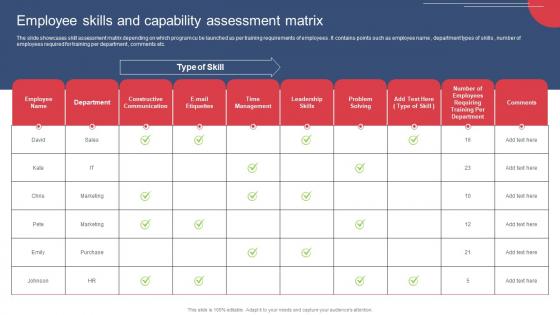
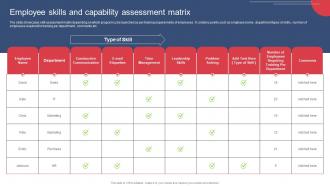
The slide showcases skill assessment matrix depending on which program cu be launched as per training requirements of employees. It contains points such as employee name, department types of skills, number of employees required for training per department, comments etc.
People who downloaded this PowerPoint presentation also viewed the following :
Employee Skills And Capability Assessment Matrix Building And Maintaining Effective Team with all 6 slides:
Use our Employee Skills And Capability Assessment Matrix Building And Maintaining Effective Team to effectively help you save your valuable time. They are readymade to fit into any presentation structure.





FAQs for Employee Skills And Capability Assessment Matrix Building And
Honestly, I'd focus on the obvious stuff first - technical skills for their specific job, plus how well they communicate (speaking and writing). Problem-solving is huge too. Adaptability matters more than people think, especially these days when everything changes constantly. Even if someone's not managing people yet, I always look for leadership potential - you want to catch future stars early. Oh, and don't sleep on the basics like teamwork and time management. Those soft skills can make or break someone's daily performance. Just match your evaluation to what each role actually needs, then think about where you want them headed next.
You'll need different tactics for each type. Technical stuff is easier - just give them actual tasks to do. Coding challenges, simulations, whatever matches the role. Way better than asking theoretical questions that anyone can memorize. Soft skills though? That's where it gets interesting. Behavioral interviews help, but I'd also throw in some group activities where you can watch how they actually interact. Peer feedback is gold too if you can swing it. Honestly, don't rely on just one method - mix a few together. Oh, and definitely create some kind of scoring system beforehand so you're not all over the place with different candidates.
Honestly, the main thing is catching skill gaps early so they don't bite you later. You can actually tailor training to what people need instead of generic stuff nobody cares about. Makes promotion decisions way less stressful when you've got real data instead of just winging it. Oh, and matching people to projects they're good at? Game changer for everyone's sanity. Employees love seeing their progress mapped out too - keeps them from getting restless. You'll spot your star players before they start updating their LinkedIn profiles. Quarterly check-ins work better than those dreaded annual reviews, trust me.
Look, skills assessments are basically your cheat sheet for figuring out where people can actually go in their careers. You map what they're good at now against what they'll need later - that's honestly where everything clicks. Way more useful than those boring training sessions everyone forgets about anyway. Have real conversations about their career path using these results, then give them mentoring or challenging projects to bridge those gaps. I've seen this work so much better than generic development programs. Start with current skills versus future role needs and you'll see what I mean.
Honestly? Just watch people actually do the work instead of giving them some boring written test. I've seen way too many people who look great on paper but can't handle the real stuff. For soft skills, get feedback from their teammates and coworkers - that 360 thing really works. Technical skills need actual problem-solving, like the messy situations your team deals with every day. Self-assessments are fine but don't rely on them alone. Oh, and figure out what skills actually matter for each role first. Then pick maybe 2-3 ways to test those specific things. Mix observation with simulations and you're golden.
Try learning management systems or skill mapping software - they'll automatically track progress and spot gaps without you chasing people down for responses. Honestly, that alone saves so much headache. Pick something that plays nice with your current HR setup though, otherwise you're just making more work for yourself. Oh, and definitely test it with a small group first. I learned that the hard way with other tools - what looks perfect on paper doesn't always work in real life. Start small, see what actually sticks.
Dude, feedback is literally everything when it comes to skills assessments. Without it, you're just making people take a test and then... nothing. That's pointless. Good feedback turns the whole thing into something that actually helps them grow - like showing exactly what they need to work on and giving them a clear next step. I swear, half the companies I know totally skip this part and wonder why their assessments don't do anything. When you connect the feedback to real training or development stuff, people can tell you're not just going through the motions. They see you actually want them to get better.
So here's the thing - skills assessments show you exactly where your people are versus where they need to be. You'll spot who's missing key stuff and who's ready for the next level. Way better than just throwing training budgets around randomly (guilty as charged lol). Map out what skills each role actually needs first. Then compare that to your assessment data. Short sentences work here: prioritize the big gaps. Don't overwhelm everyone with courses they don't need. Honestly, it's like finally having GPS instead of wandering around lost with your L&D strategy.
Check completion rates first - if people aren't finishing, your assessments are probably too long or confusing. Then track whether those skill gaps you identified are actually shrinking through training. Here's what really matters though: job performance 3-6 months later. Are people genuinely better at the stuff where you found gaps? Don't forget employee satisfaction with the whole process either - nobody likes feeling tested constantly. Those four things will tell you if it's working. Oh, and honestly? The performance improvement piece is way more telling than completion rates.
Okay so first thing - standardize everything. Same questions, same scoring, same process for everyone. Don't just wing the interviews (guilty of this myself honestly). Train your team on unconscious bias and make sure they're diverse. When you can, remove names and other identifying info so people focus on actual skills instead of making assumptions. Short sentences work. But you also want to check your results regularly - if certain groups keep scoring lower, something's probably wrong with your process. Oh and definitely review your current questions with fresh eyes. Half the time these assessments don't even predict if someone will actually be good at the job.
Honestly, the worst thing you can do is jump in without knowing what you're actually trying to figure out first. You'll just collect a bunch of useless data. Don't go overboard either - nobody wants to sit through like 20 different personality tests, trust me. Pick stuff that actually relates to the job. Also, tell people WHY you're doing this upfront or they'll think you're building a case to fire them. Which... kills the whole point since they won't be honest. Oh, and don't treat it like some one-and-done thing. Start small and make sure it connects to real work stuff, not just abstract traits.
Honestly, most companies screw this up by testing random stuff that doesn't matter. First thing - figure out what skills actually connect to your business goals. Expanding internationally? Test language abilities and cultural awareness. Going digital? Focus on tech skills, obviously. I'd pick maybe 3-5 critical skills max and build everything around those. Don't waste time on "nice to have" capabilities that won't move your performance metrics. It's tempting to test everything, but you'll just end up with data overload and no clear direction.
Honestly, skills assessments can be amazing for engagement if you do them right. Frame it as development, not criticism - that's huge. People actually love when you invest in their growth and help them spot opportunities to level up. But here's where it gets tricky - I've watched managers totally botch this by using results mainly for performance reviews without offering any real next steps. Pretty demotivating, right? Your move is connecting assessments to actual support: training money, mentoring, advancement paths. Makes people feel supported instead of judged.
Honestly, just go digital and stop trying to recreate office vibes online - it's awkward and doesn't work. Video calls are great for behavioral stuff, and you can use collaborative tools for team assessments. Give people real tasks that actually match what they'd do remotely. Focus on results instead of watching how they work (since you can't anyway). I'd set clear deadlines and tell them exactly what success looks like upfront. Then let them figure out how to show their skills. Way more realistic than those weird virtual office simulations some companies try.
Be super upfront about why you're doing this—it's about finding growth opportunities, not catching people slacking off. I've watched this blow up when managers weren't clear! Tell them you'll use the results to build personalized development plans and get them on cooler projects. Honestly, sharing success stories from other teams helps a ton. Let employees pick which skills they want to work on too. Makes them feel like partners instead of lab rats being studied. The whole thing works way better when people see it as an investment in their future rather than some weird evaluation exercise.
-
“Detailed and great to save your time.”
-
Every time I ask for something out-of-the-box from them and they never fail in delivering that. No words for their excellence!