

Employee Upskilling Training Program Introducing A Risk Based Approach To Cyber Security




Try Before you Buy Download Free Sample Product
 Impress Your
 Audience
 100%
100% Editable
 Save Hours
 of Time


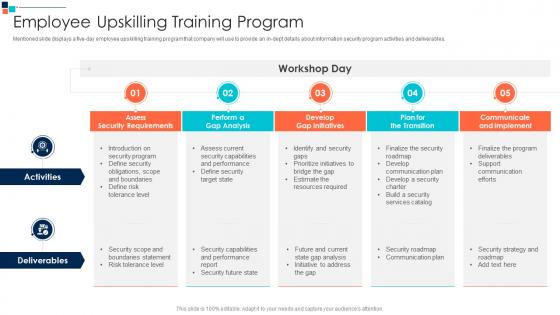
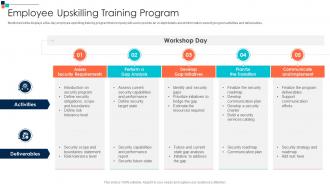
Mentioned slide displays a five day employee upskilling training program that company will use to provide an in dept details about information security program activities and deliverables.
People who downloaded this PowerPoint presentation also viewed the following :
Employee Upskilling Training Program Introducing A Risk Based Approach To Cyber Security with all 6 slides:
Use our Employee Upskilling Training Program Introducing A Risk Based Approach To Cyber Security to effectively help you save your valuable time. They are readymade to fit into any presentation structure.





FAQs for Employee Upskilling Training Program Introducing A Risk Based Approach
Essential cybersecurity skills include threat detection and incident response, risk assessment and vulnerability management, network security protocols, cloud security architecture, and regulatory compliance frameworks. These competencies enable professionals to safeguard organizational assets through proactive monitoring, strategic defense implementation, and rapid threat mitigation, with many enterprises finding that skilled practitioners deliver enhanced security postures and competitive advantages.
Organizations identify cybersecurity skill gaps through comprehensive assessments including technical evaluations, certification audits, threat simulation exercises, and performance reviews against current security frameworks. Many companies combine skills matrices with hands-on penetration testing scenarios, ultimately revealing specific deficiencies in areas like incident response and cloud security, enabling targeted training investments and strategic hiring decisions.
Online courses and certifications provide structured learning paths, hands-on labs, industry-recognized credentials, flexible scheduling, and access to expert instruction for cybersecurity upskilling. These educational resources enable professionals to master emerging threats, compliance frameworks, and security technologies while maintaining current roles, with many organizations finding that certified employees deliver enhanced incident response, stronger risk management, and ultimately improved organizational security posture.
Mentorship programs enhance cybersecurity skills by providing hands-on guidance, real-world threat analysis experience, and personalized career development pathways for emerging professionals. Through structured pairing with experienced practitioners, new cybersecurity specialists gain practical incident response knowledge, threat detection expertise, and industry networking opportunities, ultimately accelerating their professional readiness and organizational security capabilities.
Emerging cybersecurity trends include AI-powered threat detection, zero-trust architecture, cloud security frameworks, quantum-resistant encryption, and DevSecOps integration. These technologies streamline threat response, enhance data protection, and automate vulnerability management, with many organizations finding that professionals skilled in these areas deliver faster incident resolution and significantly improved security postures.
Businesses can foster continuous cybersecurity learning through regular training programs, mentorship initiatives, knowledge-sharing sessions, cross-functional collaboration, and incentivized certification pursuits. These approaches enhance team capabilities by encouraging peer learning, providing structured development paths, and creating environments where security professionals stay current with emerging threats, ultimately delivering stronger organizational resilience and competitive advantage in an increasingly complex digital landscape.
Cybersecurity professionals should upskill in cloud security platforms, AI-powered threat detection, zero-trust architecture, container security tools, and automated incident response systems. These technologies enhance organizational defenses by streamlining threat identification, minimizing response times, and securing hybrid environments, with many enterprises finding that professionals skilled in these areas deliver significantly faster threat mitigation and improved security postures.
Hands-on experience is crucial for cybersecurity upskilling, as it bridges the gap between theoretical knowledge and real-world application through simulated attacks, incident response scenarios, and vulnerability assessments. This practical approach enables professionals to develop critical thinking skills, improve response times during actual security breaches, and build confidence in high-pressure situations, ultimately delivering more effective threat detection and organizational protection.
Gamification enhances cybersecurity training through interactive simulations, point-based learning systems, competitive leaderboards, scenario-based challenges, and real-time feedback mechanisms. These approaches transform traditional security education by increasing engagement, improving knowledge retention, and enabling hands-on practice with threats, ultimately delivering more effective workforce preparedness and stronger organizational security postures.
Top cybersecurity certifications include CISSP, CISM, CEH, CompTIA Security+, and CISA, each targeting different specialization areas from management to technical implementation. These credentials enhance career advancement by validating expertise, increasing salary potential, and opening leadership opportunities, with many organizations in banking, healthcare, and government requiring specific certifications for senior cybersecurity roles.
Cross-disciplinary knowledge significantly enhances cybersecurity professionals' effectiveness by enabling deeper threat detection, automated security responses, and comprehensive cloud infrastructure protection. Understanding AI allows professionals to leverage machine learning for predictive threat analysis and incident response, while cloud computing expertise enables seamless security architecture across hybrid environments, ultimately delivering faster threat mitigation and strategic competitive advantage in an increasingly complex digital landscape.
Best practices include conducting skills gap assessments, developing role-based learning paths, incorporating hands-on labs and simulations, establishing mentorship programs, and providing continuous certification support. These approaches enhance team capabilities by combining theoretical knowledge with practical experience, real-world scenario training, and peer learning, ultimately delivering stronger defense capabilities and improved incident response across organizations.
Simulated cyber attack exercises enhance skills by providing hands-on experience with real-world threat scenarios, improving incident response times, strengthening team coordination, and developing critical thinking under pressure. These controlled environments enable cybersecurity professionals to practice advanced threat detection, refine defense strategies, and build confidence in high-stakes situations, ultimately delivering stronger organizational resilience and faster threat mitigation capabilities.
Cybersecurity upskilling challenges include rapidly evolving threat landscapes, complex technical requirements, high certification costs, limited hands-on practice opportunities, and finding time alongside current responsibilities. While these obstacles can seem daunting, many professionals find that structured learning paths, employer-sponsored training programs, and practical lab environments help bridge knowledge gaps, ultimately delivering enhanced career prospects and organizational security capabilities.
Diversity in cybersecurity enhances problem-solving by bringing varied perspectives, cultural insights, different educational backgrounds, and unique analytical approaches that identify vulnerabilities others might miss. Teams with diverse gender, ethnic, and experiential representation consistently develop more innovative threat detection methods, create comprehensive security strategies, and deliver more effective solutions, ultimately strengthening organizational resilience against increasingly sophisticated cyber threats.
-
Easy to use and customize templates. Helped me give a last minute presentation.
-
You guys are life-saver when it comes to presentations. Honestly I cannot do much without your services. Thank you!!!