


Employee Value Proposition Framework Powerpoint Presentation Slides




Try Before you Buy Download Free Sample Product
 Impress Your
 Audience
 100%
100% Editable
 Save Hours
 of Time


Identify staff efficiency and effectiveness by using the Employee Value Proposition Framework PowerPoint Presentation Slides. You can monitor the performance level of your subordinates with the aid of employee progression presentation templates. Use employee talent development PPT deck to build a good team that helps to maximize the productivity of the business. With the help of the employee value proposition PowerPoint graphic, you can encourage the work of your teammates and provide them with different benefits. Take the assistance of human resource management PPT slideshow to explain how to create a well-organized working environment within the organization. In this professionally designed employee relationship management PPT theme, you can appreciate the different skills of your staff. With the use of high-grade icons present in this deck, you can make your presentation visually appealing. You can provide useful training sessions for your employees and develop more career paths for them by downloading our ready-to-use talent management PowerPoint layout.
People who downloaded this PowerPoint presentation also viewed the following :
Content of this Powerpoint Presentation
Slide 1: This slide introduces Employee Value Proposition Framework. State Your Company Name and begin.
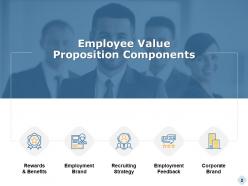
Slide 2: This slide shows Employee Value Proposition Components as- Rewards & Benefits, Employment Brand, Recruiting Strategy, Corporate Brand, Employment Feedback.
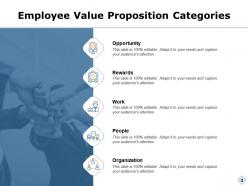
Slide 3: This slide presents Employee Value Proposition Categories as- Opportunity, Rewards, Work, People, Organization.
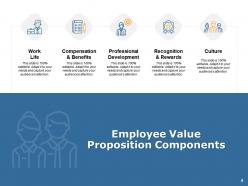
Slide 4: This slide displays Employee Value Proposition Components describing- Work Life, Compensation & Benefits, Professional Development, Recognition & Rewards, Culture.
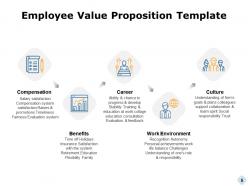
Slide 5: This slide represents Employee Value Proposition Template with categories as- Compensation, Benefits, Career, Work Environment, Culture.
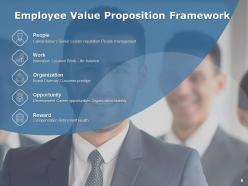
Slide 6: This slide showcases Employee Value Proposition Framework describing- People, Work, Opportunity, Reward, Organization.
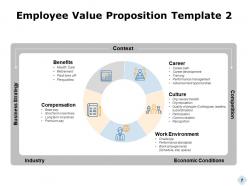
Slide 7: This slide shows Employee Value Proposition Template 2 describing- Career, Culture, Work Environment, Compensation, Benefits.
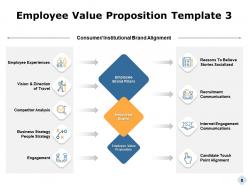
Slide 8: This is another template for Employee Value Proposition.
Slide 9: This slide displays Employee Value Proposition Framework Icons.
Slide 10: This slide reminds about 10 minutes coffee break.
Slide 11: This slide is titled as additional slide for moving forward.
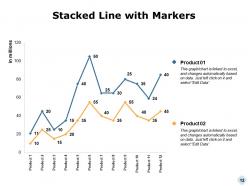
Slide 12: This slide shows Stacked Line with Markers.
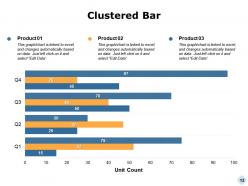
Slide 13: This slide presents Clustered Bar chart with three products comparison.
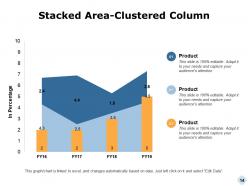
Slide 14: This slide displays Stacked Area-Clustered Column chart with three products comparison.
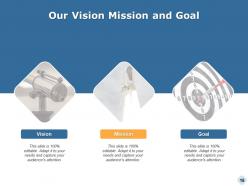
Slide 15: This is Our Vision Mission and Goal slide with related imagery and text.
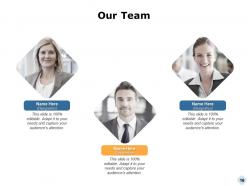
Slide 16: This is Our Team slide with names and designation.
Slide 17: This is a Comparison slide to state comparison between commodities, entities etc.
Slide 18: This is a Puzzle slide with text boxes to show information.
Slide 19: This is a Thank You slide with address, contact numbers and email address.
Employee Value Proposition Framework Powerpoint Presentation Slides with all 19 slides:
Use our Employee Value Proposition Framework Powerpoint Presentation Slides to effectively help you save your valuable time. They are readymade to fit into any presentation structure.

FAQs for Employee Value Proposition Framework
Effective Employee Value Propositions include competitive compensation, comprehensive benefits, career development opportunities, positive workplace culture, and meaningful work purpose. These components work together by addressing both tangible and intangible employee needs, with many organizations finding that strategic combination of growth opportunities, recognition programs, and flexible work arrangements ultimately delivers higher retention rates and stronger talent acquisition.
Companies identify their unique EVP by conducting employee surveys, analyzing competitor offerings, assessing organizational culture and benefits, and gathering feedback from recent hires and departures. Through strategic workforce analysis, organizations can articulate distinctive value propositions that highlight career development opportunities, work-life balance initiatives, and compensation packages, ultimately delivering competitive recruitment advantages and enhanced employee retention rates.
A strong EVP significantly enhances employee retention by creating emotional connection, demonstrating career growth opportunities, offering competitive compensation, and fostering positive workplace culture. Organizations with well-defined EVPs experience reduced turnover costs, improved employee engagement, and enhanced talent attraction, with many companies finding that strategic EVP implementation delivers measurable improvements in satisfaction scores and long-term workforce stability.
Organizations measure EVP effectiveness through employee engagement surveys, retention rates, recruitment metrics, employer brand scores, and internal mobility tracking. These measurement approaches enable companies to assess talent attraction improvements, cultural alignment strength, and workforce satisfaction levels, with many finding that regular EVP assessments ultimately deliver enhanced competitive positioning and reduced turnover costs.
Company culture serves as the foundation of a compelling Employee Value Proposition by defining the work environment, values, and experiences that attract and retain talent. A strong, authentic culture enhances EVP by creating differentiation in competitive markets, fostering employee engagement through shared purpose, and delivering meaningful workplace experiences, with many organizations finding that cultural alignment significantly improves retention rates and overall performance.
Businesses align their EVP with brand identity by ensuring consistent messaging across recruitment materials, employee communications, and external branding, while reflecting core company values and culture authentically. This strategic alignment involves integrating brand promises with employee experiences, from onboarding through career development, ultimately creating cohesive storytelling that resonates with both customers and talent in competitive markets.
Common EVP pitfalls include creating generic messaging, overpromising benefits, ignoring employee feedback, copying competitor strategies, and failing to align with company culture. Organizations often struggle by developing EVPs in isolation from actual employee experiences, with many HR teams finding that authentic, research-backed propositions significantly outperform assumptions-based approaches in attracting talent.
Organizations tailor their EVP by offering flexible benefits packages, diverse career pathways, inclusive leadership development programs, remote work options, and culturally responsive wellness initiatives. Through personalized engagement strategies, companies address generational preferences, cultural backgrounds, and individual career aspirations, with many finding that customized value propositions significantly enhance recruitment success and employee retention across all demographics.
Leaders can communicate their EVP through targeted recruitment marketing, authentic employee testimonials, comprehensive career websites, strategic social media presence, and transparent interview processes. Through platforms like LinkedIn and company blogs, organizations showcase real workplace experiences, growth opportunities, and cultural values, while many successful companies find that combining digital storytelling with genuine employee voices ultimately delivers stronger candidate engagement and attraction.
Employee feedback can be integrated into EVP development through surveys, focus groups, exit interviews, stay interviews, and one-on-one conversations with managers. These engagement methods enable organizations to identify what employees truly value, understand retention drivers, and align EVP messaging with actual workplace experiences, ultimately creating more authentic value propositions that resonate across departments and improve talent acquisition outcomes.
EVP serves as the strategic foundation for employer branding, defining the unique value employees receive while employer branding communicates this promise through marketing channels, recruitment campaigns, and candidate touchpoints. Together, they create a compelling narrative that attracts top talent, with organizations finding that aligned EVP-branding strategies significantly reduce hiring costs, improve candidate quality, and accelerate offer acceptance rates in competitive talent markets.
Remote companies create strong EVPs by emphasizing flexibility, work-life balance, professional development opportunities, competitive compensation, and inclusive digital culture. Through virtual team-building initiatives, comprehensive onboarding programs, and transparent communication platforms, these organizations deliver enhanced employee autonomy, reduced commuting costs, and global collaboration opportunities, ultimately attracting top talent in an increasingly distributed workforce landscape.
Strategies include flexible work arrangements, comprehensive wellbeing programs, continuous learning opportunities, transparent communication, and purpose-driven mission alignment. These approaches enhance employee satisfaction by addressing work-life balance, mental health support, and career development, with many organizations finding that hybrid models, upskilling initiatives, and values-based leadership ultimately deliver stronger retention and competitive talent acquisition.
Employee Value Propositions evolve through organizational growth, market shifts, generational changes, and competitive pressures, requiring regular assessment to maintain relevance and attraction power. Companies should reevaluate their EVP during mergers, leadership transitions, talent shortages, or when employee feedback indicates misalignment, with many organizations finding that annual reviews ensure their value proposition remains compelling and competitive.
Organizations can ensure EVP resonance by conducting regular employee surveys, aligning values with authentic workplace culture, personalizing benefits to diverse workforce needs, and maintaining transparent communication about career development opportunities. Through consistent feedback loops and data-driven adjustments, companies across sectors like technology and healthcare find that tailored EVPs significantly enhance retention rates, employee engagement, and ultimately deliver stronger competitive advantage in talent acquisition.
-
The Designed Graphic are very professional and classic.
-
Appreciate the research and its presentable format.
-
Editable templates with innovative design and color combination.
-
Best Representation of topics, really appreciable.
-
Graphics are very appealing to eyes.