

Employees Sales Performance Comparison Pie Chart





Try Before you Buy Download Free Sample Product
 Impress Your
Audience
 100%
Editable
 Save Hours
of Time


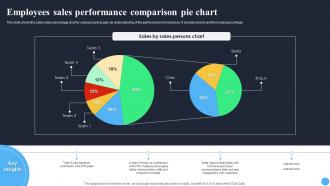
This slide shows the sales share percentage chart by salespersons to gain an understanding of the performance of employees. It includes teams and their sales percentage.
People who downloaded this PowerPoint presentation also viewed the following :
Employees Sales Performance Comparison Pie Chart with all 7 slides:
Use our Employees Sales Performance Comparison Pie Chart to effectively help you save your valuable time. They are readymade to fit into any presentation structure.






FAQs for Employees Sales Performance
Key sales metrics include conversion rates, average deal size, sales cycle length, customer acquisition cost, and revenue per representative. These metrics enable organizations to identify bottlenecks, optimize resource allocation, and enhance team productivity, with many companies finding that tracking these indicators ultimately delivers improved forecasting accuracy and sustainable revenue growth.
Sales training programs can be tailored through personalized skill assessments, role-specific modules, interactive simulations, and performance-based learning paths that address individual strengths and weaknesses. These targeted approaches enhance team performance by improving closing techniques, customer relationship management, and product knowledge, with many organizations finding that customized training delivers higher conversion rates and increased revenue growth.
Technology enhances sales performance metrics by automating data collection, providing real-time analytics, and enabling predictive forecasting capabilities. Through CRM systems and AI-powered tools, sales teams streamline lead management, track conversion rates more accurately, and identify performance gaps faster, with many organizations finding that automated reporting delivers deeper insights and ultimately improves closing rates significantly.
Data analytics leverages historical sales data, customer behavior patterns, market trends, and predictive modeling to forecast future performance and identify growth opportunities. Through machine learning algorithms and real-time dashboards, businesses can optimize pricing strategies, enhance customer targeting, and streamline resource allocation, ultimately delivering improved conversion rates and competitive advantage.
Team collaboration significantly impacts sales success by improving lead qualification, accelerating deal closure, enhancing customer relationship management, and optimizing resource allocation across opportunities. Through shared insights and coordinated strategies, sales teams deliver more personalized customer experiences, reduce response times, and ultimately achieve higher conversion rates, with many organizations finding that collaborative approaches increase revenue by 15-25%.
Customer feedback and satisfaction significantly influence sales performance analysis by providing insights into customer retention rates, purchase patterns, and revenue predictability across different market segments. These metrics enable sales teams to identify high-value customer characteristics, refine targeting strategies, and predict future sales outcomes, with many organizations finding that satisfied customers generate 2.6 times more revenue than dissatisfied ones, ultimately delivering improved forecasting accuracy and sustainable growth trajectories.
Effective sales team motivation strategies include performance-based incentives, clear goal setting, regular coaching and feedback, recognition programs, and career development opportunities. These approaches enhance team morale by providing financial rewards, professional growth pathways, and achievement recognition, with many organizations finding that combining monetary incentives with skill development ultimately delivers improved performance and higher target attainment.
Sales performance in remote environments can be assessed through digital analytics, CRM tracking, video call monitoring, virtual pipeline reviews, and outcome-based metrics rather than activity observation. These methods enable managers to evaluate conversion rates, deal progression, and customer engagement remotely, with many organizations finding that data-driven assessments actually provide more comprehensive insights than traditional in-person evaluations.
Sales performance review best practices include setting clear metrics beforehand, using data-driven assessments, providing specific feedback examples, creating actionable improvement plans, and conducting regular check-ins beyond annual reviews. These approaches enhance accountability, motivation, and skill development by combining quantitative results with qualitative coaching, ultimately delivering improved sales outcomes and stronger team performance across organizations.
Market competition significantly impacts sales performance by driving innovation in sales strategies, accelerating customer acquisition efforts, and intensifying focus on value proposition differentiation. While competitive pressure can initially challenge teams, it ultimately enhances performance through improved sales processes, stronger customer relationships, and strategic territory management, with many organizations finding that competitive environments foster higher achievement levels and revenue growth.
High-quality leads significantly improve sales conversion rates by targeting prospects with genuine interest, proper budget allocation, and decision-making authority, often increasing conversions by 20-50% compared to unqualified leads. Through strategic lead scoring and qualification processes, sales teams in sectors like software, real estate, and financial services streamline their efforts, reduce sales cycle times, and ultimately achieve higher revenue per representative while minimizing resource waste.
Businesses can identify underperforming sales representatives through CRM analytics, conversion rate tracking, activity monitoring, peer comparisons, and customer feedback analysis. These data-driven insights enable targeted coaching, skills training, territory adjustments, and mentorship programs, with many organizations finding that personalized development plans and regular performance reviews ultimately transform struggling salespeople into productive team members.
SMART goals in sales performance management provide clarity, measurability, and accountability by establishing specific targets, measurable outcomes, achievable benchmarks, relevant objectives, and time-bound deadlines. This structured approach enables sales teams to track progress more effectively, prioritize high-impact activities, and align individual performance with broader business objectives, ultimately delivering improved conversion rates and revenue growth.
Seasonal trends significantly influence sales performance by creating predictable demand cycles, inventory challenges, and revenue fluctuations across industries. Retail businesses experience holiday surges, travel companies peak during summer months, and tax services thrive in spring, with many organizations finding that strategic seasonal planning, targeted marketing campaigns, and flexible staffing models ultimately deliver competitive advantage and optimized revenue streams.
Sales leaders can create high-performance culture through clear goal setting, regular coaching sessions, performance recognition programs, collaborative team environments, and data-driven feedback systems. These techniques work by establishing accountability, developing individual skills, and fostering healthy competition, with many organizations finding that combining structured mentorship with transparent performance metrics ultimately delivers improved conversion rates, higher team morale, and sustained revenue growth.
-
My team has been relying on SlideTeam’s professional PPT designs for a while now. It has greatly sped up quality work at my organization. So thanks!
-
“Excellent information with easy access.”