

Enabling High Quality Customer Experience By Transforming Business Process Digitally DT CD




Try Before you Buy Download Free Sample Product
 Impress Your
 Audience
 100%
100% Editable
 Save Hours
 of Time


Check out our meticulously crafted PowerPoint Presentation titled, Enabling High Quality Customer Experience by Transforming Business Process Digitally covering leveraging digital technologies in organizations to ensure high-quality user experience. Additionally, our Virtual assistants deck involves key technologies such as virtual reality, artificial intelligence, and augmented reality. It also involves the integration of key technologies in various sectors such as retail, banking and and financial services. Furthermore, the sensors module includes e-commerce, hospitality, and tourism to enhance customer journeys by leveraging digital applications such as smart payment solutions, social media tools, etc. Lastly, our Online Banking Solutions Presentation consists comparative analysis of customer relationship management software for workflow automation, a budget for integrating solutions, and a dashboard to assess the impact on KPIs such as customer satisfaction rate, turnover rate, repeat purchases, etc. Get access now.
People who downloaded this PowerPoint presentation also viewed the following :
Content of this Powerpoint Presentation
Slide 1: This slide introduces Enabling High Quality Customer Experience by Transforming Business Process Digitally. State Your Company Name and begin.
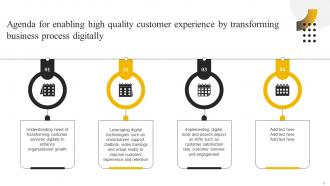
Slide 2: This slide is an Agenda slide. State your agendas here.
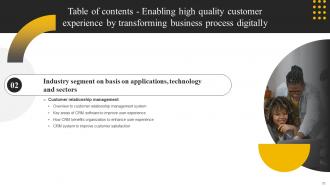
Slide 3: This slide shows a Table of Contents for the presentation.
Slide 4: This slide is an introductory slide.
Slide 5: This slide covers overview to business digital transformation to enhance customer experience.
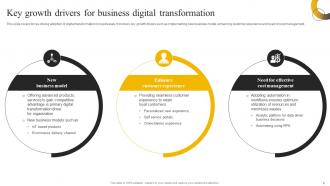
Slide 6: This slide caters to forces driving adoption of digital transformation in businesses.
Slide 7: This slide consists need of investing in technology for enhancing customer service procedure of organization.
Slide 8: This slide comprises framework for adopting digital transformation in business.
Slide 9: This slide depicts current digital transformation trends to enhance customer experience.
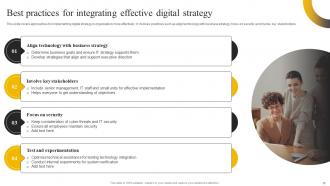
Slide 10: This slide demonstrates approaches for implementing digital strategy in organization more effectively.
Slide 11: This slide denotes process to ensure effective deployment of technology strategy to enhance operational efficiency.
Slide 12: This slide is an introductory slide.
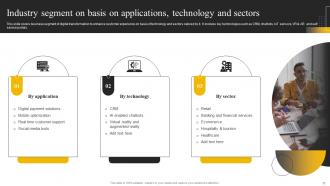
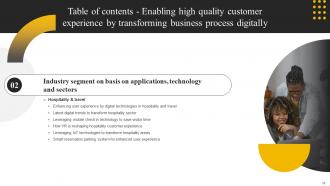
Slide 13: This slide entails business segment of digital transformation to enhance customer experience on basis of technology and sectors catered by it.
Slide 14: This slide is an introductory slide.
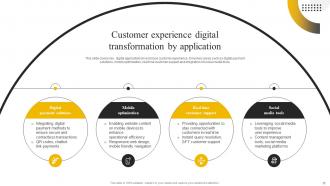
Slide 15: This slide covers key digital applications to embrace customer experience.
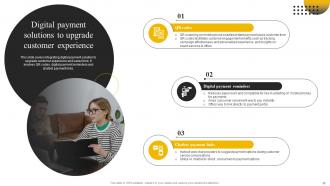
Slide 16: This slide presents integrating digital payment solution to upgrade customer experience and saves time.
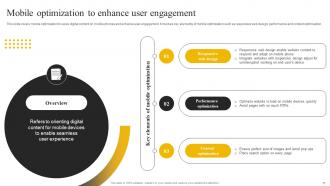
Slide 17: This slide represents mobile optimization to serve digital content on mobile phones and enhance user engagement.
Slide 18: This slide mentions offering real time customer support to deliver valuable outcomes and enhance customer satisfaction.
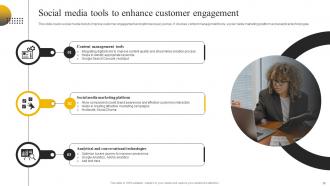
Slide 19: This slide portrays social media tools to improve customer engagement and optimize buyer journey.
Slide 20: This slide is an introductory slide.
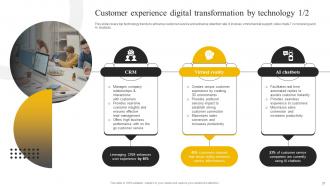
Slide 21: This slide presents top technology trends to enhance customer service and enhance retention rate.
Slide 22: This slide illustrates top technology trends to enhance customer service and enhance retention rate.
Slide 23: This slide is an introductory slide.
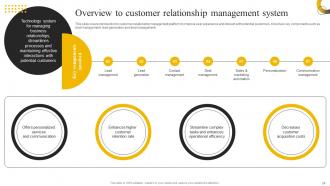
Slide 24: This slide highlights introduction to customer relationship management platform.
Slide 25: This slide covers key areas of customer relationship management system to provide effective user experience.
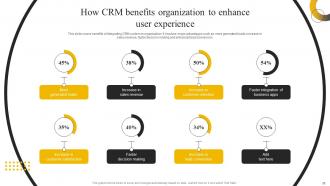
Slide 26: This slide features benefits of integrating CRM system in organization.
Slide 27: This slide puts how CRM system helps in improving customer satisfaction to enhance retention rate.
Slide 28: This slide is an introductory slide.
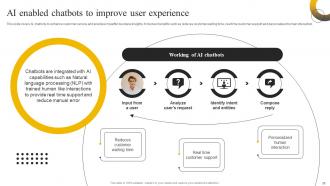
Slide 29: This slide marks AI chatbots to enhance customer service and enables impactful business insights.
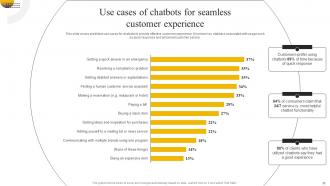
Slide 30: This slide elucidates predictive use cases for chatbots to provide effective customer experience.
Slide 31: This slide highlights chatbots for effective customer interaction and solves queries.
Slide 32: This slide is an introductory slide.
Slide 33: This slide entails emergence of virtual reality technology to improve user experience in different sectors.
Slide 34: This slide covers key statistics associated with leveraging virtual reality (VR) technology by various sectors.
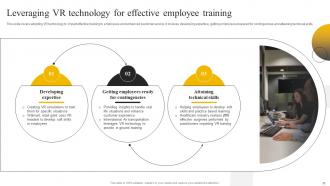
Slide 35: This slide represents adopting VR technology to impart effective training to employees and enhanced customer service.
Slide 36: This slide presents integrating virtual try on technology to offer personalization and in store experience to customers.
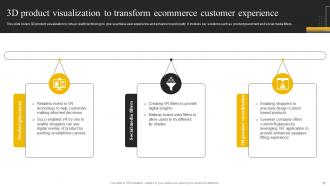
Slide 37: This slide elucidates 3D product visualization by virtual reality technology to give seamless user experience and enhance brand loyalty.
Slide 38: This slide is an introductory slide.
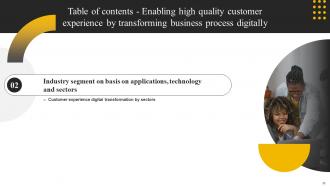
Slide 39: This slide covers sectors leveraging digital technologies to transform businesses and provide excellent customer experience.
Slide 40: This slide is an introductory slide.
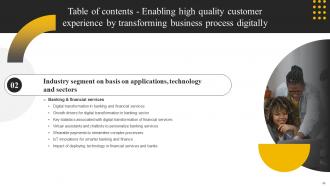
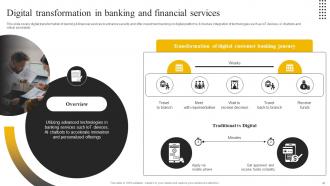
Slide 41: This slide depicts digital transformation of banking & financial services to enhance security and offer investment banking on digital platforms.
Slide 42: This slide demonstrates need of digital banking transformation.
Slide 43: This slide demarcates key statistics associated with emerging trends of digital banking.
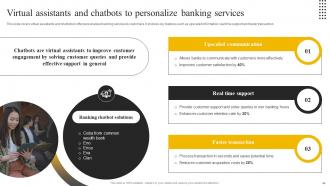
Slide 44: This slide features virtual assistants and chatbots to offer personalized banking services to customers.
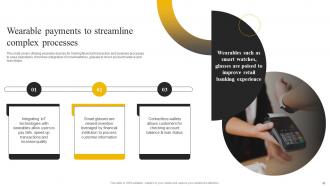
Slide 45: This slide covers utilizing wearable devices for making financial transaction and business processes to ease operations.
Slide 46: This slide entails IoT devices to enhance financial productivity of banking sector.
Slide 47: This slide elucidates impact of integrating technology in financial services and bank.
Slide 48: This slide is an introductory slide.
Slide 49: This slide covers introduction to digital transformation in retail sector to improve customer satisfaction.
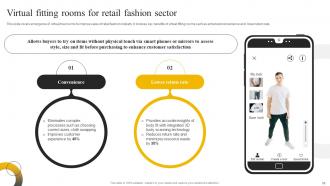
Slide 50: This slide puts emergence of virtual trial rooms to improve sales of retail fashion industry.
Slide 51: This slide shows leveraging smart shelves management system to improve retail sales.
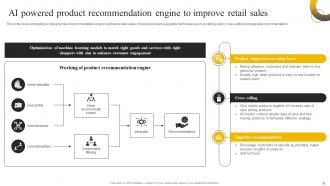
Slide 52: This slide showcases integrating AI power product recommendation engine to enhance retail sales.
Slide 53: This slide presents integrating automated system to improve supply chain management.
Slide 54: This slide is an introductory slide.
Slide 55: This slide represents leveraging advanced technologies in ecommerce business to improve customer satisfaction.
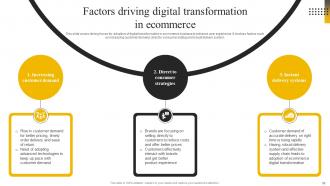
Slide 56: This slide involves driving forces for adoption of digital transformation in ecommerce business to enhance user experience.
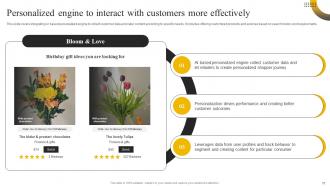
Slide 57: This slide includes integrating AI based personalized engine to collect customer data and cater content according to specific needs.
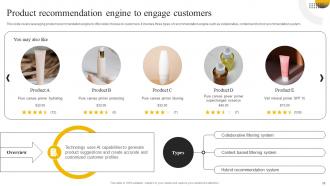
Slide 58: This slide mentions leveraging product recommendation engine to offer wider choices to customers.
Slide 59: This slide is an introductory slide.
Slide 60: This slide covers digital transformation of hospitality and travel sector to improve user experience and streamline operational complexity.
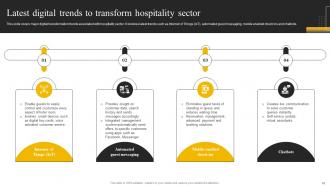
Slide 61: This slide shows major digital transformation trends associated with hospitality sector.
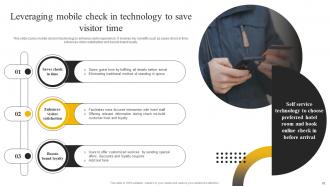
Slide 62: This slide elucidates mobile check in technology to enhance visitor experience.
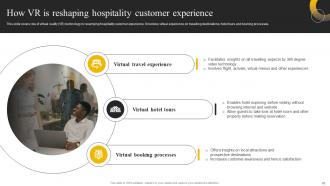
Slide 63: This slide presents role of virtual reality (VR) technology in revamping hospitality customer experience.
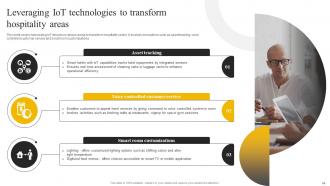
Slide 64: This slide represents harnessing IoT devices in various areas to transform hospitality sector.
Slide 65: This slide categorises integrating smart reservation parking system in hotels to enhance visitor experience and retention rate.
Slide 66: This slide is an introductory slide.
Slide 67: This slide covers digital transformation in healthcare sector to enhance patient outcomes.
Slide 68: This slide highlights top technology trends to enhance healthcare services.
Slide 69: This slide involves applications of IoT technology in healthcare and medical industry.
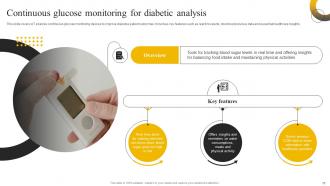
Slide 70: This slide portrays IoT enables continuous glucose monitoring devices to improve diabetes patient outcomes.
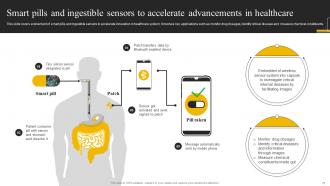
Slide 71: This slide shows evolvement of smart pills and ingestible sensors to accelerate innovation in healthcare system.
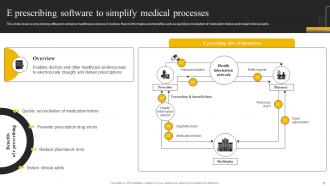
Slide 72: This slide illustrates e prescribing software to enhance healthcare services.
Slide 73: This slide is an introductory slide.
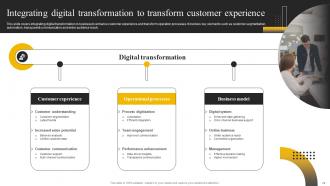
Slide 74: This slide covers integrating digital transformation in business to enhance customer experience and transform operation processes.
Slide 75: This slide involves main areas for transforming businesses digitally and enhance user experience.
Slide 76: This slide consists guide roadmap for implementing digital transformation strategy in organization.
Slide 77: This slide caters to key challenges associated with customer experience digital transformation.
Slide 78: This slide portrays analyzing key areas for enhancing digital customer experience journey.
Slide 79: This slide marks maturity model for implementing digital customer experience strategy.
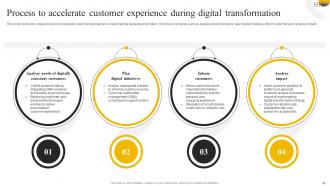
Slide 80: This slide depicts four steps process to accelerate customer experience by implementing digital transformation.
Slide 81: This slide denotes roles and responsibilities for integrating effective digital customer experience solutions.
Slide 82: This slide covers employee training program for integrating smart solutions in production sector to streamline complex processes.
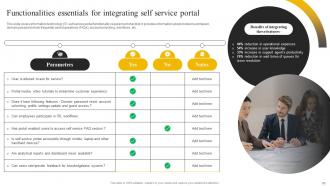
Slide 83: This slide entails information technology (IT) self service portal functionality requirement checklist.
Slide 84: This slide elucidates assessing cost for integrating customer service solutions effectively.
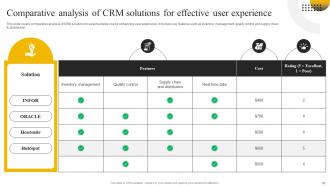
Slide 85: This slide covers comparative analysis of CRM solutions to select suitable one for enhancing user experience.
Slide 86: This slide is an introductory slide.
Slide 87: This slide consists KPIs to measure impact of integrating technologies on customers.
Slide 88: This slide is an introductory slide.
Slide 89: This slide entails KPI dashboard to track customer service performance and enhance customer satisfaction rate.
Slide 90: This slide pertains to KPI dashboard to track customer satisfaction rate.
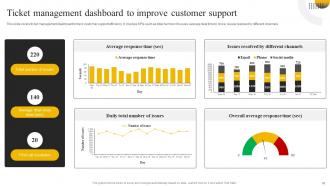
Slide 91: This slide portrays ticket management dashboard to track customer support efficiency.
Slide 92: This slide marks CRM software dashboard to track buyer journey and enhance user experience.
Slide 93: This slide shows all the icons included in the presentation.
Slide 94: This slide is a thank-you slide with address, contact numbers, and email address.
Enabling High Quality Customer Experience By Transforming Business Process Digitally DT CD with all 102 slides:
Use our Enabling High Quality Customer Experience By Transforming Business Process Digitally DT CD to effectively help you save your valuable time. They are readymade to fit into any presentation structure.











































FAQs for Enabling High Quality Customer Experience By Transforming Business Process
Key components include cloud infrastructure, data analytics platforms, process automation tools, cybersecurity frameworks, and employee digital training programs. These elements work together by modernizing operations, enhancing decision-making capabilities, and streamlining workflows, with many organizations finding that strategic integration of these components delivers improved customer experiences and significant competitive advantages.
Organizations measure digital transformation ROI through key performance indicators like operational efficiency gains, cost reduction percentages, revenue growth metrics, customer satisfaction scores, and employee productivity improvements. Financial services companies track faster loan processing times, while healthcare systems monitor reduced administrative costs and improved patient experiences, ultimately delivering measurable competitive advantages and sustainable business growth.
Company culture serves as the foundation for digital transformation success, influencing employee adoption, change management, collaboration, and innovation capacity throughout the organization. A culture that embraces continuous learning, experimentation, and adaptability enables smoother technology integration, while resistance to change can significantly hinder progress, with many organizations finding that cultural alignment ultimately determines whether digital initiatives deliver sustained competitive advantage.
Data analytics drives effective decision-making during digital transformation by providing real-time insights into customer behavior, operational efficiency, and market trends. Through predictive modeling and performance dashboards, organizations can identify transformation opportunities, measure implementation success, and adjust strategies accordingly, with many companies finding that data-driven approaches reduce transformation risks while accelerating competitive advantage.
Small and medium-sized enterprises face challenges including limited budgets, insufficient technical expertise, resistance to change, cybersecurity concerns, and integration complexities with existing systems. While these obstacles present initial hurdles, many SMEs find that strategic phased approaches, cloud-based solutions, and targeted staff training ultimately deliver enhanced operational efficiency and competitive advantage in increasingly digital markets.
AI and IoT fundamentally reshape digital transformation strategies by enabling real-time data analytics, predictive maintenance, and automated decision-making processes. These technologies streamline operations across manufacturing, healthcare, and retail sectors, with organizations finding that integrated AI-IoT ecosystems deliver enhanced customer experiences, reduced operational costs, and significant competitive advantages in increasingly data-driven markets.
Best practices for engaging employees in digital transformation include clear communication of benefits, comprehensive training programs, involving staff in decision-making processes, recognizing early adopters, and providing ongoing support throughout implementation. These strategies enhance buy-in by addressing concerns proactively, building digital confidence, and creating ownership, with many organizations finding that employee-centric approaches ultimately deliver smoother transitions and higher adoption rates.
Organizations ensure cybersecurity during digital transformation by implementing security-by-design principles, continuous monitoring systems, zero-trust architectures, and comprehensive employee training programs. These approaches enable companies to maintain robust protection while modernizing operations, with many financial institutions and healthcare providers finding that integrated security frameworks actually accelerate transformation initiatives while reducing risk exposure.
Digital transformation significantly enhances customer experience by enabling personalized interactions, omnichannel communication, real-time support, and data-driven insights across all touchpoints. Through AI-powered chatbots, mobile apps, and integrated CRM systems, organizations streamline customer journeys, reduce response times, and deliver seamless experiences, with many retail and financial services companies finding that digital initiatives ultimately increase customer satisfaction and loyalty.
Legacy systems significantly slow digital transformation by creating integration complexities, requiring extensive data migration efforts, and demanding substantial infrastructure overhauls. While these older technologies present challenges, many established companies find that strategic modernization approaches, including phased migrations and hybrid cloud solutions, ultimately deliver enhanced operational efficiency, streamlined workflows, and competitive advantage in an increasingly digital marketplace.
Essential digital transformation tools include project management platforms like Microsoft Project and Asana, cloud infrastructure solutions such as AWS and Azure, data analytics tools like Tableau and Power BI, collaboration software including Slack and Teams, and automation platforms like Zapier. These technologies streamline project coordination, enhance data visibility, and facilitate seamless communication across departments, with many organizations finding that strategic integration of these tools accelerates implementation timelines while reducing operational complexity.
Collaboration and partnerships enhance digital transformation by combining complementary expertise, sharing implementation costs, and accelerating technology adoption across organizations. Strategic alliances enable companies to access specialized skills, leverage shared resources, and reduce transformation risks, with many enterprises finding that collaborative approaches deliver faster innovation cycles, enhanced operational efficiency, and stronger competitive positioning in increasingly digital markets.
Leaders driving digital transformation require strategic vision, change management expertise, data literacy, technology comprehension, and collaborative communication skills. These competencies enable executives to navigate organizational resistance, interpret analytics for decision-making, and align cross-functional teams, with many organizations finding that leaders combining technical understanding with people-focused capabilities ultimately deliver faster adoption and sustainable competitive advantage.
Digital transformation project prioritization involves evaluating business impact, resource requirements, implementation complexity, and strategic alignment with organizational goals. Organizations typically assess projects through frameworks considering ROI potential, customer experience enhancement, and operational efficiency gains, with many companies finding that starting with high-impact, low-complexity initiatives builds momentum while delivering measurable competitive advantages.
Digital transformation and sustainability initiatives are increasingly interconnected, with digital technologies enabling organizations to optimize resource usage, reduce waste, and improve environmental monitoring through IoT sensors, AI analytics, and automated systems. Companies across manufacturing, logistics, and energy sectors leverage digital tools to track carbon footprints, streamline operations, and enhance supply chain transparency, ultimately delivering both cost savings and environmental benefits.
-
“Ample and amazing variety of templates available, really helpful for making professional PPT for day to day workings.”
-
Informative design.