

Endpoint Security Roadmap To Implement Effective Endpoint Security




Try Before you Buy Download Free Sample Product
 Impress Your
 Audience
 100%
100% Editable
 Save Hours
 of Time


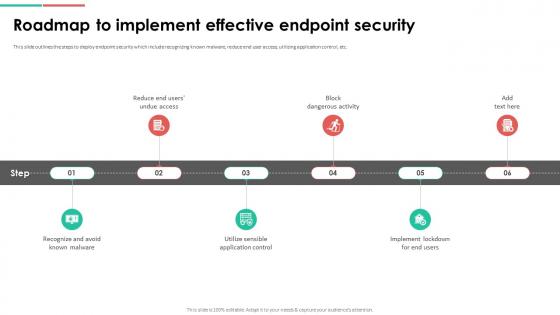
This slide outlines the steps to deploy endpoint security which include recognizing known malware, reduce end user access, utilizing application control, etc.
People who downloaded this PowerPoint presentation also viewed the following :
Endpoint Security Roadmap To Implement Effective Endpoint Security with all 9 slides:
Use our Endpoint Security Roadmap To Implement Effective Endpoint Security to effectively help you save your valuable time. They are readymade to fit into any presentation structure.








FAQs for Endpoint Security Roadmap To Implement
Effective endpoint security strategies include antivirus software, endpoint detection and response (EDR) tools, device encryption, access controls, and regular patch management. These components work together by monitoring suspicious activities, preventing malware infections, and securing data transmission, with many organizations finding that this layered approach significantly reduces cyber threats while maintaining operational efficiency.
Organizations can assess their current endpoint security posture through comprehensive audits, vulnerability scanning, threat detection analysis, compliance reviews, and endpoint visibility assessments. These evaluations help identify security gaps, unmanaged devices, and policy enforcement weaknesses across networks, with many enterprises finding that regular assessments enable proactive threat mitigation and enhanced security investments.
Machine learning enhances endpoint protection by analyzing behavior patterns, detecting anomalies in real-time, and identifying previously unknown threats through predictive algorithms. These AI-driven systems enable organizations to automate threat response, reduce false positives, and strengthen defenses against sophisticated malware, with many enterprises finding that machine learning delivers faster incident response and improved security outcomes.
Endpoint security solutions provide comprehensive protection through behavioral analysis, threat intelligence, network monitoring, device management, and real-time response capabilities, while traditional antivirus relies primarily on signature-based detection. Modern endpoint platforms enable organizations to detect advanced threats, manage remote devices, and respond to incidents automatically, ultimately delivering faster threat resolution and enhanced security posture across distributed workforces.
Common endpoint vulnerabilities include unpatched software, weak authentication, malware infections, unsecured network connections, and inadequate access controls. These security gaps enable cybercriminals to exploit devices through phishing attacks, ransomware deployment, and data breaches, with many organizations finding that comprehensive endpoint protection strategies significantly reduce risk exposure and enhance overall network security.
Mobile Device Management (MDM) enhances endpoint security by enforcing consistent security policies, enabling remote device monitoring, and providing centralized control over mobile endpoints accessing corporate networks. Through automated compliance checks and remote wipe capabilities, organizations streamline security management while reducing vulnerabilities, with many enterprises finding that MDM delivers stronger data protection and operational efficiency.
Remote work significantly expands the attack surface by introducing unsecured home networks, personal devices, and varied connection points that traditional perimeter-based security cannot adequately protect. Organizations increasingly implement zero-trust architectures, enhanced endpoint detection and response tools, and comprehensive device management policies, ultimately delivering more robust, location-independent security frameworks that protect distributed workforces.
Organizations ensure regulatory compliance through comprehensive endpoint policies, regular security audits, data encryption, access controls, and continuous monitoring systems. These measures help meet GDPR, HIPAA, and SOX requirements by protecting sensitive data across all devices, with many financial institutions and healthcare providers finding that automated compliance reporting and real-time threat detection ultimately streamline regulatory processes while minimizing audit risks.
Cloud endpoint security best practices include implementing zero-trust architecture, multi-factor authentication, endpoint detection and response solutions, regular patch management, and data encryption. These strategies enhance protection by continuously monitoring device behavior, restricting unauthorized access, and automating threat responses, with many organizations finding that comprehensive endpoint visibility ultimately delivers faster incident resolution and reduced security risks.
Zero-trust models apply to endpoint security by requiring continuous authentication, device verification, and behavioral monitoring for every access request, regardless of location or previous trust status. Through microsegmentation and real-time threat detection, organizations streamline security protocols while minimizing breach risks, with many financial institutions and healthcare providers finding enhanced protection without compromising user productivity.
**INPUT**: What steps should be taken to respond to a security breach at an endpoint? **OUTPUT**: Endpoint security breach response involves immediate isolation, comprehensive assessment, threat containment, system recovery, and stakeholder communication. Organizations across sectors like healthcare, finance, and retail find that structured incident response protocols, combined with automated containment tools and forensic analysis, ultimately minimize damage while enabling faster recovery and stronger future defenses.
User training is crucial for endpoint security because human error accounts for most security breaches, with employees often inadvertently clicking malicious links, downloading infected files, or falling victim to phishing attacks. Through comprehensive security awareness programs, organizations can significantly reduce vulnerabilities by educating staff on recognizing threats, following proper protocols, and maintaining security hygiene, ultimately creating a human firewall that strengthens overall cybersecurity defenses.
Endpoint security solutions integrate with existing IT infrastructure through APIs, centralized management consoles, directory services like Active Directory, and SIEM platforms. These integrations enable organizations to streamline security operations, automate threat response workflows, and maintain consistent policy enforcement across networks, while ultimately delivering enhanced visibility and reduced administrative overhead.
Emerging endpoint security threats include AI-powered malware, supply chain attacks, cloud misconfigurations, IoT device vulnerabilities, and zero-day exploits targeting remote work infrastructure. These sophisticated threats exploit expanded attack surfaces by bypassing traditional defenses, targeting third-party integrations, and leveraging machine learning, with many organizations finding that proactive threat hunting and behavioral analytics deliver stronger protection.
Threat intelligence improves endpoint security by providing real-time insights into emerging threats, enabling proactive defense strategies, and enhancing automated response capabilities. Through advanced analytics and global threat data, organizations can identify suspicious patterns, predict attack vectors, and streamline incident response, with many enterprises finding that intelligence-driven security significantly reduces breach response times and overall risk exposure.
-
They saved me a lot of time because they had exactly what I was looking for. Couldn’t be happier!
-
My search for complete decks ended with SlideTeam. Such a surplus collection of HD PowerPoints. Moreover, their standard and widescreen formats have helped me in delivering bullseye presentations.