

Enterprise Cyber Risk Management Dashboard Enterprise Risk Mitigation Strategies




Try Before you Buy Download Free Sample Product
 Impress Your
Audience
 100%
Editable
 Save Hours
of Time


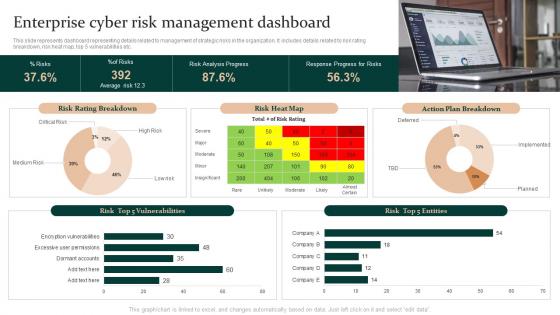
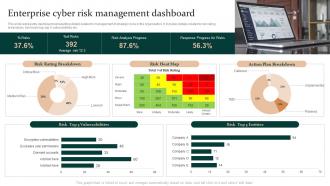
This slide represents dashboard representing details related to management of strategic risks in the organization. It includes details related to risk rating breakdown, risk heat map, top 5 vulnerabilities etc.
People who downloaded this PowerPoint presentation also viewed the following :
Enterprise Cyber Risk Management Dashboard Enterprise Risk Mitigation Strategies with all 7 slides:
Use our Enterprise Cyber Risk Management Dashboard Enterprise Risk Mitigation Strategies to effectively help you save your valuable time. They are readymade to fit into any presentation structure.






FAQs for Enterprise Cyber Risk Management Dashboard Enterprise
Effective cyber risk management frameworks include risk assessment protocols, threat detection systems, incident response plans, employee training programs, and continuous monitoring capabilities. These components work together by identifying vulnerabilities, preventing breaches, and minimizing damage, with many organizations finding that strategic integration ultimately delivers enhanced security posture and competitive advantage.
Organizations assess their cybersecurity posture through comprehensive security audits, vulnerability scans, penetration testing, risk assessments, and compliance evaluations. These methodologies help identify network weaknesses, outdated systems, and policy gaps, with many financial institutions and healthcare organizations finding that regular assessments significantly enhance their defensive capabilities and regulatory compliance.
Employee training serves as a critical first line of defense against cyber threats by educating staff on recognizing phishing attempts, implementing strong password protocols, identifying social engineering tactics, and following secure data handling procedures. Through comprehensive cybersecurity awareness programs, organizations significantly reduce human error incidents, enhance overall security posture, and create a culture of cyber vigilance, with many companies finding that well-trained employees prevent costly breaches.
AI and machine learning significantly enhance cyber risk management by enabling predictive threat detection, automated incident response, and behavioral analysis of network anomalies. These technologies streamline security operations through real-time monitoring, pattern recognition, and adaptive defense mechanisms, with many financial institutions and healthcare organizations finding that AI-driven approaches ultimately deliver faster threat mitigation and more robust protection against evolving cyberattacks.
Organizations today face cyber threats including ransomware, phishing attacks, data breaches, insider threats, and advanced persistent threats (APTs). These security challenges increasingly target critical business infrastructure, financial systems, and customer data across sectors like healthcare, banking, and retail, with many organizations finding that comprehensive threat awareness enables more strategic cybersecurity investments and faster incident response capabilities.
Organizations can prioritize cyber risk assessments by identifying mission-critical systems, high-value data repositories, customer-facing applications, and regulatory compliance requirements, then ranking these assets based on business impact potential. This strategic approach enables companies to allocate security resources efficiently, with financial institutions and healthcare organizations finding that asset-based prioritization significantly reduces breach response times and compliance costs.
Cyber risk management must address data protection laws like GDPR, industry regulations such as HIPAA for healthcare and PCI DSS for finance, breach notification requirements, and liability frameworks. These compliance mandates drive organizations to implement robust security controls, incident response procedures, and documentation practices, ultimately delivering regulatory alignment while minimizing legal exposure and potential penalties.
Businesses can effectively communicate cyber risks through clear, non-technical language, regular risk assessments, quantified impact scenarios, and tailored messaging for different stakeholder groups. By presenting cybersecurity as a business enabler rather than just a cost center, organizations enhance board engagement, secure adequate funding, and build stakeholder confidence, ultimately strengthening their overall security posture.
Best practices for cyber incident response include establishing clear communication protocols, defining role-specific responsibilities, creating detailed containment procedures, implementing evidence preservation methods, and conducting regular response drills. These comprehensive approaches streamline crisis management by minimizing response time, reducing business disruption, and ensuring regulatory compliance, with many organizations finding that proactive planning significantly reduces recovery costs and reputational damage.
Third-party vendor management strengthens cyber risk strategy by establishing security standards, conducting regular assessments, monitoring compliance, and implementing contractual safeguards that extend organizational protections beyond internal boundaries. Through comprehensive vendor vetting and continuous oversight, organizations minimize supply chain vulnerabilities while ensuring partners meet stringent cybersecurity requirements, ultimately reducing attack surfaces and maintaining operational resilience across interconnected business ecosystems.
Organizations should track metrics including mean time to detection and response, security incident frequency and severity, vulnerability remediation rates, employee security training completion, and cyber insurance claim ratios. Through comprehensive dashboards, companies in banking, healthcare, and retail can monitor threat landscape changes, assess control effectiveness, and demonstrate ROI on security investments, ultimately enabling data-driven decisions that strengthen their overall security posture.
Organizations balance cybersecurity costs with potential cyber incident impacts through comprehensive risk assessments, prioritized threat modeling, and strategic resource allocation based on business-critical assets. This approach enables companies to optimize their security investments by focusing on high-impact vulnerabilities first, while implementing scalable solutions that grow with organizational needs, ultimately delivering cost-effective protection and minimizing expensive breach remediation.
Regular cyber risk management plan updates require continuous monitoring, quarterly assessments, incident-based reviews, stakeholder feedback integration, and compliance auditing processes. These systematic approaches enable organizations to adapt to emerging threats, evolving regulations, and changing business landscapes, with many financial services and healthcare institutions finding that structured revision cycles ultimately deliver enhanced security posture and regulatory compliance.
Cultural factors significantly influence cyber risk management through leadership commitment, employee attitudes toward security protocols, communication patterns, and risk tolerance levels. Organizations with strong security cultures experience fewer breaches and faster incident responses, while those prioritizing convenience over security face increased vulnerabilities, ultimately making cultural alignment essential for effective cyber resilience.
Insurance serves as a crucial financial safety net within comprehensive cyber risk management, complementing prevention, detection, and response capabilities to transfer residual risk. While organizations implement robust security measures and incident response plans, cyber insurance provides essential coverage for business interruption, data breach costs, and regulatory fines, ultimately enabling companies to maintain operational continuity and financial stability.
-
“Excellent information with easy access.”
-
Best Representation of topics, really appreciable.