

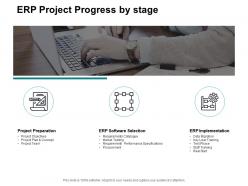
Erp project progress by stage ppt powerpoint presentation slides layout





Try Before you Buy Download Free Sample Product
 Impress Your
Audience
 100%
Editable
 Save Hours
of Time


Be certain your faith in our ERP Project Progress By Stage Ppt Powerpoint Presentation Slides Layout will not be belied. You can confidently bank on it.
People who downloaded this PowerPoint presentation also viewed the following :
Erp project progress by stage ppt powerpoint presentation slides layout with all 2 slides:
Bring it on the anvil with our ERP Project Progress By Stage Ppt Powerpoint Presentation Slides Layout. Hammer it into the form you desire.

FAQs for Erp project progress by stage ppt powerpoint
ERP project lifecycle includes planning and requirements gathering, system design and configuration, data migration and integration, testing and validation, and deployment with training. These stages ensure systematic implementation by establishing clear objectives, customizing functionality to business needs, and minimizing operational disruptions, with many organizations finding that structured phasing reduces costs while delivering faster user adoption and improved process efficiency.
Project goals evolve from broad strategic objectives during initiation to detailed, measurable requirements during implementation, with stakeholder needs, technical constraints, and organizational changes refining scope throughout each phase. Through iterative planning and discovery processes, organizations streamline initial visions into specific functional requirements, system configurations, and user workflows, ultimately delivering customized ERP solutions that enhance operational efficiency and competitive advantage.
Stakeholder engagement ensures alignment, buy-in, and smooth transitions across planning, implementation, testing, and deployment stages through regular communication, feedback collection, and collaborative decision-making. Active involvement from department heads, end-users, and executives helps identify requirements early, resolve issues quickly, and accelerate user adoption, ultimately delivering higher project success rates and reduced implementation costs.
Organizations can assess readiness through comprehensive evaluation of technical infrastructure, stakeholder buy-in, resource allocation, change management capabilities, and defined success metrics for each implementation phase. Through systematic readiness assessments, companies in manufacturing, retail, and financial services streamline transitions between planning, configuration, testing, and deployment stages, while identifying potential bottlenecks early, ultimately delivering smoother implementations and faster time-to-value.
Common ERP planning stage challenges include inadequate stakeholder engagement, unrealistic timeline expectations, insufficient budget allocation, poor requirement gathering, and lack of change management preparation. These obstacles can derail projects by creating scope creep, resource constraints, and user resistance, with many organizations finding that thorough upfront planning ultimately delivers smoother implementations and higher success rates.
Effective change management ensures smoother ERP transitions by addressing user resistance, maintaining stakeholder alignment, and preserving project momentum across phases. Through structured communication protocols, targeted training programs, and phased rollout strategies, organizations minimize disruption during stage transitions, with many enterprises finding that proactive change management reduces implementation timelines and enhances user adoption rates significantly.
ERP project metrics include milestone completion rates, budget variance tracking, resource utilization percentages, system integration testing results, and user acceptance scores at each phase. These measurements enable project managers to identify bottlenecks early, optimize resource allocation, and ensure on-time delivery, with many organizations finding that structured metric tracking reduces implementation costs by 15-20%.
Training and user acceptance testing significantly influence implementation by ensuring seamless system adoption, identifying critical functionality gaps, and minimizing post-launch disruptions through comprehensive user preparation. Through structured training programs and rigorous testing protocols, organizations enhance user confidence, reduce resistance to change, and accelerate operational efficiency, ultimately delivering smoother transitions and faster return on investment.
Successful ERP data migration strategies include comprehensive data auditing, establishing clear mapping protocols, implementing robust validation frameworks, conducting iterative testing phases, and maintaining detailed backup procedures. Through systematic cleansing and verification processes, organizations streamline accuracy while minimizing operational disruptions, with many enterprises finding that phased migration approaches ultimately deliver enhanced data integrity and reduced implementation risks.
Post-implementation support and evaluation are critical for ERP project success, determining whether investments deliver sustained business value through system optimization, user adoption reinforcement, and performance monitoring. These phases enable organizations to address emerging issues, refine workflows, and maximize ROI, with many companies finding that comprehensive post-launch support ultimately distinguishes successful transformations from costly implementations.
ERP case studies reveal that momentum loss typically occurs during data migration, user training, and go-live phases due to inadequate change management, unrealistic timelines, and insufficient stakeholder engagement. These projects demonstrate that successful implementations require dedicated project champions, comprehensive training programs, and phased rollouts, with organizations finding that investing in robust communication strategies and realistic milestone planning ultimately delivers smoother transitions and higher user adoption rates.
Risk management should be tailored by focusing on planning and vendor selection risks during initiation, technical integration and data migration challenges during implementation, and user adoption and performance optimization during go-live phases. Each stage requires different mitigation strategies, with early phases emphasizing strategic alignment and resource allocation, while later phases prioritize operational continuity and change management, ultimately ensuring project success.
Organizations can ensure seamless ERP integration at the design stage by conducting comprehensive system audits, mapping data flows between legacy and new systems, establishing standardized APIs, and creating detailed integration protocols. Through strategic planning and stakeholder collaboration, companies across manufacturing, retail, and financial services streamline operations, minimize disruption, and ultimately deliver enhanced efficiency while reducing implementation costs.
ERP communication best practices include establishing regular stakeholder updates, creating dedicated project channels, implementing structured feedback loops, maintaining transparent progress dashboards, and conducting frequent cross-functional meetings. These approaches streamline coordination by ensuring alignment across departments, minimizing misunderstandings, and addressing concerns proactively, with many organizations finding that consistent communication ultimately reduces project delays and enhances user adoption rates.
Feedback loops in ERP projects can be established through regular stage-gate reviews, stakeholder surveys, performance metrics tracking, post-implementation assessments, and cross-functional team debriefs. These mechanisms enable organizations to capture real-time insights, identify bottlenecks early, and refine processes continuously, with many enterprises finding that structured feedback ultimately accelerates deployment timelines and enhances user adoption rates.
No Reviews