


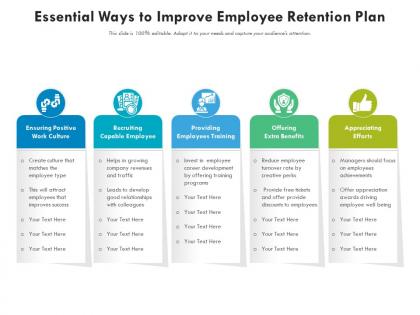
Essential ways to improve employee retention plan




Try Before you Buy Download Free Sample Product
 Impress Your
 Audience
 100%
100% Editable
 Save Hours
 of Time


Our Essential Ways To Improve Employee Retention Plan are topically designed to provide an attractive backdrop to any subject. Use them to look like a presentation pro.
People who downloaded this PowerPoint presentation also viewed the following :
Essential ways to improve employee retention plan with all 2 slides:
Use our Essential Ways To Improve Employee Retention Plan to effectively help you save your valuable time. They are readymade to fit into any presentation structure.

FAQs for Essential ways to improve
Effective employee engagement strategies include flexible work arrangements, professional development opportunities, recognition programs, competitive compensation packages, and meaningful career advancement paths. These approaches enhance retention by fostering workplace satisfaction, building employee loyalty, and creating growth opportunities, with many organizations finding that engaged employees are significantly more likely to remain long-term.
Companies leverage feedback mechanisms to enhance employee satisfaction through regular surveys, one-on-one meetings, anonymous suggestion systems, pulse checks, and exit interviews. These approaches enable organizations to identify concerns early, address workplace issues proactively, and create more responsive management practices, with many companies finding that consistent feedback loops significantly improve retention rates and overall employee engagement.
Company culture serves as the foundation for employee retention by shaping workplace values, communication patterns, work-life balance, and career development opportunities. A positive culture that emphasizes recognition, collaboration, and growth enables organizations to reduce turnover costs, enhance productivity, and attract top talent, with many companies finding that strong cultural alignment ultimately delivers competitive advantage in increasingly tight labor markets.
Effective onboarding reduces turnover by establishing clear expectations, providing comprehensive training, and fostering early engagement through structured mentorship programs, regular check-ins, and cultural integration activities. Organizations implementing strategic onboarding processes, especially in healthcare and financial services, experience significantly lower first-year turnover rates, enhanced employee satisfaction, and faster productivity gains, ultimately delivering stronger retention and reduced recruitment costs.
Mentorship programs enhance employee retention by fostering professional development, improving job satisfaction, creating stronger workplace relationships, and providing clear career advancement pathways. These initiatives streamline knowledge transfer while building organizational loyalty, with many companies finding that structured mentoring reduces turnover by 25%, ultimately delivering enhanced employee engagement and significant cost savings in recruitment.
Flexible work arrangements significantly enhance employee loyalty by improving work-life balance, reducing commute stress, and demonstrating organizational trust in employee autonomy. These policies enable companies to retain top talent while reducing turnover costs, with many organizations finding that remote and hybrid options ultimately deliver higher job satisfaction, increased productivity, and stronger long-term commitment from their workforce.
Effective recognition and rewards systems combine monetary incentives, career development opportunities, performance-based bonuses, flexible benefits, and meaningful acknowledgment programs. These structured approaches foster long-term commitment by aligning individual achievements with organizational goals, creating pathways for advancement, and delivering personalized recognition, with many companies finding that consistent, multi-tiered rewards significantly enhance employee loyalty and retention.
Professional development opportunities significantly enhance employee retention by demonstrating organizational investment in career growth, increasing job satisfaction, and providing clear advancement pathways. Companies offering comprehensive training programs, mentorship opportunities, and skill-building initiatives experience substantially lower turnover rates, with employees feeling more engaged and committed to long-term organizational success.
Managers can be trained through comprehensive leadership development programs, mentorship initiatives, retention-focused workshops, regular feedback sessions, and emotional intelligence training. These approaches enhance managers' abilities to recognize employee needs, provide meaningful career development opportunities, and create supportive work environments, with many organizations finding that well-trained managers significantly reduce turnover while improving team engagement.
Organizations should track turnover rates, time-to-fill positions, employee engagement scores, exit interview insights, and retention rates by department or role. These metrics enable companies to identify patterns in departures, measure engagement effectiveness, and optimize recruitment costs, with many finding that tracking promotion rates and internal mobility ultimately delivers better workforce planning and competitive talent advantages.
Diversity and inclusion initiatives enhance employee retention by creating psychological safety, expanding career advancement opportunities, and fostering belonging through inclusive cultures. Organizations implementing comprehensive D&I programs, particularly in technology and financial services sectors, experience significantly lower turnover rates, improved employee engagement, and stronger talent attraction, ultimately delivering competitive advantage in increasingly diverse markets.
Employee compensation significantly impacts retention rates by directly influencing job satisfaction, financial security, and perceived value within organizations. Competitive salaries, comprehensive benefits, and performance-based incentives reduce turnover by 25-40%, with companies in technology, healthcare, and finance finding that strategic compensation packages ultimately deliver higher employee loyalty, reduced recruitment costs, and stronger organizational stability.
Work-life balance is crucial for retaining top talent, as it directly impacts employee satisfaction, productivity, and long-term commitment to organizations. Companies prioritizing flexible schedules, remote work options, and wellness programs see significantly lower turnover rates, with many finding that balanced employees deliver higher performance, reduced burnout, and ultimately stronger competitive advantage in talent retention.
Common reasons employees cite for leaving include limited career advancement, inadequate compensation, poor management relationships, lack of recognition, and insufficient work-life balance. Companies can address these through structured career development programs, competitive salary reviews, management training initiatives, regular recognition systems, and flexible work arrangements, with many organizations finding that proactive retention strategies significantly reduce turnover costs while enhancing workplace satisfaction.
Exit interviews reveal retention challenges through departing employees' candid feedback about management practices, workplace culture, career development opportunities, and compensation concerns. Organizations strategically analyze these insights to identify recurring themes, implement targeted improvements like enhanced training programs or flexible work arrangements, and ultimately reduce future turnover while strengthening employee satisfaction across departments.
-
Wonderful templates design to use in business meetings.
-
Designs have enough space to add content.
-
The Designed Graphic are very professional and classic.
-
Wonderful templates design to use in business meetings.
-
Great product with effective design. Helped a lot in our corporate presentations. Easy to edit and stunning visuals.
-
Awesome presentation, really professional and easy to edit.
-
Unique research projects to present in meeting.
-
Perfect template with attractive color combination.
-
Easily Understandable slides.