

Ethical hacking phase 5 clearing tracks ppt powerpoint presentation visual aids summary




Try Before you Buy Download Free Sample Product
 Impress Your
 Audience
 100%
100% Editable
 Save Hours
 of Time


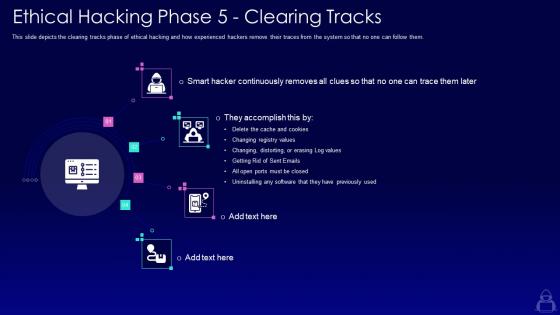
This slide depicts the clearing tracks phase of ethical hacking and how experienced hackers remove their traces from the system so that no one can follow them.
People who downloaded this PowerPoint presentation also viewed the following :
Ethical hacking phase 5 clearing tracks ppt powerpoint presentation visual aids summary with all 6 slides:
Use our Ethical Hacking Phase 5 Clearing Tracks Ppt Powerpoint Presentation Visual Aids Summary to effectively help you save your valuable time. They are readymade to fit into any presentation structure.





FAQs for Ethical hacking phase 5 clearing tracks ppt powerpoint presentation
Ethical hacking differs from malicious hacking through authorized access, transparent reporting, protective intent, and legal compliance, while malicious hacking involves unauthorized intrusion and criminal activity. Ethical hackers work with organizations to identify vulnerabilities before cybercriminals exploit them, ultimately strengthening security frameworks and delivering enhanced protection, while malicious hackers seek financial gain or cause damage through illegal activities.
Individuals can pursue ethical hacking careers through cybersecurity degrees, industry certifications like CEH or CISSP, hands-on practice with penetration testing tools, and specialized bootcamps or training programs. Many organizations increasingly seek professionals who combine technical expertise with business acumen, with sectors like banking, healthcare, and retail finding that certified ethical hackers deliver enhanced security postures, reduced breach risks, and stronger regulatory compliance.
Ethical hacking enhances cybersecurity by proactively identifying vulnerabilities, testing system defenses, simulating real-world attack scenarios, and providing actionable security recommendations before malicious actors can exploit weaknesses. Through penetration testing and security assessments, organizations across sectors like banking, healthcare, and retail can strengthen their infrastructure, reduce breach risks, and maintain customer trust, ultimately delivering robust protection and competitive advantage.
Ethical hackers ensure operational continuity through comprehensive pre-testing agreements, controlled testing environments, and phased vulnerability assessments that isolate critical systems from potential disruption. These professionals work closely with IT teams to establish testing windows, create data backups, and implement real-time monitoring protocols, ultimately delivering security insights while maintaining business functionality and protecting sensitive information throughout the assessment process.
**INPUT**: What are some common tools and technologies used by ethical hackers in their assessments? **OUTPUT**: Common ethical hacking tools include Nmap for network scanning, Metasploit for penetration testing, Wireshark for traffic analysis, Burp Suite for web application testing, and Nessus for vulnerability assessment. These technologies streamline security evaluations by automating threat detection, identifying system weaknesses, and simulating real-world attacks, with many organizations finding that comprehensive assessments ultimately enhance their defensive capabilities and reduce breach risks. [Word count: 60 words]
Ethical hackers stay updated through continuous learning platforms, vulnerability databases like CVE and NVD, cybersecurity conferences, and threat intelligence feeds from security vendors. They actively participate in bug bounty programs, security forums, and professional networks, while pursuing certifications and attending training sessions, ultimately maintaining their expertise in an increasingly dynamic threat landscape where staying current delivers competitive advantage.
Ethical hackers must adhere to strict authorization protocols, maintaining explicit written consent, respecting scope boundaries, preserving data confidentiality, and ensuring minimal system disruption during testing. These professionals follow responsible disclosure practices, document findings securely, and avoid accessing personal information unnecessarily, with many cybersecurity firms finding that clear ethical frameworks ultimately deliver stronger client trust and more effective security assessments.
Yes, ethical hacking significantly helps organizations comply with regulatory frameworks like GDPR and HIPAA by identifying vulnerabilities, testing data protection measures, and validating security controls before audits. Through penetration testing and vulnerability assessments, healthcare institutions and financial services can demonstrate due diligence in protecting sensitive data, ultimately reducing compliance risks and avoiding costly regulatory penalties.
Organizations determine ethical hacking scope through comprehensive asset inventory, risk assessment, compliance requirements, and business-critical system identification. These engagements typically focus on network infrastructure, web applications, and data repositories, with many financial institutions and healthcare providers finding that clearly defined boundaries and specific testing objectives ultimately deliver actionable security insights and regulatory compliance.
Notable ethical hacking successes include penetration testing that revealed critical vulnerabilities in banking systems, bug bounty programs uncovering zero-day exploits in major platforms, and red team exercises exposing weaknesses in healthcare networks. These strategic security assessments enable organizations to patch vulnerabilities before malicious actors exploit them, ultimately delivering enhanced protection, regulatory compliance, and competitive advantage in an increasingly threat-laden digital landscape.
Bug bounty programs formalize ethical hacking by inviting security researchers to find and report vulnerabilities in exchange for monetary rewards, creating structured partnerships between organizations and ethical hackers. These programs deliver enhanced security coverage through diverse expertise, cost-effective vulnerability discovery compared to traditional audits, and improved incident response capabilities, with companies like Microsoft and Google finding that crowdsourced security testing significantly strengthens their defense posture while building trust.
Social engineering involves manipulating human psychology to extract confidential information or gain unauthorized access through deception, phishing, pretexting, and baiting techniques. Ethical hackers utilize these methods in controlled assessments to identify vulnerabilities in employee training and organizational security awareness, ultimately helping companies strengthen their human firewall defenses and minimize susceptibility to real-world attacks.
Ethical hacking risks include potential system damage, data exposure, scope creep beyond authorized boundaries, and misinterpretation of findings by stakeholders. While proper authorization and contracts mitigate legal concerns, organizations must ensure clear engagement parameters, comprehensive documentation, and compliance with regulations like GDPR, with many finding that structured programs ultimately enhance security posture.
Ethical hacking for web applications focuses on input validation, authentication flaws, and application-layer vulnerabilities through techniques like SQL injection testing and cross-site scripting analysis. Network system testing emphasizes infrastructure security, examining firewalls, routers, and network protocols through port scanning and penetration testing, with organizations finding that comprehensive approaches addressing both application and network layers deliver stronger overall security postures.
Future trends in ethical hacking include AI-powered vulnerability assessment, quantum-resistant security protocols, cloud-native penetration testing, IoT device security auditing, and blockchain-based threat detection systems. These evolving methodologies enable organizations to stay ahead of sophisticated cyber threats, automate security processes, and protect increasingly complex digital infrastructures, ultimately delivering enhanced resilience and competitive advantage.
-
Professional and unique presentations.
-
Awesome use of colors and designs in product templates.