


Ethical hacking white hat hacker vs black hat hacker ppt example file




Try Before you Buy Download Free Sample Product
 Impress Your
 Audience
 100%
100% Editable
 Save Hours
 of Time


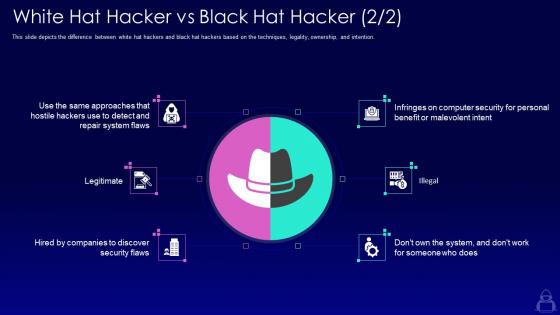
This slide depicts the difference between white hat hackers and black hat hackers based on the techniques, legality, ownership, and intention.
People who downloaded this PowerPoint presentation also viewed the following :
Ethical hacking white hat hacker vs black hat hacker ppt example file with all 6 slides:
Use our Ethical Hacking White Hat Hacker Vs Black Hat Hacker Ppt Example File to effectively help you save your valuable time. They are readymade to fit into any presentation structure.





FAQs for Ethical hacking white hat hacker vs black hat hacker
Dude, first thing - get written permission before you touch ANYTHING. Seriously, without that you're just a regular hacker. Stay in your lane too, don't go poking around systems they didn't ask you to test. If you find vulnerabilities, report them to the client first instead of posting about it online like an idiot. Document everything as you go so there's proof of what you did and when. Oh and obviously don't mess with any sensitive data you stumble across. Honestly the permission thing can't be stressed enough - that's what separates ethical hacking from... well, just hacking.
So basically, ethical hackers get permission first - that's the huge difference. They're trying to help companies find weak spots in their security. Malicious hackers? They just break in to steal stuff or mess things up for money. It's like having a locksmith test your door vs some random person trying to break in at 2am (which is terrifying btw). Ethical hackers have to follow rules, write everything down, and tell the company what they found. If you ever want to try it, get written permission first or you'll definitely end up in legal trouble.
So the main tools everyone uses are Nmap for scanning networks, Metasploit for pen testing, and Wireshark to analyze packets. Burp Suite is probably what I use most for web app stuff - super handy. Nessus does vulnerability scans, Aircrack-ng handles wireless testing, and John the Ripper cracks passwords. Oh, and OWASP ZAP is solid too if you want something free. Honestly just grab VirtualBox first and throw Kali Linux on it. Start messing around with Nmap and Burp Suite - those two will teach you the basics pretty quickly. Way better than jumping into everything at once.
Start with networking basics and get comfortable with Linux - that's your bread and butter. Python's probably the best first language to pick up, but JavaScript helps too since web apps are where most of the fun vulnerabilities live. CompTIA Security+ is a decent starting cert, though honestly some hiring managers care more about what you can actually do. You'll be explaining complex stuff to people who have no clue what you're talking about, so work on that communication thing. Oh, and databases - learn how they work because SQL injection is still everywhere. The field changes fast so you'll always be learning something new.
Dude, ethical hackers are worth their weight in gold. They find all the weak spots before actual criminals do. Think of it like hiring a burglar to test your locks, except legal and way more technical. They'll hit your systems from every angle - apps, networks, even trying to trick your employees with fake phishing emails (which honestly can be pretty entertaining to watch). Way better to discover problems now than after someone's already stolen your data. Trust me, fixing a bug is infinitely cheaper than dealing with angry customers and lawyers. I'd start small though - just test your most important stuff first.
Dude, this stuff is all over the place depending where you are. US laws like the CFAA are pretty straightforward if you've got proper authorization first. But Europe? Each country does their own thing - it's honestly a mess to navigate. Singapore will come down hard even if you meant well, which is kinda harsh IMO. The UK's usually cool with ethical hackers as long as you do responsible disclosure. Other countries though? They don't really care about your intentions. Always get written permission before you touch anything, and definitely check local laws if you're crossing borders.
Yeah, ethical hacking can totally transform your security setup if you do it right. Start with basic pen testing on your critical systems - I'd work with certified hackers who document everything properly. Bug bounty programs are solid too, plus red team exercises that mimic actual attacks. Honestly, I've watched companies find holes their regular security tools completely missed, which was pretty wild to see. The whole approach just gives you a way better picture than traditional scanning alone. Once you see what that first test reveals, you can expand from there.
So there's CEH and CISSP if you're leaning toward management stuff. But honestly? OSCP is where it's at - total nightmare to get through but every employer I know goes crazy for it. CompTIA PenTest+ is way more chill for starting out. GIAC has GPEN too, though that one's pricey as hell. Really depends what you wanna specialize in first. I'd scroll through some job posts around here and see what keeps showing up - that's usually your best bet for figuring out priorities.
So ethical hackers basically run security checkups on your systems to catch vulnerabilities before actual criminals do. First they'll use automated tools like Nessus or OpenVAS to spot known issues. Then comes the manual stuff - testing for misconfigurations, logic flaws, SQL injection, cross-site scripting, you name it. Honestly, it's way more thorough than most people expect. You should probably get this done quarterly if you can swing it - that way you're patching holes before they turn into actual breaches. Think of it like preventive maintenance but for cybersecurity.
So penetration testing is where you actually get to break into stuff (legally, obviously). You're basically playing the role of a hacker but for good reasons - finding weak spots before actual criminals do. It's like testing how secure your house is by trying to break in yourself, which sounds weird when I put it that way lol. Most of your hands-on work in ethical hacking will be pen testing. You'll use the same tools and methods that malicious hackers use, just with permission. The goal? Find vulnerabilities so companies can patch them up before they become real problems.
Planning everything out beforehand is huge - get that scope agreement locked down so you know exactly what's fair game. I usually run tests in sandboxed environments or during maintenance windows when nobody's really using the systems. Start small and work your way up instead of going full force right away. Monitor how everything's performing as you go. Keep the IT team in the loop constantly - they hate surprises, trust me. Oh, and definitely have a backup plan ready before you touch anything. Last thing you want is to break something with no way to fix it.
Honestly, the biggest thing is legal liability - cross the wrong line and you're screwed. Data breaches are another nightmare, plus you might accidentally brick their systems. I've watched pentesters crash production servers during "harmless" scans, which is... not ideal. Client relationships can get messy too if you find more problems than they want to deal with. Get everything in writing before you touch anything. Solid contracts are non-negotiable, plus good insurance. Oh, and document literally everything - trust me on this one. Stay within scope or you'll regret it.
Dude, AI is totally flipping ethical hacking on its head. You can automate vuln scans now and crunch through data way faster than doing everything manually. Pretty wild how it generates these crazy sophisticated attack scenarios too. But here's the thing - hackers are using the exact same tools, so it's gotten messy. Plus you've got these new attack surfaces to worry about, like prompt injection and model poisoning in AI systems themselves. I swear, traditional pen testing feels ancient now. You really gotta start diving into AI security stuff because the whole game's changed.
Dude, ethical hackers have literally saved so many companies from getting wrecked. Google's Project Zero team catches critical Windows vulnerabilities before the bad guys do. Tesla's smart too - they pay hackers through bug bounty programs to find car software flaws. Can you imagine hackers taking control of someone's Tesla? Scary stuff. White hat hackers also discovered huge problems in hospital systems and voting machines during security tests. Companies fix these issues before they blow up in the news. Honestly, if you're worried about your own security, maybe look into penetration testing or bug bounties?
Dude, ethical hackers are like having insurance for compliance stuff. They'll find weak spots in your systems before regulators do - or worse, actual criminals. Testing against GDPR, HIPAA, whatever you need. Then they document everything so when audit time comes, you're golden. Honestly, the simulation attacks they run are pretty clever. You get reports showing exactly where your data protection sucks and what to fix first. Oh, and having those reports proves to regulators that you're actually trying to secure things, which is half the battle right there.
-
Excellent work done on template design and graphics.
-
I discovered this website through a google search, the services matched my needs perfectly and the pricing was very reasonable. I was thrilled with the product and the customer service. I will definitely use their slides again for my presentations and recommend them to other colleagues.