


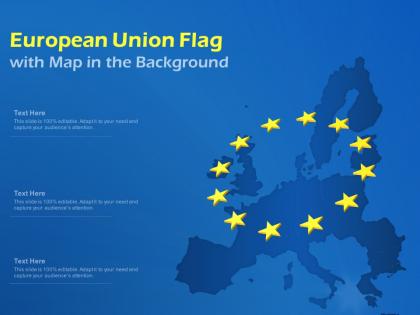
European union flag with map in the background




Try Before you Buy Download Free Sample Product
 Impress Your
 Audience
 100%
100% Editable
 Save Hours
 of Time


Our European Union Flag With Map In The Background are topically designed to provide an attractive backdrop to any subject. Use them to look like a presentation pro.
People who downloaded this PowerPoint presentation also viewed the following :
European union flag with map in the background with all 2 slides:
Use our European Union Flag With Map In The Background to effectively help you save your valuable time. They are readymade to fit into any presentation structure.

FAQs for European union flag with map
The European Union flag features twelve golden stars arranged in a circle on a blue background, symbolizing unity, solidarity, and harmony among European peoples. Blue represents the ideals of peace and stability, while the twelve stars signify completeness and perfection regardless of member count, with many European institutions finding that this timeless design reinforces collective identity and shared democratic values.
The EU flag symbolizes unity through its twelve golden stars arranged in a perfect circle on blue background, representing completeness, solidarity, and harmony among all member nations regardless of their individual number. This enduring design transcends national boundaries by creating shared visual identity, with member states displaying it alongside national flags in government buildings, diplomatic missions, and public ceremonies, ultimately fostering collective European identity and democratic values.
The EU flag's adoption in 1986 stemmed from decades of European integration efforts, beginning with the 1951 Coal and Steel Community, progressing through the 1957 Treaty of Rome, and accelerating with the 1986 Single European Act. This symbolized the Union's evolution from economic cooperation to political unity, with member nations finding that shared visual identity enhanced diplomatic cohesion and strengthened collective bargaining power globally.
The EU flag has been received differently across member countries, with acceptance often correlating with national EU support levels, economic benefits from membership, and historical political contexts. While countries like Germany and Belgium display strong positive reception through widespread public display and integration into national ceremonies, nations experiencing economic challenges or sovereignty concerns show more mixed reactions, with many citizens increasingly recognizing its symbolic importance for European unity and competitive advantage in global markets.
The EU flag serves as a powerful symbol of collective European identity in international forums, trade negotiations, and diplomatic missions, representing 27 member nations as a unified bloc. Through its presence at G7 summits, UN assemblies, and bilateral meetings, the flag enhances Europe's negotiating power and global influence, with many international partners finding that engaging with the unified EU delivers more comprehensive agreements and strategic partnerships.
The EU flag's twelve gold stars arranged in a circle on blue symbolize unity, solidarity, and harmony among European peoples, with the circle representing completeness and the number twelve signifying perfection. This design reflects the Union's core principles by emphasizing equality through identical stars, cooperation through their circular arrangement, and shared values across diverse member nations, ultimately delivering a visual representation of European integration and collective strength.
Common misconceptions about the EU flag include that the twelve stars represent the founding member countries, that stars are added when new nations join, that it's solely a political symbol, and that it has religious significance. Many people don't realize the stars symbolize unity and completeness in European tradition, remaining constant at twelve regardless of membership changes, ultimately representing European ideals rather than political structures.
The EU flag is flown at virtually all official EU events, including European Council meetings, parliamentary sessions, treaty signings, and diplomatic ceremonies. This consistent display reinforces European unity and institutional identity across member states, with the flag serving as a powerful symbol of shared values and collective governance in an increasingly integrated European landscape.
The primary EU flag features twelve golden stars on a blue background, with variations including protocol flags for official ceremonies, maritime versions for vessels, and institutional adaptations used by Parliament, Commission, and Council. These variations maintain the core symbolism while serving specific diplomatic, ceremonial, and administrative functions across member states, ultimately delivering standardized visual identity and institutional recognition in an increasingly integrated European landscape.
Non-EU countries relate to the EU flag through varied political lenses, from aspirational symbols in candidate nations like Ukraine and Moldova to diplomatic tools in Switzerland and Norway. These relationships reflect complex positioning strategies, with many neighboring countries finding that the flag represents both economic opportunity and sovereignty considerations, ultimately shaping their integration policies and public discourse.
**INPUT**: What are the protocols for displaying the EU flag at public and official gatherings? **OUTPUT**: EU flag protocols include positioning it at equal height with national flags, displaying it to the right of national flags, ensuring proper proportions, maintaining pristine condition, and following ceremonial precedence rules. These guidelines enable institutions, government offices, and diplomatic venues to demonstrate European unity while respecting national sovereignty, ultimately delivering consistent symbolic representation and diplomatic courtesy across member states.
Euroscepticism has polarized perceptions of the EU flag, with some viewing it as representing bureaucratic overreach and loss of national sovereignty, while others see it as symbolizing unity and cooperation. This divide has intensified during crises like Brexit and economic challenges, with many nations finding that the flag increasingly represents political identity rather than simple institutional membership, ultimately reflecting broader debates about European integration.
The EU flag strengthens European identity by providing a unifying visual symbol that transcends national boundaries, fostering shared values of unity, democracy, and cooperation among citizens. Through its presence at international events, government buildings, and cultural celebrations, many Europeans find that the flag enhances their sense of collective belonging while complementing rather than replacing national identities, ultimately delivering broader cultural connection.
Different political groups within the EU interpret the flag's symbolism through varying ideological lenses, with federalists emphasizing unity and integration while Eurosceptics focus on national sovereignty concerns. Pro-EU parties celebrate the circle representing equality and cooperation, while conservative and nationalist groups often view it as symbolizing centralized authority, ultimately reflecting broader debates about European identity versus national independence.
The EU flag serves as a unifying symbol at cultural festivals, sporting events, arts celebrations, and diplomatic gatherings across member nations, representing shared European identity and values. During events like Eurovision, European Capital of Culture celebrations, and international trade fairs, the flag enhances cross-border collaboration and cultural exchange, ultimately strengthening community bonds and European integration.
-
Excellent template with unique design.
-
Professional and unique presentations.
-
Understandable and informative presentation.