

Evaluating It System Security Using Swot Analysis Building A Security Awareness Program




Try Before you Buy Download Free Sample Product
 Impress Your
Audience
 100%
Editable
 Save Hours
of Time


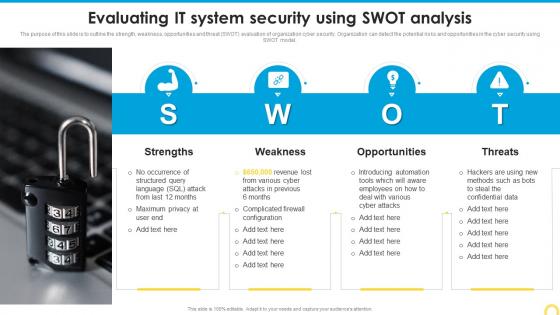
The purpose of this slide is to outline the strength, weakness, opportunities and threat SWOT evaluation of organization cyber security. Organization can detect the potential risks and opportunities in the cyber security using SWOT model.
People who downloaded this PowerPoint presentation also viewed the following :
Evaluating It System Security Using Swot Analysis Building A Security Awareness Program with all 6 slides:
Use our Evaluating It System Security Using Swot Analysis Building A Security Awareness Program to effectively help you save your valuable time. They are readymade to fit into any presentation structure.






FAQs for Evaluating It System Security Using Swot Analysis Building A
The most common IT system vulnerabilities include unpatched software, weak authentication protocols, misconfigured access controls, inadequate network segmentation, and human error through phishing attacks. These vulnerabilities create significant security gaps across industries, with many financial institutions and healthcare organizations finding that comprehensive security audits and employee training programs ultimately deliver stronger defenses and reduced breach risks.
Companies assess and prioritize IT infrastructure risks through vulnerability scanning, threat modeling, business impact analysis, asset classification, and risk matrices that evaluate probability versus potential damage. These systematic approaches enable organizations to allocate security resources strategically, with many financial institutions and healthcare systems finding that regular risk assessments significantly reduce breach likelihood while optimizing cybersecurity investments.
Employee training plays a crucial role in enhancing IT system security by educating staff on recognizing phishing attempts, implementing strong password protocols, identifying social engineering tactics, and following proper data handling procedures. Through comprehensive security awareness programs, organizations significantly reduce human error incidents, strengthen their overall security posture, and create a culture of cybersecurity vigilance, ultimately delivering enhanced protection and operational resilience.
Organizations can effectively implement multi-factor authentication by conducting thorough security assessments, selecting appropriate authentication methods like biometrics and tokens, integrating with existing systems, and providing comprehensive user training. Through phased rollouts, companies in banking, healthcare, and retail enhance security while maintaining user experience, ultimately reducing breach risks by over 99% and strengthening customer trust.
Best practices for securing cloud-based services include multi-factor authentication, data encryption, regular security audits, access controls, and continuous monitoring. These measures enhance protection by establishing identity verification, safeguarding data transmission, and detecting threats in real-time, with many organizations finding that strategic implementation ultimately delivers reduced vulnerabilities and improved compliance across their operations.
Businesses ensure compliance through comprehensive data governance frameworks, regular security audits, employee training programs, access controls, and automated monitoring systems. These approaches streamline regulatory adherence by minimizing data exposure, tracking information flows, and maintaining audit trails, with many organizations finding that proactive compliance strategies ultimately deliver enhanced customer trust and competitive advantage.
Regular software updates and patch management are critical for IT security because they address newly discovered vulnerabilities, enhance system defenses, and prevent exploitation by cybercriminals. Through automated patch management systems, organizations streamline security maintenance, reduce breach risks, and maintain compliance requirements, with many financial institutions and healthcare providers finding that proactive updating significantly strengthens their overall security posture.
Incident response plans mitigate security breach impact by establishing clear protocols for detection, containment, and recovery, while minimizing downtime and data loss through rapid response procedures. These structured frameworks enable organizations to reduce financial losses, maintain customer trust, and ensure regulatory compliance, with many financial institutions and healthcare providers finding that comprehensive plans significantly accelerate breach resolution.
Effective cyber threat detection technologies include artificial intelligence-powered analytics, behavioral monitoring systems, endpoint detection and response tools, network traffic analysis platforms, and automated incident response solutions. These technologies enhance security by identifying anomalies in real-time, accelerating threat response, and minimizing potential damage, with many organizations finding that strategic combinations deliver comprehensive protection and operational efficiency.
Organizations safeguard sensitive data during employee transitions by implementing immediate access revocation protocols, conducting comprehensive exit audits, and securing physical device returns. Through automated identity management systems, companies can instantly disable accounts, retrieve credentials, and monitor data access patterns, while conducting thorough security briefings ensures departing employees understand ongoing confidentiality obligations.
**INPUT**: What measures should be taken to secure remote work environments? **OUTPUT**: Securing remote work environments requires implementing VPNs, multi-factor authentication, endpoint protection software, regular security training, and encrypted communication tools. These measures streamline security by establishing secure connections, verifying user identities, and protecting devices from threats, with many organizations finding that comprehensive remote security protocols ultimately deliver enhanced operational efficiency and competitive advantage.
Penetration testing actively simulates real cyberattacks to exploit system weaknesses, while vulnerability assessments systematically identify and catalog potential security gaps without attempting exploitation. Both approaches deliver comprehensive security coverage, with vulnerability assessments providing broad risk visibility and penetration testing validating actual exploit potential, ultimately enabling organizations to prioritize remediation efforts and strengthen defenses against increasingly sophisticated threats.
Encryption secures data by converting it into unreadable code using mathematical algorithms, protecting information whether stored in databases, servers, or cloud systems, or transmitted across networks and communication channels. This technology enables organizations to safeguard sensitive customer information, financial records, and proprietary data from unauthorized access, with many institutions finding that robust encryption strategies significantly reduce breach risks while ensuring regulatory compliance.
Organizations leverage artificial intelligence to enhance security through predictive threat detection, automated incident response, behavioral analytics, real-time monitoring, and intelligent vulnerability assessment. These AI-driven capabilities streamline security operations by identifying anomalies faster, reducing false positives, and enabling proactive defense strategies, with many financial institutions and healthcare organizations finding that automated threat intelligence ultimately delivers stronger protection and significantly reduced response times.
Preventing insider threats requires comprehensive access controls, continuous monitoring systems, behavioral analytics, regular security training, and strict data governance policies. These strategies work by establishing role-based permissions, detecting unusual activities, and fostering security awareness, with many organizations finding that combining technical safeguards with cultural initiatives significantly reduces internal vulnerabilities while maintaining operational efficiency.
-
SlideTeam offers so many variations of designs and topics. It’s unbelievable! Easy to create such stunning presentations now.
-
I want to thank SlideTeam for the work that they do, especially their customer service.