

Evolution Of Generative AI The Next Big Thing In Technology AI SS V




Try Before you Buy Download Free Sample Product
 Impress Your
Audience
 100%
Editable
 Save Hours
of Time


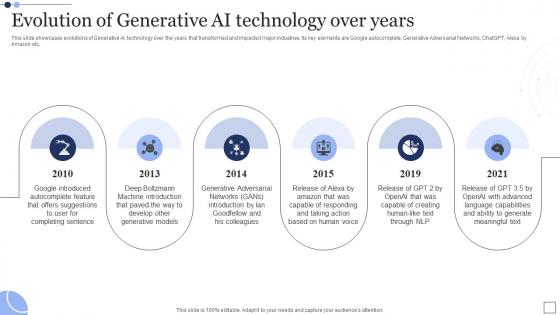
This slide showcases evolutions of Generative AI technology over the years that transformed and impacted major industries. Its key elements are Google autocomplete, Generative Adversarial Networks, ChatGPT, Alexa by Amazon etc.
People who downloaded this PowerPoint presentation also viewed the following :
Evolution Of Generative AI The Next Big Thing In Technology AI SS V with all 9 slides:
Use our Evolution Of Generative AI The Next Big Thing In Technology AI SS V to effectively help you save your valuable time. They are readymade to fit into any presentation structure.









FAQs for Evolution Of Generative AI The Next Big Thing In Technology
So basically, traditional AI looks at data and goes "based on what I've seen, here's my prediction." Pretty straightforward stuff - like forecasting sales or sorting emails. Generative AI? Totally different beast. It actually creates new stuff from scratch - writes stories, makes images, codes programs. Think Netflix recommendations vs ChatGPT writing you a poem. Both use similar tech under the hood, but one's analyzing while the other's being creative (which honestly still blows my mind). Quick test: need insights from existing data or need something brand new made? That'll tell you which direction to go.
So AI is basically taking over parts of the creative world right now. You can literally type "draw me a dragon" and get decent art, same with music and writing. It's honestly pretty crazy how far it's come. Artists are kinda split on this - some use it for brainstorming or rough drafts, which saves tons of time on boring stuff. Others worry it'll make human work less valuable or replace them entirely. I think the smart move is learning to work WITH these tools instead of pretending they don't exist. Like, you're not gonna win fighting against them, you know?
Honestly, the copyright stuff is probably the biggest mess - these models scrape content without asking anyone. You've gotta be transparent about using AI too, which some people conveniently forget. The whole "artists losing jobs" thing is genuinely depressing if you think about it too much. Bias is another problem since the outputs can reflect whatever garbage was in the training data. Oh, and fake-looking content that's actually total BS? Yeah, that's a thing. Just be honest when you use it and double-check anything important before you hit publish.
Oh dude, generative AI is actually a game-changer for marketing stuff. I use it all the time for email campaigns and social media posts - you can customize everything for different customer groups without losing your mind. Also great for cranking out multiple ad variations when you're A/B testing. My team was stuck on product descriptions last month and AI totally saved us from that creative block. The chatbot responses it writes don't sound super robotic either, which is nice. Just don't use whatever it spits out directly - you'll want to tweak it so it actually sounds like your brand.
Dude, AI is absolutely changing how research gets done. Scientists are using it to spot patterns in massive datasets that would take forever to find otherwise. Drug discovery is getting crazy fast - AI can predict protein structures and generate new compounds in weeks instead of years. It's also great for simulating complex systems and automating those tedious literature reviews (thank god). Honestly, the pattern recognition stuff is probably the biggest game-changer. If you're doing any kind of data analysis or hypothesis testing, I'd definitely check out some AI tools to speed up your workflow. The tech is moving so fast it's hard to keep up.
Dude, generative AI has become such a game-changer for coding. GitHub Copilot and ChatGPT can pump out code snippets and debug stuff way faster than me scrolling through Stack Overflow at 2am (been there too many times). They're crazy good at explaining algorithms in normal English too. You can prototype ideas super quick and get all that boring boilerplate code generated instantly. The suggestions are honestly pretty spot-on most of the time. Just don't trust it blindly - it'll still mess up or miss important context. Think of it like having a really smart junior dev helping out. Great for speeding things up, but you're still the one calling the shots.
Honestly, data quality will probably make you want to pull your hair out - you need tons of clean data or everything falls apart. Infrastructure costs are brutal too, like seriously budget 3x what you're thinking for compute. Models can be super unpredictable and biased, which is fun to explain to stakeholders. Oh and regulatory stuff is getting messier by the day. Start with something small first though. Set clear goals upfront so you know if it's actually working. I learned the hard way that proof-of-concepts save you from bigger disasters later.
Honestly, I'd start with something simple like making quiz questions for your next class. See how that goes first. AI's pretty solid at creating personalized stuff for different learning styles and giving students quick feedback on their work. Super helpful for cutting down your prep time too - which let's be real, we all need more of. My friend uses it to create those step-by-step problem walkthroughs that students love. Interactive scenarios work great for tricky concepts. Just think of it as your teaching assistant, not something that'll replace what you actually know. Don't go overboard right away though.
So basically, generative AI looks at all your data - browsing history, what you buy, your preferences - and spits out custom content for each person. We're talking personalized product descriptions, email subject lines, ad copy, the whole thing. It's honestly pretty crazy how fast it works. You can get thousands of different versions in seconds. Marketers love it because they don't have to manually write everything anymore - the AI handles personalized videos, website experiences, even chatbot responses. Oh, and you can test way more creative ideas since you're not stuck making each piece by hand.
Look, generative AI is actually pretty solid for knocking out repetitive work. Start by figuring out what eats up most of your time - could be writing reports, data entry, drafting emails, whatever. Then find AI tools that tackle those specific things. I've seen it work great for generating product descriptions and code snippets too. Manufacturing companies use it for scheduling optimization. Healthcare does patient docs and insurance stuff with it. Honestly, the time savings can be ridiculous once you get it dialed in right.
Honestly, it's a total shitshow right now. Nobody knows who owns what when AI spits out content. The models trained on tons of copyrighted stuff without asking anyone first, which is... problematic. You might get sued even if your AI accidentally copies someone's work. Courts can't agree if AI content is even copyrightable - like, does a robot get intellectual property rights? Weird times. My advice? Keep notes on how you created things and maybe throw in some disclaimers when you're using AI tools. Better safe than sorry until the lawyers figure this mess out.
So generative AI was pretty basic in the early 2000s - just simple text and image stuff. Then transformer architecture hit around 2017 and everything changed. That's what powers ChatGPT and all those crazy tools now. We went from rule-based systems to these huge neural networks trained on basically the entire internet. Now AI can write code, make photorealistic images, compose music, even generate videos that look... honestly kinda scary real? The whole field moves so fast it's hard to keep up. If you're thinking about trying it, maybe start with ChatGPT for writing stuff - good way to test the waters.
So OpenAI's API and Hugging Face Transformers are probably your best starting points. LangChain's great for building actual AI apps. PyTorch and TensorFlow exist if you want to train from scratch, but honestly who has time for that? Most people just grab pre-trained models anyway. For images, you've got Stable Diffusion and DALL-E. Oh, and vector databases like Pinecone are everywhere now for RAG stuff - though I still think the name "Pinecone" is weird for a database lol. Start with Hugging Face though. Their model hub lets you mess around without setting up a million things first.
Yeah so basically whatever biases are in your training data just get copied straight into the AI's outputs. Kids pick up their parents' prejudices without knowing it - same thing here. The model's just matching patterns it learned, so if there were gender stereotypes or racial biases in the data, congrats, now your AI has them too. Honestly the whole thing is pretty frustrating. You gotta audit your datasets before training and test outputs across different groups. Catch this stuff early or you'll be dealing with biased results forever.
AI's gonna get crazy good at mixing everything together - text, images, video, audio all at once. The reasoning will be way sharper too, plus it'll handle huge documents without choking. Honestly, the speed this stuff is moving is kinda insane. Quality keeps getting better while prices drop through the floor. Makes me wonder what my job will look like in five years, lol. But seriously, mess around with the current tools now. You'll want that head start when the really wild stuff drops.
-
SlideTeam was so customer-centric and quick service-provider that I doubted the amount I was paying and literally re-checked the transaction.
-
It saves your time and decrease your efforts in half.