

Executive Summary A Brief Introduction Planning A Coffee Shop Business BP SS




Try Before you Buy Download Free Sample Product
 Impress Your
 Audience
 100%
100% Editable
 Save Hours
 of Time


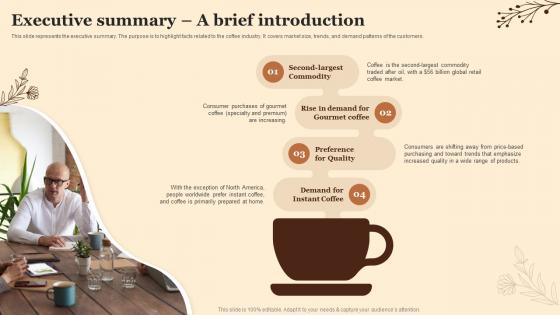
This slide represents the executive summary. The purpose is to highlight facts related to the coffee industry. It covers market size, trends, and demand patterns of the customers.
People who downloaded this PowerPoint presentation also viewed the following :
Executive Summary A Brief Introduction Planning A Coffee Shop Business BP SS with all 9 slides:
Use our Executive Summary A Brief Introduction Planning A Coffee Shop Business BP SS to effectively help you save your valuable time. They are readymade to fit into any presentation structure.








FAQs for Executive Summary A Brief Introduction Planning A Coffee Shop
A successful coffee shop business plan includes market analysis, competitive positioning, location strategy, financial projections, menu development, and operational workflows. These components work together by identifying target customers, optimizing cost structures, and streamlining service delivery, with many coffee entrepreneurs finding that thorough planning significantly enhances profitability and customer retention in an increasingly competitive market.
Market trends significantly influence coffee shop business plans by shaping menu development, pricing strategies, location selection, and operational approaches. Current trends like specialty brewing methods, plant-based alternatives, and sustainability practices drive strategic decisions, with many coffee entrepreneurs finding that aligning with consumer preferences for artisanal experiences and ethical sourcing ultimately delivers competitive differentiation and customer loyalty.
Effective market research strategies include customer surveys, competitor analysis, demographic studies, location foot traffic analysis, and focus groups with target audiences. These approaches enable coffee shop entrepreneurs to identify customer preferences, pricing expectations, and market gaps, while many successful cafes find that combining online research with direct community engagement delivers the most actionable insights for strategic positioning.
Understanding target customer demographics shapes coffee shop offerings through menu customization, pricing strategies, ambiance design, and service models tailored to specific preferences and behaviors. For instance, targeting busy professionals might emphasize quick service and mobile ordering, while focusing on students could involve extended hours and study-friendly spaces, ultimately delivering enhanced customer experiences and stronger market positioning.
Location significantly impacts financial projections through rent costs, foot traffic potential, customer demographics, and local competition levels, directly affecting revenue forecasts and operational expenses. Prime locations with high visibility and accessibility command higher rents but deliver greater sales volumes, with many coffee shops finding that strategic positioning near offices, universities, or transit hubs ultimately justifies premium location costs through increased profitability.
Coffee shops can differentiate through specialized offerings like artisan roasting, unique brewing methods, locally-sourced ingredients, experiential elements, and strategic partnerships with local businesses or artists. These approaches enable establishments to create distinctive brand identities, foster community connections, and command premium pricing, with many successful shops finding that combining authentic storytelling with consistent quality ultimately delivers customer loyalty and sustainable competitive advantage.
Effective budgeting techniques include demand forecasting, just-in-time ordering, ABC inventory analysis, vendor negotiation, and seasonal planning adjustments. These approaches streamline costs by minimizing waste, optimizing storage space, and maintaining consistent quality, with many coffee shop owners finding that strategic supplier partnerships and inventory tracking systems ultimately deliver 15-20% cost reductions and enhanced operational efficiency.
A coffee shop should define its brand identity through target audience analysis, unique value proposition, visual elements like logo and color scheme, brand voice and personality, and competitive positioning strategy. This strategic combination enables differentiation in an increasingly crowded market, with many successful coffee shops finding that clear brand identity streamlines marketing efforts, enhances customer loyalty, and ultimately delivers consistent experiences that drive repeat business and sustainable growth.
Essential financial statements include income statements, cash flow projections, balance sheets, break-even analysis, and profit-and-loss forecasts spanning three to five years. These documents streamline investor evaluation by demonstrating revenue potential, operational costs, and growth trajectories, with many coffee shop entrepreneurs finding that detailed financial modeling ultimately delivers stronger funding opportunities and strategic operational insights.
Technology integration includes point-of-sale systems, mobile ordering apps, inventory management software, customer loyalty programs, and social media platforms. These tools streamline operations by reducing wait times, automating stock tracking, and enhancing customer engagement, with many coffee shops finding that digital ordering and targeted social campaigns ultimately drive repeat business and operational efficiency.
Common pitfalls include underestimating startup costs, overlooking local competition analysis, neglecting seasonal revenue fluctuations, insufficient market research, and unrealistic profit projections. These oversights often lead to cash flow problems, poor location decisions, and inadequate inventory planning, with many coffee entrepreneurs finding that thorough financial modeling and competitive positioning ultimately determine long-term success and operational sustainability.
Seasonal trends significantly influence coffee shop sales forecasting through temperature variations, holiday patterns, local events, and customer behavior shifts. Winter months typically drive higher hot beverage sales while summer increases iced drink demand, with many coffee shops finding that adjusting inventory, staffing levels, and promotional strategies around these predictable patterns ultimately delivers more accurate forecasting and improved operational efficiency.
Coffee shop marketing best practices include defining target demographics, developing brand identity, leveraging social media engagement, implementing loyalty programs, and establishing community partnerships. These strategies enhance customer retention by creating memorable experiences, building local connections, and fostering repeat visits, with many successful coffee shops finding that combining digital marketing with authentic community involvement ultimately delivers sustained foot traffic and competitive advantage.
Partnerships with local suppliers enhance sustainability by reducing transportation emissions, supporting regional economies, and ensuring fresher ingredients with shorter supply chains. These collaborations enable coffee shops to offer unique, seasonal menu items, build stronger community connections, and attract environmentally conscious customers, while often reducing costs and creating compelling marketing narratives around local sourcing and community support.
Legal considerations include business structure selection, licensing requirements, health department permits, employment law compliance, and liability insurance coverage. These regulations vary by location and business size, with many coffee shop owners finding that early legal consultation streamlines the permit process, ensures proper worker classifications, and establishes comprehensive insurance protection, ultimately reducing operational risks and regulatory complications.
-
Fantastic and innovative graphics with useful content. The templates are the best and latest in the industry.
-
Easily Understandable slides.