

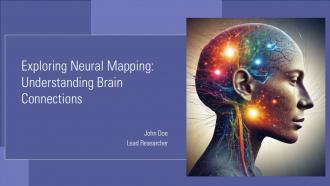
Exploring Neural Mapping Understanding Brain Connections PPT Presentation ST AI





Try Before you Buy Download Free Sample Product
 Impress Your
Audience
 100%
Editable
 Save Hours
of Time


Unlock the mysteries of the brain with our Exploring Neural Mapping Understanding Brain Connections PowerPoint presentation. This comprehensive deck delves into neural pathways, mapping techniques, and their implications for neuroscience. Perfect for educators, researchers, and students, it enhances understanding of complex brain networks and connectivity.
People who downloaded this PowerPoint presentation also viewed the following :
Exploring Neural Mapping Understanding Brain Connections PPT Presentation ST AI with all 39 slides:
Use our Exploring Neural Mapping Understanding Brain Connections PPT Presentation ST AI to effectively help you save your valuable time. They are readymade to fit into any presentation structure.










FAQs for Exploring Neural Mapping Understanding Brain Connections PPT
Neural mapping is the process of creating detailed representations of neural networks and brain structures using advanced computational methods, machine learning algorithms, and high-resolution imaging technologies. Unlike traditional mapping techniques that rely on static anatomical charts, neural mapping dynamically visualizes real-time brain activity, connectivity patterns, and synaptic relationships, enabling researchers and medical professionals to understand complex neurological functions with unprecedented precision and accuracy.
Neural mapping applications include brain connectivity analysis, cognitive function localization, disease progression tracking, neural network architecture design, and AI model optimization. These technologies enhance understanding by visualizing neural pathways, identifying dysfunction patterns, and enabling precise interventions, with researchers in neuroscience and AI development finding that detailed mapping accelerates both therapeutic breakthroughs and intelligent system performance.
Neural mapping enhances our understanding of brain connectivity by visualizing neural pathways, identifying communication patterns between brain regions, and revealing how different areas coordinate during cognitive tasks. These advanced imaging techniques enable neuroscientists to map both structural and functional connections, with research institutions finding that comprehensive connectivity maps accelerate breakthroughs in treating neurological disorders and optimizing brain health interventions.
Key neural mapping technologies include functional magnetic resonance imaging (fMRI), electroencephalography (EEG), optogenetics, calcium imaging, and diffusion tensor imaging. These technologies work together by capturing real-time brain activity, tracking neural pathways, and mapping connectivity patterns, with research institutions and medical centers finding that this strategic combination ultimately delivers enhanced diagnostic capabilities and accelerated neuroscience discoveries.
Machine learning algorithms enhance neural mapping accuracy by analyzing vast datasets to identify patterns, automating feature detection in brain scans, and continuously refining predictive models through iterative learning processes. These advanced computational methods enable researchers and medical professionals to achieve more precise brain tissue classification, faster diagnostic capabilities, and improved treatment planning, with many neuroscience institutions finding that AI-enhanced mapping delivers significantly better patient outcomes.
Neural mapping in medical research raises significant ethical considerations including informed consent complexities, data privacy protection, potential misuse of brain information, and equity in access to treatments. While these technologies present challenges around mental privacy and cognitive enhancement disparities, they also deliver unprecedented opportunities for treating neurological disorders, with many medical institutions finding that robust ethical frameworks ultimately enable both patient protection and groundbreaking therapeutic advances.
Neural mapping informs brain-computer interface development by identifying optimal electrode placement sites, determining signal patterns for specific intentions, and establishing neural pathways for motor and cognitive functions. Through detailed cortical mapping, researchers can enhance signal accuracy, reduce invasiveness, and improve user control precision, with many medical device companies finding that comprehensive neural maps ultimately deliver more reliable interfaces and better patient outcomes.
Neural mapping significantly advances neuroplasticity research by providing detailed visualizations of brain structure changes, tracking synaptic adaptations, and identifying neural pathway reorganization patterns. These mapping technologies enable researchers and clinicians to monitor rehabilitation progress, optimize therapeutic interventions, and develop personalized treatment protocols, with stroke recovery centers and brain injury rehabilitation facilities finding measurably improved patient outcomes.
Current neural mapping methodologies face limitations including spatial resolution constraints, temporal processing delays, invasive procedure requirements, high computational costs, and data interpretation complexities. While these challenges present obstacles, many research institutions and medical centers are finding that emerging technologies like advanced imaging and machine learning algorithms increasingly enhance mapping precision, ultimately delivering more accurate brain analysis and improved neurological treatments.
Neural mapping assists in diagnosing neurological disorders by identifying abnormal brain activity patterns, pinpointing structural anomalies, and tracking neural pathway disruptions through advanced imaging technologies. This approach enables neurologists to detect conditions like epilepsy, Alzheimer's, and stroke with greater precision, ultimately delivering faster diagnoses and more targeted treatment plans for improved patient outcomes.
Neural mapping enables researchers to identify memory formation pathways, track learning-related brain changes, and understand how different regions coordinate during cognitive processes. Through advanced imaging techniques, neuroscientists can observe real-time neural activity during memory tasks, learning experiments, and skill acquisition, with many educational institutions and research centers finding that these insights revolutionize personalized learning approaches and cognitive enhancement strategies.
Advancements in neuroimaging techniques revolutionize neural mapping by enabling higher spatial resolution, real-time brain activity monitoring, and enhanced connectivity analysis between neural networks. These technological improvements allow researchers and clinicians to create more precise brain maps, accelerate diagnostic processes, and develop targeted treatments, with neurology centers increasingly finding that advanced imaging delivers better patient outcomes and more effective therapeutic interventions.
Neural mapping can personalize mental health treatments by identifying individual brain patterns, mapping neural connectivity differences, and revealing biomarkers specific to each patient's condition. Through advanced neuroimaging and AI analysis, clinicians can tailor therapies, optimize medication selections, and predict treatment responses, with many psychiatric hospitals finding that personalized approaches significantly improve patient outcomes and reduce trial-and-error prescribing.
Integrating neural mapping data presents challenges including varying resolution standards, different imaging protocols, inconsistent annotation methods, temporal misalignments, and diverse analytical frameworks across studies. These technical complexities require standardized data formats, harmonized processing pipelines, and robust validation protocols, with many research institutions finding that collaborative platforms and shared methodologies ultimately enhance reproducibility and accelerate breakthrough discoveries.
Neural mapping enables researchers to visualize complex brain networks by combining advanced imaging techniques, computational modeling, and data visualization tools to create detailed representations of neural connectivity and activity patterns. Through technologies like fMRI and diffusion tensor imaging, neuroscientists can track neural pathways, identify network hubs, and map functional regions, ultimately delivering insights that enhance understanding of brain disorders, cognitive processes, and treatment approaches.
-
Placing an order on SlideTeam is very simple and convenient, saves you a lot of your time.
-
The team is highly dedicated and professional. They deliver their work on time and with perfection.