

Exploring The Sonication Method For Enhanced Results Ppt Template ST AI





Try Before you Buy Download Free Sample Product
 Impress Your
Audience
 100%
Editable
 Save Hours
of Time


Unlock the potential of your presentations with our Exploring The Sonication Method PowerPoint template. This professional deck features visually engaging slides, comprehensive data analysis, and innovative design elements, perfect for showcasing enhanced results in scientific research. Elevate your message and captivate your audience effortlessly.
People who downloaded this PowerPoint presentation also viewed the following :
Exploring The Sonication Method For Enhanced Results Ppt Template ST AI with all 40 slides:
Use our Exploring The Sonication Method For Enhanced Results Ppt Template ST AI to effectively help you save your valuable time. They are readymade to fit into any presentation structure.














FAQs for Exploring The Sonication Method For Enhanced Results Ppt
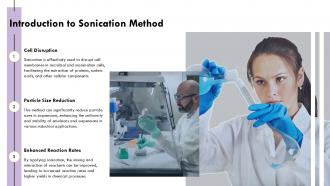
Sonication uses high-frequency sound waves to agitate particles in liquid, creating microscopic bubbles that implode and generate intense localized energy. This technique streamlines cell disruption, DNA extraction, and nanoparticle dispersion across pharmaceutical, biotechnology, and materials research laboratories, ultimately delivering faster sample preparation, enhanced mixing efficiency, and improved analytical accuracy.
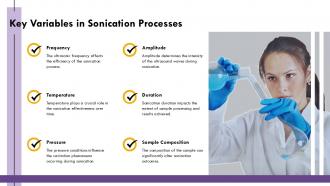
**INPUT**: How does the frequency and amplitude of ultrasonic waves affect the sonication process? **OUTPUT**: Ultrasonic frequency and amplitude significantly influence sonication effectiveness by controlling cavitation intensity, particle size reduction, and energy distribution throughout the sample. Higher frequencies enable precise cellular disruption and emulsification in pharmaceutical and biotechnology applications, while optimized amplitude settings enhance extraction efficiency and homogenization consistency, ultimately delivering superior product quality and processing control. [Word count: 54 words]
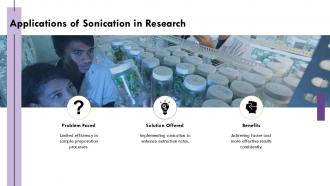
Common sonication applications in biology and chemistry include cell lysis for protein extraction, DNA fragmentation, homogenization of tissue samples, nanoparticle synthesis, and emulsification processes. These techniques streamline laboratory workflows by accelerating sample preparation, enhancing reaction efficiency, and improving reproducibility across pharmaceutical research, biotechnology development, and analytical chemistry, with many laboratories finding that ultrasonic processing delivers faster results and better sample quality.
Sonication delivers superior efficiency compared to mechanical homogenization, freeze-thaw cycles, and enzymatic lysis by providing precise control, faster processing times, and higher protein yields. While requiring careful optimization to prevent sample overheating, many research laboratories and biotechnology companies find that ultrasonic disruption consistently achieves 85-95% cell breakage rates, ultimately enabling faster downstream processing and improved product recovery across diverse applications.
Sonication effectively processes both solid and liquid samples, though each requires distinct approaches regarding power intensity, probe selection, temperature control, and processing duration. Solid samples typically need higher energy input and specialized probe tips for particle breakdown, while liquids require gentler parameters for emulsification or mixing, with laboratories finding that optimized protocols for each sample type deliver superior extraction efficiency and reproducible results.
Essential safety measures include wearing appropriate PPE like safety glasses and hearing protection, ensuring proper ventilation to manage aerosols, maintaining equipment regularly, and using sound-dampening enclosures. These protocols streamline laboratory operations by minimizing contamination risks, reducing noise exposure, and preventing equipment damage, with many research institutions finding that comprehensive safety frameworks ultimately enhance both researcher wellbeing and experimental reliability.
Sonication method significantly influences nanoparticle size and distribution by breaking down particle aggregates through high-frequency ultrasonic waves, reducing average particle size while creating more uniform dispersions. The cavitation bubbles generated during sonication deliver intense localized energy that fragments larger clusters, with pharmaceutical and materials manufacturing industries finding that optimized sonication parameters enable better product consistency, enhanced bioavailability, and improved suspension stability.
Temperature significantly affects sonication efficiency by influencing cavitation bubble formation, viscosity, and chemical reaction rates, with higher temperatures generally enhancing cavitation intensity but potentially degrading heat-sensitive materials. Control methods include ice baths, temperature-controlled water baths, pulsed sonication protocols, and automated cooling systems, with many laboratories finding that maintaining optimal temperature ranges between 4-25°C delivers consistent results while preserving sample integrity.
Sonication effectiveness can be measured through particle size analysis, temperature monitoring, power consumption tracking, and acoustic field mapping across different experimental configurations. These measurement approaches enable researchers to optimize parameters like frequency, amplitude, and duration for specific applications, with laboratories finding that combining multiple measurement techniques delivers more reliable results and enhances reproducibility in diverse experimental setups.
Sonication limitations include potential sample heating, protein denaturation, inconsistent results across different sample types, equipment maintenance requirements, and noise generation during operation. While these challenges exist, many laboratories find that careful parameter optimization, temperature monitoring, and proper technique training effectively minimize these issues, ultimately delivering reliable cell disruption and extraction results across pharmaceutical, biotechnology, and academic research applications.
Solvent selection significantly impacts sonication effectiveness by influencing cavitation intensity, particle dispersion rates, and extraction efficiency through varying viscosity, surface tension, and chemical compatibility. Polar solvents like ethanol enhance pharmaceutical extractions, while non-polar solvents optimize lipid recovery in food processing, with many laboratories finding that strategic solvent matching delivers faster processing and higher yields.
Recent advancements in sonication technology include ultrasonic processors with enhanced frequency control, automated amplitude modulation systems, real-time temperature monitoring, and multi-frequency probe designs. These innovations streamline sample preparation, cell disruption, and nanoparticle synthesis by delivering more precise energy control, reducing processing times, and minimizing sample degradation, with pharmaceutical and biotechnology companies finding significantly improved reproducibility and scalability.
Sonication enhances bioactive compound extraction by creating acoustic cavitation bubbles that disrupt plant cell walls, increasing mass transfer rates, and reducing extraction time significantly. This ultrasound-assisted method enables pharmaceutical and nutraceutical companies to achieve higher yields of valuable compounds like antioxidants and alkaloids while minimizing solvent usage, ultimately delivering more efficient and cost-effective extraction processes.
**INPUT**: What troubleshooting techniques can be applied if sonication does not yield the expected results? **OUTPUT**: Sonication troubleshooting involves adjusting amplitude settings, modifying pulse durations, optimizing sample temperature, checking probe positioning, and verifying buffer compositions to enhance efficiency. These systematic approaches enable researchers across pharmaceutical and biotechnology sectors to achieve consistent cell lysis, protein extraction, and nanoparticle dispersion, ultimately delivering reliable experimental outcomes and maintaining laboratory productivity standards. [Word count: 54 words]
Sonication improves experimental reproducibility by ensuring uniform particle dispersion, eliminating aggregation variability, and providing consistent energy distribution across samples. Through standardized frequency and amplitude parameters, researchers achieve reliable homogenization, precise emulsification, and repeatable extraction yields, with laboratories finding that controlled sonication protocols minimize batch-to-batch variations and enhance data reliability.
-
Wonderful ideas and visuals. I'm really pleased with the templates, which are unique and up to date.
-
You guys are life-saver when it comes to presentations. Honestly I cannot do much without your services. Thank you!!!