

F218 Employee Training For Procurement Process Improving Management Logistics Automation




Try Before you Buy Download Free Sample Product
 Impress Your
 Audience
 100%
100% Editable
 Save Hours
 of Time


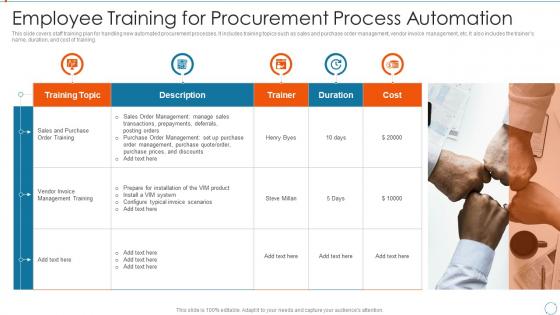
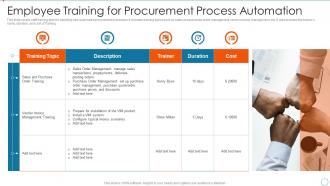
This slide covers staff training plan for handling new automated procurement processes. It includes training topics such as sales and purchase order management, vendor invoice management, etc. It also includes the trainers name, duration, and cost of training.
People who downloaded this PowerPoint presentation also viewed the following :
F218 Employee Training For Procurement Process Improving Management Logistics Automation with all 6 slides:
Use our F218 Employee Training For Procurement Process Improving Management Logistics Automation to effectively help you save your valuable time. They are readymade to fit into any presentation structure.





FAQs for F218 Employee Training For Procurement Process Improving
Effective methods for assessing employee training needs include performance evaluations, skills gap analyses, employee surveys, manager feedback, and competency assessments. These approaches streamline workforce development by identifying specific knowledge deficits, aligning training with business objectives, and measuring skill progression, with many organizations finding that strategic needs assessment ultimately delivers enhanced productivity, reduced turnover, and stronger competitive positioning.
Organizations can measure training success through performance metrics, skill assessments, employee feedback surveys, retention rates, and productivity improvements. These evaluation methods enable companies to track knowledge transfer, behavioral changes, and business impact across departments, with many finding that comprehensive measurement approaches ultimately deliver higher ROI and enhanced competitive advantage.
Technology streamlines modern employee training through virtual reality simulations, AI-powered personalized learning paths, mobile microlearning platforms, and real-time performance analytics. These digital tools enhance engagement, reduce training costs, and accelerate skill development, with organizations across healthcare, finance, and manufacturing finding that technology-enabled training delivers faster competency building and measurable performance improvements.
Companies ensure training alignment by conducting thorough needs assessments, mapping learning objectives to strategic priorities, and establishing clear performance metrics tied to business outcomes. Through regular stakeholder consultations and data-driven evaluation processes, organizations can continuously adjust their training programs, ultimately delivering improved productivity, enhanced employee engagement, and measurable competitive advantage across all business functions.
Personalized training plans deliver enhanced skill development, improved employee engagement, better retention rates, faster competency building, and increased job satisfaction. These strategic approaches streamline learning by addressing individual knowledge gaps, aligning with career goals, and maximizing resource allocation, with many organizations finding that customized training ultimately reduces turnover costs while accelerating professional growth and operational efficiency.
Organizations foster continuous learning cultures by implementing mentorship programs, providing regular skills assessments, offering flexible learning budgets, creating knowledge-sharing sessions, and establishing clear development pathways. Through strategic combinations of formal training, peer collaboration, and self-directed learning opportunities, companies enhance employee engagement, improve retention rates, and build adaptive workforces, with many finding that continuous learning initiatives ultimately deliver competitive advantage in rapidly evolving markets.
Best practices for onboarding new employees include structured orientation programs, role-specific skill development, mentorship pairing, interactive learning modules, and regular progress assessments. These approaches streamline integration by establishing clear expectations, accelerating productivity, and building workplace relationships, with many organizations finding that comprehensive onboarding reduces turnover while enhancing employee engagement and long-term performance.
Remote and hybrid training encompasses digital collaboration tools, virtual communication skills, time management techniques, cybersecurity protocols, and remote leadership development. These programs enhance productivity by streamlining virtual workflows, improving cross-team coordination, and maintaining security standards, with many organizations finding that structured remote training ultimately delivers higher employee engagement and operational efficiency.
Managers support employee training by setting clear learning objectives, providing dedicated time and resources, offering regular feedback and mentorship, and connecting training outcomes to career advancement opportunities. Through active participation in training sessions and follow-up discussions, managers reinforce learning while demonstrating organizational commitment, ultimately enhancing skill retention and employee engagement across teams.
Key components of successful training program evaluation include reaction assessments, learning measurements, behavior change tracking, results analysis, and ROI calculations. These evaluation methods streamline program effectiveness by measuring participant satisfaction, knowledge retention, and workplace application, with many organizations finding that comprehensive evaluation delivers improved performance outcomes, enhanced resource allocation, and measurable competitive advantages across departments.
Strategies include interactive workshops, gamification elements, personalized learning paths, peer collaboration sessions, and regular feedback mechanisms. These approaches enhance engagement by creating dynamic experiences, fostering competition, addressing individual needs, and building community connections, with many organizations finding that varied delivery methods significantly improve retention rates and practical application.
Organizations leverage peer-to-peer learning through mentorship programs, cross-functional project teams, knowledge-sharing sessions, collaborative workshops, and internal communities of practice. These approaches enhance skill development by encouraging direct knowledge transfer, fostering team collaboration, and creating sustainable learning cultures, with many companies finding that peer learning reduces training costs while improving employee engagement and retention rates.
Employee feedback significantly impacts training content evolution by identifying knowledge gaps, highlighting relevant skill requirements, and revealing learning preferences across different roles and departments. Through continuous feedback loops, organizations can adapt their training materials, update outdated modules, and introduce new topics that directly address workplace challenges, ultimately ensuring training remains practical, engaging, and aligned with evolving business needs.
Companies can effectively train employees on compliance through regular workshops, interactive e-learning modules, scenario-based simulations, mentorship programs, and continuous assessment tools. These approaches streamline understanding by providing real-world applications, personalizing learning paths, and ensuring ongoing reinforcement, with many organizations finding that combining digital platforms with hands-on practice ultimately delivers better retention and regulatory adherence.
Training a diverse workforce presents challenges including varying learning styles, language barriers, cultural differences, generational preferences, and accessibility needs across team members. Organizations overcome these through multilingual resources, flexible delivery methods, culturally inclusive content, and adaptive technologies, with many companies finding that personalized training approaches ultimately enhance engagement and deliver stronger performance outcomes.
-
One word for SlideTeam–Versatile!
-
Definitely recommend SlideTeam to all who need help with PowerPoint presentations. Their design team can create anything you need.