


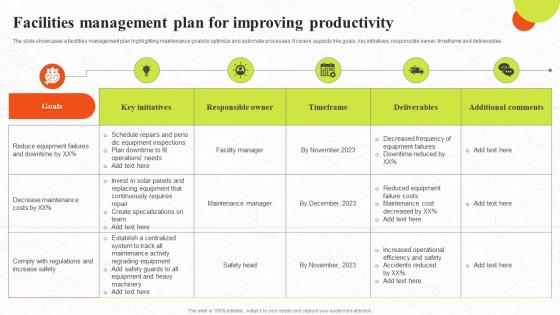
Facilities Management Plan For Improving Productivity




Try Before you Buy Download Free Sample Product
 Impress Your
 Audience
 100%
100% Editable
 Save Hours
 of Time


The slide showcases a five year plan for facilities improvement and optimization. It covers aspects like project, budget estimates and responsible owner for execution.
People who downloaded this PowerPoint presentation also viewed the following :
Facilities Management Plan For Improving Productivity with all 6 slides:
Use our Facilities Management Plan For Improving Productivity to effectively help you save your valuable time. They are readymade to fit into any presentation structure.





FAQs for Facilities Management Plan
Honestly, focus on the big four first: preventive maintenance, space planning, vendor management, and budget control. Most facilities skip tracking data though - which is dumb because how else do you know what's actually working? Emergency procedures and sustainability stuff should be built in early too, not tacked on later. Asset management and compliance tracking are also must-haves. I'd start by looking at what you've got now in each area, then tackle whatever's causing you the biggest headaches first. Budget will probably dictate the order anyway.
Honestly, tech is a total lifesaver for facilities management. IoT sensors track your HVAC and space usage automatically - no more guessing games. CMMS software handles all your work orders and maintenance schedules way better than spreadsheets ever could. Your team can report problems instantly through mobile apps instead of playing phone tag all day. The coolest part? Predictive analytics actually warns you before equipment craps out. Though I'd say start simple - maybe just tackle work order management first, then add other stuff once you've got that dialed in. Don't try to do everything at once or you'll drive yourself crazy.
Dude, sustainability isn't optional anymore in facilities management - it's literally driving everything. Energy audits are your best starting point, trust me. They'll show you which upgrades actually pay for themselves. LED lighting, efficient HVAC systems, waste reduction programs... all that stuff adds up to serious utility savings. Plus your employees will be happier (weird but true), and you'll hit those corporate ESG targets everyone's obsessing over now. Green building certifications are becoming standard too. What started as feel-good fluff is now straight-up business necessity for cost savings and staying compliant.
Dude, think of maintenance like going to the dentist - skip it and you're screwed later. Those little HVAC tune-ups and roof checks stop one broken thing from wrecking everything else. I watched a buddy ignore his roof for years, turned a simple repair into a total nightmare with water damage everywhere (his insurance wasn't thrilled either). You'll actually hit those 20-30 year lifespans if you stay on top of stuff. Start with whatever would be most expensive to replace. Trust me on this one.
Honestly, get everything in writing first - SLAs, response times, all that boring contract stuff. Verbal promises are useless when things hit the fan. Don't just call when stuff breaks either. Monthly check-ins keep everyone honest, plus quarterly reviews for the bigger picture. Oh, and spread the work around different vendors if you can. Being stuck with one contractor is asking for trouble. Here's the thing though - treat them like actual partners instead of just hired help. When they do well, you look good to the bosses too.
Honestly, good facilities management makes a huge difference for productivity and morale. People can't focus when the AC's broken or the lighting sucks - I've literally watched entire teams get cranky over temperature issues (so petty but so real). Clean, well-maintained spaces just make employees happier to be there. Smart space design helps too - having actual quiet zones for focused work and decent meeting rooms where you can collaborate. The trick is staying ahead of problems instead of playing catch-up. Oh, and actually asking your team what's bugging them about the workspace. They'll tell you exactly what needs fixing.
Honestly, you gotta track both the money side and how things actually run day-to-day. Cost per square foot is obvious, but also look at energy consumption and how fast maintenance tickets get handled. Space utilization rates tell you if you're wasting money on empty rooms. Work order completion times are critical - nobody wants to sit in a sweltering office for weeks waiting on repairs. I'd also track tenant satisfaction scores because miserable people complain constantly. Preventive maintenance ratios and vendor performance matter too. Start with maybe 3-4 metrics that actually make sense for your building, then add more later.
Honestly, it's like finding money you didn't know you had. Track which spaces actually get used for a few weeks - you'll be shocked how many conference rooms sit empty or entire floors that nobody visits. We did this at my last job and found we could ditch like 20% of our office space. The savings are real - anywhere from 15-30% on lease costs. Plus you can stop heating empty areas and cut back on cleaning dead zones. Just use basic sensors or have someone do headcounts for 2-4 weeks to see your patterns. Way easier than you'd think.
Honestly? Budget fights and people being stubborn about change are your worst enemies. Management controls the money, staff hate learning new systems - getting both on board is brutal. Legacy software integration will make you want to scream, trust me on this one. Training always drags on forever, plus you'll hit random compatibility problems nobody saw coming. Oh, and workflows people have used for years? Good luck convincing them to switch. Start with small pilot programs first. Prove it works and saves money before you try changing everything at once.
Dude, compliance runs the whole show in facilities - OSHA, fire codes, ADA stuff, environmental regs. They're not optional! Your maintenance schedules, equipment picks, emergency plans? All gotta fit these rules. Honestly felt like drinking from a fire hose when I started and realized how many there were. But here's what helped me: flip your mindset. Don't see them as annoying barriers - they're actually your priority list for work orders and budgets. Once you think of compliance as just managing risk, it's so much easier to get approval for what you need.
Dude, you literally can't mess around with emergency planning - when stuff hits the fan, your facilities team becomes everyone's lifeline. Fires, floods, power outages, whatever - people are counting on you to know what's happening. Map out evacuation routes first, then get your communication systems and backup power figured out. Staff training is huge too. Honestly, I'd start with a risk assessment of your specific building because every place has different threats. Like, why plan for earthquakes if you're in Florida, you know? Without solid plans, you're just winging it during the worst possible moments.
So integrated facilities management is basically having one company handle all your building stuff - HVAC, cleaning, security, maintenance, the whole deal. Instead of dealing with multiple contractors pointing fingers at each other (which is honestly the worst), you get one contact for everything. The cost savings are pretty solid since they can buy supplies in bulk and stuff. Plus your facilities people can actually do strategic work instead of playing phone tag with different vendors all day. I'd say figure out what's driving you crazy right now - maintenance delays, communication nightmares, whatever - and that's probably where you'll see the biggest difference first.
So the big stuff happening right now is smart building tech, sustainability, and flexible workspace design. IoT sensors are literally everywhere now for predictive maintenance. Energy management systems that don't suck, thank god. Spaces you can reconfigure whenever you need to. Post-COVID everyone's obsessed with health features - air quality monitors, touchless everything. Data analytics is finally giving facilities teams real insights instead of them just winging it. My advice? Start small with one smart system and see how it goes before you blow your whole budget on tech upgrades.
Oh man, budget cuts are brutal but they force you to get smart about priorities. First thing - audit what you're spending now to find the biggest money pits. Switch from that "fix it when it breaks" approach to preventive maintenance. I know it sounds backwards spending money upfront, but trust me, it saves tons later. Look at all your service contracts too - can you bundle stuff or bring some work in-house? Sometimes contractors are bleeding you dry. Don't cut corners on the important stuff though, that always backfires.
Dude, good communication saves FM teams from absolute chaos. Picture this: maintenance thinks a room's empty while events has 200 people showing up. Yikes. Regular updates and consistent channels help everyone coordinate work orders and emergencies way better. I've watched so many projects crash because someone figured others would "just know" what's going on - spoiler alert, they didn't. Daily check-ins work great. Shared dashboards too. Better to overcommunicate than guess what's happening. Trust me, you'll be grateful later when everything actually runs smoothly instead of falling apart.
-
Much better than the original! Thanks for the quick turnaround.
-
Editable, diversified, compatible with MS PPT and Google Slides, and on top of that finest graphics!! I mean in the words of the famous Ross Geller, “What more do you want!”