

Factors affecting compensation management system internal factors ppt gallery ideas




Try Before you Buy Download Free Sample Product
 Impress Your
 Audience
 100%
100% Editable
 Save Hours
 of Time


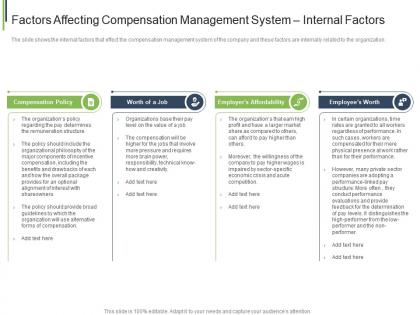
The slide shows the internal factors that effect the compensation management system of the company and these factors are internally related to the organization.
People who downloaded this PowerPoint presentation also viewed the following :
Factors affecting compensation management system internal factors ppt gallery ideas with all 2 slides:
Use our Factors Affecting Compensation Management System Internal Factors Ppt Gallery Ideas to effectively help you save your valuable time. They are readymade to fit into any presentation structure.

FAQs for Factors affecting compensation management system internal factors
Key components include job evaluation frameworks, salary structures, performance-based incentives, benefits administration, and compliance tracking systems. These elements work together by ensuring pay equity, attracting top talent, and maintaining regulatory compliance, with many organizations finding that integrated compensation platforms streamline administration while enhancing employee satisfaction and retention rates.
Technology enhances compensation management systems through automated salary calculations, real-time market benchmarking, predictive analytics, and integrated performance tracking. These innovations streamline administrative processes, minimize errors, and enable data-driven decision-making, with many organizations finding that automated systems deliver faster compensation reviews, improved pay equity analysis, and ultimately enhanced employee satisfaction.
Employee performance serves as the foundation for merit-based pay increases, bonus calculations, skill-based compensation adjustments, and promotional salary decisions within compensation management strategies. This performance-driven approach enables organizations to reward high achievers, retain top talent, and align individual contributions with business objectives, with many companies finding that linking compensation to performance metrics ultimately enhances productivity and competitive advantage.
Organizations ensure internal equity by conducting comprehensive job evaluations, establishing clear pay grades and salary bands, implementing consistent compensation frameworks across departments, and regularly benchmarking roles with similar responsibilities. Through systematic job analysis and structured pay scales, companies can minimize wage disparities, enhance employee satisfaction, and reduce turnover risks, while many organizations finding that transparent compensation structures ultimately strengthen talent retention and organizational trust.
Common challenges in implementing compensation management systems include data migration complexities, employee resistance to change, integration difficulties with existing HR platforms, budget constraints, and ensuring regulatory compliance across different jurisdictions. While these obstacles can initially slow deployment, organizations that address them systematically through phased rollouts and comprehensive training often find enhanced pay equity, streamlined administration, and improved employee satisfaction, ultimately delivering competitive advantage in talent retention.
Market trends significantly influence compensation practices by driving shifts toward performance-based pay, remote work allowances, wellness benefits, and skills-based premium structures across industries. Financial services emphasize variable compensation tied to market performance, while technology companies prioritize equity packages and flexible benefits, with healthcare and manufacturing sectors increasingly adopting comprehensive total rewards strategies to attract talent in competitive markets.
Organizations should track metrics including pay equity ratios, employee retention rates, compensation budget variance, time-to-fill positions, employee satisfaction scores, and market competitiveness ratios. These measurements enable companies to assess fairness, control costs, and maintain talent attraction, with many finding that regular tracking streamlines adjustments, enhances employee engagement, and ultimately delivers stronger competitive positioning in increasingly dynamic talent markets.
A compensation management system integrates with talent management by linking pay structures to performance metrics, career development pathways, succession planning, and retention goals. This strategic alignment enables organizations to attract top talent, reward high performers equitably, and reduce turnover costs, while ensuring compensation budgets support broader workforce planning and competitive positioning initiatives.
Legal and ethical considerations in compensation management include equal pay compliance, wage and hour regulations, benefits administration requirements, discrimination prevention, and transparency obligations. These frameworks protect organizations by ensuring fair compensation practices, reducing litigation risks, and maintaining employee trust, with many companies finding that ethical compensation strategies ultimately enhance retention, reputation, and competitive positioning.
Employee feedback can be integrated into compensation management through regular salary surveys, performance review discussions, exit interviews, and anonymous compensation satisfaction surveys. This strategic combination enables organizations to identify pay equity gaps, adjust compensation structures based on market realities, and enhance employee retention, with many companies finding that transparent feedback loops ultimately deliver improved morale and competitive talent acquisition advantages.
A compensation management system supports diversity and inclusion by enabling pay equity audits, standardizing compensation criteria, and providing transparent salary benchmarking across demographic groups. These systems help organizations identify and eliminate pay gaps, ensure fair promotion pathways, and create accountability through data-driven reporting, ultimately delivering equitable workplace practices and enhanced employee trust.
Pay transparency can be effectively managed through structured salary bands, clear job leveling frameworks, standardized performance metrics, and accessible compensation policies within the system. These approaches streamline communication by establishing consistent pay scales across departments, enabling automated reporting capabilities, and providing employees with clear advancement pathways, ultimately delivering enhanced trust and reduced pay inequities while supporting organizational growth.
Direct compensation includes base salary, hourly wages, bonuses, commissions, and overtime pay, while indirect compensation encompasses benefits like health insurance, retirement contributions, paid time off, and stock options. Organizations should track direct compensation through payroll systems with clear metrics and budget allocations, while indirect compensation requires comprehensive benefits valuation and cost-per-employee calculations, ultimately delivering transparent total compensation packages that enhance employee retention and competitive positioning.
Compensation management systems adapt to remote work dynamics by incorporating location-based pay scales, flexible benefit packages, and performance-driven variable compensation structures. These platforms enable organizations to manage geographically dispersed teams through automated salary adjustments, remote work stipends, and digital wellness benefits, while maintaining pay equity and competitive positioning across different markets.
**INPUT**: What tools or software solutions are most effective for managing compensation data? **OUTPUT**: Effective compensation management tools include HRIS platforms like Workday and SuccessFactors, specialized solutions such as PayScale and Salary.com, analytics software like Tableau, cloud-based systems, and integrated payroll platforms. These technologies streamline data collection, benchmark analysis, and reporting processes, with many organizations finding that automated compensation planning reduces administrative burden while enhancing pay equity transparency and strategic decision-making. [Word count: 60 words]
-
Excellent template with unique design.
-
Very unique and reliable designs.