

Failure Mode Effects And Criticality Analysis FMECA Method Operational Quality Control




Try Before you Buy Download Free Sample Product
 Impress Your
 Audience
 100%
100% Editable
 Save Hours
 of Time


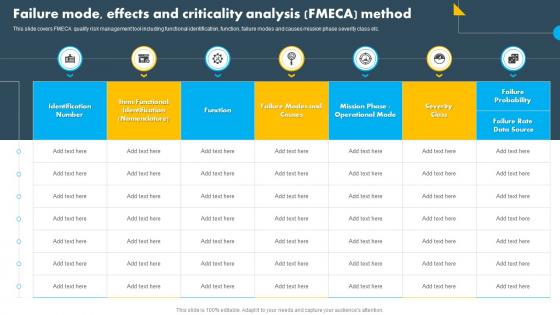
This slide covers FMECA quality risk management tool including functional identification, function, failure modes and causes mission phase severity class etc.
People who downloaded this PowerPoint presentation also viewed the following :
Failure Mode Effects And Criticality Analysis FMECA Method Operational Quality Control with all 7 slides:
Use our Failure Mode Effects And Criticality Analysis FMECA Method Operational Quality Control to effectively help you save your valuable time. They are readymade to fit into any presentation structure.





FAQs for Failure Mode Effects And Criticality Analysis FMECA Method
FMECA key components include failure mode identification, effects analysis, severity assessment, occurrence probability evaluation, detection capability analysis, and criticality ranking through Risk Priority Numbers (RPNs). These systematic elements work together by enabling organizations to prioritize maintenance strategies, optimize resource allocation, and enhance operational reliability, with manufacturing and aerospace industries finding that structured FMECA processes significantly reduce unexpected downtime and maintenance costs.
FMECA extends traditional FMEA by adding criticality analysis, which quantifies and prioritizes failure modes based on their probability, severity, and detection likelihood through numerical scoring systems. This enhancement enables organizations to allocate resources more strategically, focusing maintenance efforts on the most critical failure modes, ultimately delivering improved risk management and operational efficiency across manufacturing, aerospace, and automotive industries.
FMECA is widely utilized in aerospace, automotive, healthcare, nuclear power, and manufacturing industries due to their critical safety requirements and complex systems. These sectors benefit particularly from FMECA's systematic approach to identifying potential failures before they occur, enabling proactive maintenance strategies, reducing costly downtime, and ensuring regulatory compliance, ultimately delivering enhanced safety standards and operational reliability.
Failure modes in FMECA are prioritized using Risk Priority Numbers (RPNs), calculated by multiplying severity, occurrence, and detection ratings on standardized scales. This systematic ranking enables organizations to focus resources on the highest-risk failures first, with manufacturing and aerospace industries finding that addressing top-priority modes delivers significant cost reductions and enhanced operational reliability.
Techniques for identifying failure modes in FMECA include brainstorming sessions, historical data analysis, fault tree analysis, process flow diagrams, and expert interviews with cross-functional teams. These systematic approaches enable organizations to uncover potential failures by examining past incidents, mapping failure pathways, and leveraging institutional knowledge, ultimately delivering comprehensive risk assessment and enhanced operational reliability across manufacturing, aerospace, and automotive industries.
Software tools enhance the FMECA process by automating data collection, standardizing risk assessment calculations, and providing real-time collaboration capabilities across engineering teams. These platforms streamline failure mode identification, enable consistent severity and probability scoring, and generate comprehensive reports, with many manufacturing and aerospace organizations finding that automated FMECA workflows reduce analysis time while improving accuracy and regulatory compliance.
FMECA serves as a cornerstone of comprehensive risk management by systematically identifying potential failure modes, analyzing their effects on system performance, and prioritizing risks based on severity and probability. This structured approach enables organizations across manufacturing, aerospace, and healthcare to develop targeted mitigation strategies, allocate resources efficiently, and implement preventive measures that significantly reduce operational risks while enhancing system reliability.
Stakeholder engagement during FMECA requires establishing clear communication channels, defining roles and responsibilities, conducting regular progress reviews, and facilitating collaborative workshops throughout the analysis phases. By involving cross-functional teams from engineering, operations, quality, and management in structured sessions, organizations streamline decision-making processes while ensuring comprehensive risk identification, ultimately delivering more robust failure analysis and enhanced operational reliability across all business units.
Key FMECA effectiveness metrics include Risk Priority Number (RPN) reduction, failure mode detection rates, corrective action implementation timelines, system reliability improvements, and cost avoidance measurements. These metrics enable organizations to track preventive maintenance success, operational efficiency gains, and safety performance enhancements, with many manufacturing and aerospace companies finding that comprehensive FMECA tracking delivers measurable reductions in unplanned downtime and maintenance costs.
FMECA should be reviewed annually or whenever significant system changes occur, including design modifications, operational procedure updates, regulatory changes, or after critical incidents. Many organizations in aerospace, automotive, and medical device manufacturing find that quarterly reviews for high-risk systems and biannual assessments for standard operations deliver optimal reliability while maintaining compliance and competitive advantage.
FMECA implementation challenges include resource-intensive data collection, cross-functional team coordination difficulties, insufficient historical failure data, resistance to systematic analysis processes, and maintaining updated documentation across complex systems. While organizations initially struggle with time investments and training requirements, many manufacturing and aerospace companies find that structured implementation phases, dedicated team leadership, and integrated software tools ultimately streamline operations and enhance reliability.
Organizations integrate FMECA findings into design processes by establishing feedback loops between analysis teams and design engineers, incorporating failure mode data into design reviews, and updating specifications based on identified vulnerabilities. Through systematic integration protocols, companies enhance product reliability, reduce costly redesigns, and accelerate time-to-market, with many manufacturing organizations finding that early-stage FMECA integration ultimately delivers significant competitive advantages.
Common FMECA pitfalls include inadequate team composition, insufficient failure mode identification, inconsistent severity rankings, poor documentation practices, and lack of follow-through on corrective actions. Many organizations find that rushing through the analysis phase, failing to involve cross-functional expertise, and neglecting to update assessments after design changes ultimately undermines the process's effectiveness and strategic value.
Regulatory standards significantly shape FMECA execution by mandating specific documentation requirements, risk assessment methodologies, and compliance protocols across different sectors. Industries like aerospace, automotive, and pharmaceuticals must align their FMECA processes with standards such as ISO 14971, AS9100, or FDA guidelines, ultimately ensuring systematic risk management while delivering enhanced product safety and regulatory approval efficiency.
Professionals conducting FMECA require systems engineering knowledge, risk assessment expertise, statistical analysis skills, industry-specific technical understanding, and collaborative facilitation abilities. Many organizations find that combining formal reliability engineering training with hands-on experience in manufacturing, aerospace, or automotive sectors enhances FMECA effectiveness, ultimately delivering more accurate risk identification and strategic maintenance planning.
-
Good research work and creative work done on every template.
-
My presentations were a bit amateur before I found SlideTeam’s designs. I’ve been able to find slides for nearly every topic I’ve had to present. Thanks, Slideteam!