

Fast Fashion Retailer Company Profile Ppt Presentation CP CD V





Try Before you Buy Download Free Sample Product
 Impress Your
Audience
 100%
Editable
 Save Hours
of Time


Our Fast Fashion Retailer Company Profile Ppt Presentation CP CD V are topically designed to provide an attractive backdrop to any subject. Use them to look like a presentation pro.
People who downloaded this PowerPoint presentation also viewed the following :
Content of this Powerpoint Presentation
Slide 1: This slide introduces Fast Fashion Retailer Company Profile. State your company name and begin.
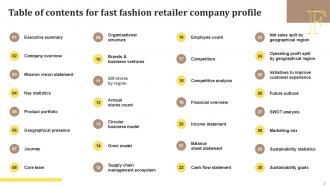
Slide 2: This slide shows Table of Content for the presentation.
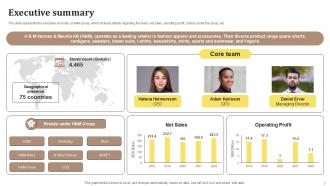
Slide 3: This slide represents the executive summary of H&M group, which includes details regarding the team, net sales, operating profit, brands under the group, etc.
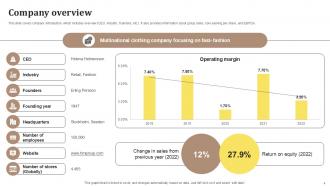
Slide 4: This slide covers company introduction, which includes overview (CEO, industry, founders, etc.). It also provides information about group sales, core earning per share etc.
Slide 5: This slide represents the vision and mission statement, showcasing the company's desired future positioning in the market.
Slide 6: This slide presents key statistics associated with company for FY 2022. It covers details regarding net sales, online sales share, cash flow from operating activities etc.
Slide 7: This slide represents product portfolio of H&M company, highlighting product areas in which the company serves – clothing, accessories, and homewares catering to women etc.
Slide 8: This slide displays global presence for the company which covers regions such as United States, South America, Europe, United Kingdom, Middle East, etc.
Slide 9: This slide represents H&M’s history and milestones, highlighting company establishment, acquisitions, opening of new stores, launch of new collection, etc.
Slide 10: This slide represents the leadership of H&M, which highlights different designations such as Chief executive officer, chief financial officer etc.
Slide 11: This slide presents team structure for H&M company, highlighting members such as chief executive officer, chief financial officer (CFO), chief technology officer (CTO) etc.
Slide 12: This slide displays brands and business ventures associated with H&M such as weekday, COS, Monki, etc. These brands aim to offer customers high quality products.
Slide 13: This slide represents the total H&M store count split by geographical regions – North and South America, The Nordics, Western Europe, etc.
Slide 14: This slide displays the annual store count for FY 2018 – 22. It also covers details regarding number of stores for each brand under H&M group.
Slide 15: This slide represents circular business model for H&M company highlighting details regarding care & repair, reuse, repurpose, recycle, etc.
Slide 16: This slide displays omni-model of H&M company highlighting focus areas such as circular customer journey, circular products, and circular supply chain.
Slide 17: This slide represents supply chain management ecosystem for H&M group. It covers details such as supplier performance indicators, risk and impact assessment, etc.
Slide 18: This slide displays the employee count trend of H&M from 2018 to 2022, highlighting changes in staff numbers globally.
Slide 19: This slide represents key competitors of H&M company in the global market – Zara, Uniqlo, Forever 21, ASOS, Abercrombie & Fitch, American Eagle Outfitters, etc.
Slide 20: This slide displays competitor analysis for H&M group on the basis of parameters such as founding year, net sales, operating profit, total number of stores etc.
Slide 21: This slide represents financial overview of H&M for FY 2021 and 2022, highlighting net sales, gross profit, gross margin, selling & administrative expenses etc.
Slide 22: This slide displays the income statement highlights for H&M company. It includes the last 5 years’ net sales, gross profit and operating profit.
Slide 23: This slide represents the balance sheet financials for H&M group. It includes the last 5 years’ total assets, Property, plant & equipment (PPE), and shareholder’s equity.
Slide 24: This slide displays the cash flow statement financials. It includes information regarding cash flow of the last 5 years’ operations, investing, and financing.
Slide 25: This slide represents net sales split by geographical region for H&M group. It covers regions – Asia & Oceania, Europe & Africa, North and South America.
Slide 26: This slide describes operating profit split by geographical region for H&M group. It covers regions – Asia & Oceania, Europe & Africa, North and South America.
Slide 27: This slide represents strategies taken by H&M group to enhance customer experience. It includes details such as customer loyalty program, payment options etc.
Slide 28: This slide displays future outlook for H&M group. It includes details regarding investment commitment, customer-centric focus, long-term goals, and expansion opportunities.
Slide 29: This slide represents SWOT analysis for H&M group highlighting strengths and weaknesses. It includes details regarding global presence, wide product range etc.
Slide 30: This slide displays SWOT analysis for H&M group highlighting opportunity and threats. It includes details regarding expansion in emerging market, sustainability initiatives etc.
Slide 31: This slide represents the marketing strategies for H&M group highlighting details regarding product mix, price mix, place, and promotion mix.
Slide 32: This slide presents key sustainability statistics for 2022 related to H&M group. It covers details related to GHG (Green House Emission) emissions, product recycling etc.
Slide 33: This slide displays sustainability goals for H&M group. It includes targets such as strategic partnership, reused interior, paper packaging, and reverse supply chain.
Slide 34: This is a Contact Us slide to show company's contact information.
Slide 35: This slide shows all the icons included in the presentation.
Slide 36: This slide is titled as Additional Slides for moving forward.
Slide 37: This is Our Vision, Mission & Goal slide. Post your Visions, Missions, and Goals here.
Slide 38: This slide provides 30 60 90 Days Plan with text boxes.
Slide 39: This slide contains Puzzle with related icons and text.
Slide 40: This slide depicts Venn diagram with text boxes.
Slide 41: This slide presents Roadmap with additional textboxes. It can be used to present different series of events.
Slide 42: This is a financial slide. Show your finance related stuff here.
Slide 43: This slide shows Post It Notes for reminders and deadlines. Post your important notes here.
Slide 44: This is a Timeline slide. Show data related to time intervals here.
Slide 45: This is a Thank You slide with address, contact numbers and email address.
Fast Fashion Retailer Company Profile Ppt Presentation CP CD V with all 53 slides:
Use our Fast Fashion Retailer Company Profile Ppt Presentation CP CD V to effectively help you save your valuable time. They are readymade to fit into any presentation structure.











FAQs for Fast Fashion Retailer Company Profile Ppt Presentation
Fast fashion retailers are characterized by rapid trend replication, accelerated production cycles, affordable pricing strategies, global supply chain networks, and high inventory turnover rates. These companies streamline design-to-shelf timelines by leveraging data analytics, flexible manufacturing partnerships, and aggressive market responsiveness, ultimately delivering accessible fashion while maintaining competitive advantage through speed and cost efficiency in an increasingly dynamic retail landscape.
Fast fashion companies influence consumer behavior through aggressive marketing campaigns, celebrity endorsements, social media presence, artificial scarcity tactics, and frequent new collection launches. These strategies create urgency and desire by promoting trend-driven consumption, leveraging influencer partnerships, and utilizing data analytics to predict preferences, with many retailers finding that rapid inventory turnover and affordable pricing ultimately drive impulse purchases and repeat customer engagement.
Fast fashion production creates significant environmental impacts including excessive water consumption, textile waste generation, chemical pollution from dyeing processes, carbon emissions from rapid manufacturing cycles, and microplastic release from synthetic materials. These practices strain natural resources and ecosystems, with many retailers increasingly recognizing that sustainable alternatives can reduce operational costs, enhance brand reputation, and deliver competitive advantages in an environmentally conscious marketplace.
Fast fashion retailers manage their supply chains through vertical integration, strategic regional supplier partnerships, advanced demand forecasting systems, and streamlined production scheduling that minimizes lead times. These companies leverage real-time inventory tracking, flexible manufacturing contracts, and direct-to-store logistics networks, with many retailers like Zara and H&M achieving design-to-shelf cycles of just 2-3 weeks, ultimately delivering competitive advantage through speed-to-market responsiveness.
Social media serves as the primary marketing channel for fast fashion brands, enabling rapid trend dissemination, influencer partnerships, user-generated content campaigns, and real-time customer engagement. These platforms streamline brand visibility by showcasing new arrivals instantly, facilitating viral marketing moments, and driving immediate purchase decisions, with many retailers finding that social media integration delivers significantly higher conversion rates and enhanced customer loyalty.
Consumer awareness significantly impacts fast fashion sales by driving demand for transparent supply chains, ethical manufacturing practices, and sustainable materials, while creating pressure for brands to adopt circular economy models. Many retailers are responding by implementing recycling programs, sustainable collections, and transparent reporting, ultimately finding that proactive sustainability strategies help maintain customer loyalty and competitive advantage in an increasingly conscious marketplace.
Ethical considerations include unsafe working conditions, excessive overtime demands, inadequate wages, child labor risks, and limited worker rights protections in manufacturing facilities. These challenges present opportunities for retailers to implement transparent supply chain monitoring, fair wage initiatives, and sustainable manufacturing partnerships, with many companies finding that ethical labor practices ultimately enhance brand reputation and customer loyalty.
Fast fashion retailers differentiate themselves through rapid trend adoption, competitive pricing, strategic store locations, targeted social media marketing, and exclusive designer collaborations. These approaches enable brands to capture specific demographics, accelerate inventory turnover, and build customer loyalty, with many retailers finding that combining digital engagement with physical accessibility ultimately delivers market share growth and sustained competitive advantage.
Fast fashion companies achieve price competitiveness through mass production, direct supplier relationships, vertical integration, minimal marketing costs, and rapid inventory turnover. These strategies enable retailers like H&M and Zara to streamline operations, reduce overhead expenses, and optimize supply chain efficiency, ultimately delivering affordable clothing while maintaining profit margins in an increasingly competitive retail landscape.
Fast fashion retailers adapt to changing trends through rapid design cycles, agile supply chains, real-time market analysis, and flexible manufacturing partnerships. These companies leverage data analytics and social media monitoring to identify emerging styles, while streamlined production processes enable them to move from concept to store shelves within weeks, ultimately delivering trendy products that capture consumer demand faster than traditional retailers.
AI-powered demand forecasting, automated manufacturing systems, 3D design software, blockchain supply chain tracking, and mobile commerce platforms are revolutionizing fast fashion operations. These technologies streamline production cycles, enhance inventory management, and improve customer experiences, with retailers like Zara and H&M finding faster time-to-market and reduced waste through strategic digital integration.
Fast fashion retailers handle inventory management through advanced demand forecasting, rapid production cycles, strategic supplier partnerships, and data-driven analytics to predict consumer trends accurately. These companies leverage real-time sales data, AI-powered inventory systems, and agile supply chains to minimize overstock while maintaining product availability, with many retailers finding that strategic inventory optimization delivers significant cost reductions and enhanced profitability.
Fast fashion significantly impacts traditional retail and luxury brands through accelerated trend cycles, price competition, and shifting consumer expectations toward immediacy and affordability. While luxury brands maintain exclusivity through superior craftsmanship and heritage storytelling, traditional retailers increasingly adopt fast fashion strategies like rapid inventory turnover and trend-responsive manufacturing, with many finding that hybrid approaches combining speed with quality deliver competitive advantage in an increasingly dynamic marketplace.
Future trends disrupting fast fashion include sustainable manufacturing technologies, circular economy models, AI-powered personalized production, blockchain supply chain transparency, and consumer shift toward quality over quantity. These developments challenge traditional volume-based approaches by enabling on-demand manufacturing, reducing waste, and meeting increasingly conscious consumer expectations, with many retailers finding that adaptation toward sustainability ultimately delivers competitive advantage and operational efficiency.
Fast fashion companies approach global expansion through standardized brand messaging, consistent visual merchandising, centralized design processes, and uniform store layouts across markets. While maintaining core brand identity, they strategically adapt product offerings to local preferences, cultural nuances, and seasonal demands, with many retailers finding that this balanced approach enables rapid international scaling while preserving brand recognition and customer loyalty.
-
The service is fast, and I could access any presentation after buying the subscription. I don’t think I’ll ever have to worry about a presentation in my life.
-
“Easy to use. I always wanted to have a quick search for products and SlideTeam has helped me have it.”