

Finance transformation brief overview of a mini project charter finance and accounting transformation




Try Before you Buy Download Free Sample Product
 Impress Your
Audience
 100%
Editable
 Save Hours
of Time


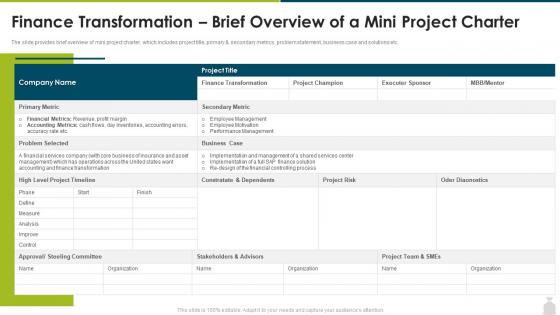
The slide provides brief overview of mini project charter, which includes project title, primary and secondary metrics, problem statement, business case and solutions etc.
People who downloaded this PowerPoint presentation also viewed the following :
Finance transformation brief overview of a mini project charter finance and accounting transformation with all 9 slides:
Use our Finance Transformation Brief Overview Of A Mini Project Charter Finance And Accounting Transformation to effectively help you save your valuable time. They are readymade to fit into any presentation structure.









FAQs for Finance transformation brief overview of a mini project charter finance
Key drivers include digital disruption, regulatory complexity, stakeholder demands for real-time insights, competitive pressure for agility, and the need for strategic decision-making capabilities. These forces compel organizations to streamline processes, enhance data analytics, and automate routine tasks, with many finding that transformation ultimately delivers cost reduction, improved accuracy, and strategic competitive advantage in an increasingly dynamic business environment.
AI and machine learning enhance finance operations by automating repetitive tasks, improving forecasting accuracy, and enabling real-time data analysis and decision-making. These technologies streamline processes like invoice processing, expense management, and risk assessment, with many financial institutions finding that automated systems reduce processing times by up to 80% while delivering enhanced accuracy and strategic insights.
Organizations should track metrics including process automation rates, financial close cycle times, forecast accuracy percentages, cost per transaction, employee productivity ratios, and data quality scores. These measurements enable finance teams to demonstrate operational efficiency improvements, enhanced decision-making capabilities, and strategic value delivery, with many organizations finding that comprehensive metric tracking accelerates transformation success and stakeholder buy-in.
Finance transformation significantly reshapes finance professionals' roles by shifting focus from routine data processing to strategic analysis, business partnering, and advisory functions. These professionals increasingly become strategic consultants, leveraging automation and analytics to provide real-time insights, support decision-making across departments, and drive organizational growth, ultimately enhancing their value as business enablers.
Common finance transformation challenges include legacy system integration, data quality inconsistencies, resistance to change from employees, regulatory compliance complexities, and resource allocation constraints. Organizations across sectors like banking, manufacturing, and retail often find that while these hurdles require careful planning and phased implementation, addressing them systematically ultimately delivers streamlined operations, enhanced reporting accuracy, and significant competitive advantages in financial decision-making capabilities.
Finance transformation enhances decision-making by implementing real-time analytics, automated reporting systems, predictive modeling capabilities, and integrated data platforms that eliminate information silos. Through advanced technologies like AI-driven forecasting and cloud-based dashboards, organizations streamline strategic planning, accelerate budget approvals, and enable data-driven insights, ultimately delivering faster responses to market changes and improved competitive positioning.
Data analytics serves as the foundation for finance transformation by enabling predictive forecasting, real-time performance monitoring, automated reporting, risk assessment, and strategic decision-making capabilities. Through advanced analytics platforms, organizations streamline financial processes, enhance accuracy in budgeting and planning, and deliver actionable insights to stakeholders, with many finance teams finding that data-driven approaches ultimately accelerate transformation initiatives while reducing operational costs.
Organizations ensure stakeholder buy-in during finance transformation by establishing clear communication channels, demonstrating tangible ROI projections, involving key stakeholders in planning phases, and providing comprehensive training programs. Through transparent progress reporting and quick wins showcasing efficiency gains, companies like manufacturing firms and financial services institutions build momentum, ultimately delivering enhanced operational transparency and sustained organizational support throughout the transformation journey.
Finance transformation enhances cross-departmental collaboration by implementing shared data platforms, standardizing reporting processes, establishing integrated planning cycles, and creating real-time dashboards accessible to all teams. These initiatives enable finance teams to serve as strategic partners rather than gatekeepers, with departments like marketing, operations, and HR finding that streamlined financial workflows and transparent budget tracking ultimately deliver faster decision-making and improved organizational alignment.
Companies should establish clear communication channels, invest in comprehensive employee training, implement phased rollouts with pilot programs, and secure strong leadership commitment throughout the transformation process. Many organizations find that involving key stakeholders early, providing continuous support during system transitions, and celebrating quick wins helps minimize resistance while building momentum, ultimately delivering smoother adoption and faster realization of operational efficiencies.
Finance transformation enhances regulatory compliance and risk management by implementing automated monitoring systems, standardized reporting frameworks, and real-time data analytics that ensure accuracy and transparency. Through advanced technologies like AI-driven compliance tracking and integrated risk assessment tools, organizations streamline audit processes, minimize human error, and maintain comprehensive documentation, ultimately delivering faster regulatory responses and reduced compliance costs.
Finance transformation revolutionizes budgeting and forecasting through real-time data integration, automated variance analysis, predictive analytics, and dynamic scenario modeling. These enhanced capabilities enable organizations to shift from static annual budgets to continuous planning cycles, delivering faster decision-making, improved accuracy, and strategic agility in increasingly volatile business environments.
Cloud-based solutions facilitate finance transformation by automating processes, enabling real-time reporting, and providing scalable infrastructure that adapts to business growth. These platforms streamline accounts payable, financial planning, and compliance management while reducing IT costs, with many organizations finding that cloud deployment accelerates decision-making and enhances operational efficiency across departments.
Cultural change drives finance transformation success by fostering collaboration, embracing automation, and shifting from traditional reporting to strategic advisory roles. This transformation requires overcoming resistance to new technologies and processes, with many organizations finding that employee engagement, continuous training, and clear communication ultimately deliver faster adoption, improved efficiency, and enhanced decision-making capabilities.
Organizations leverage finance transformation to drive sustainable financial practices by implementing automated ESG reporting systems, real-time carbon accounting platforms, and integrated sustainability metrics within financial planning processes. Through advanced analytics and cloud-based solutions, companies streamline environmental cost tracking, enhance regulatory compliance, and optimize resource allocation, ultimately delivering improved stakeholder transparency and competitive advantage in an increasingly sustainability-focused market environment.
-
Out of the box and creative design.
-
The content is very helpful from business point of view.