


Financial expense powerpoint presentation slides





Try Before you Buy Download Free Sample Product
 Impress Your
Audience
 100%
Editable
 Save Hours
of Time


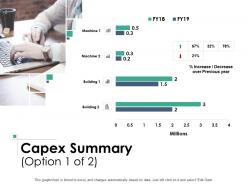
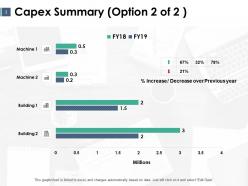
Manage your expenses optimally using these Financial Expense PowerPoint Presentation Slides. Take advantage of these financial management PPT slides to demonstrate the percentage increase/decrease in the value of machinery. Utilize this business expenditure PowerPoint deck to expound the capital expenditure valuation methods such as discounted payback period, net present value method, and IRR. Take the assistance of these organizational expenses PPT layouts to depict the computational method, advantages, and disadvantages of the three techniques. Employ this organizational budget PowerPoint slideshow to showcase two types of capital expenditure viz. maintenance expenditures and expansion expenditures. Show the importance of the capital expenditure process including maintenance of existing property, plant & equipment, and investment in technology using these financial investment PPT visuals. Select the best method according to the need of the situation using these eye-catching organizational budget PowerPoint templates. Download these amazing PowerPoint infographics to get higher returns on various investments.
People who downloaded this PowerPoint presentation also viewed the following :
Content of this Powerpoint Presentation
Slide 1: This slide introduces Financial Expense. State your company name and begin.
Slide 2: This slide represents Capex Summary graph.
Slide 3: This is also Capex Summary graph slide.
Slide 4: This slide shows Capital Expenditure Details.
Slide 5: This slide describes Capital Expenditure Valuation Methods such as- Discounted Payback Period, Internal Rate of Return and Net Present Value Method.
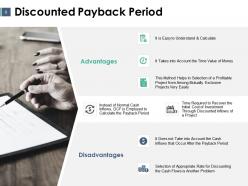
Slide 6: This slide depicts Discounted Payback Period.
Slide 7: This slide shows Discounted Payback Period – Valuation Summary.
Slide 8: This slide describes Net Present Value Method.
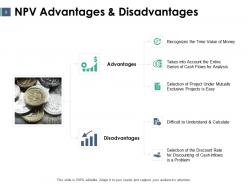
Slide 9: This slide showcases NPV Advantages & Disadvantages of Net Present Value Method.
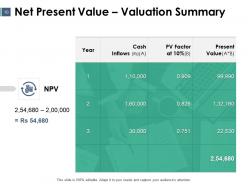
Slide 10: This slide presents Valuation Summary of Net Present Value.
Slide 11: This slide dispalys Internal Rate of Return.
Slide 12: This slide showcases advantages and disadvantages of Internal Rate of Return.
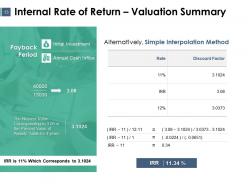
Slide 13: This slide represents Internal Rate of Return – Valuation Summary.
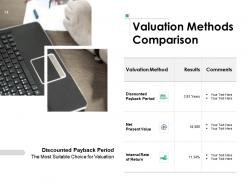
Slide 14: This slide showcases comparison of Valuation Methods.
Slide 15: This is Financial Expense Icons Slide.
Slide 16: This slide is titled as Additional Slides for moving forward.
Slide 17: This slide represents Line Chart graph.
Slide 18: This is Our Creative Team slide with Names and Designation.
Slide 19: This is About Us slide to show company specifications.
Slide 20: This is Financial slide.
Slide 21: This slide displays Quotes. Showcase the important quote.
Slide 22: This is Idea Generation slide to state new idea, highlight information etc.
Slide 23: This is Thank You slide with Address, Email address and contact number.
Financial expense powerpoint presentation slides with all 23 slides:
Use our Financial Expense Powerpoint Presentation Slides to effectively help you save your valuable time. They are readymade to fit into any presentation structure.














FAQs for Financial expense
The most common financial expense categories include operational costs, personnel expenses, debt servicing, marketing investments, and regulatory compliance costs. These expenses significantly impact cash flow management and profitability across industries, with many organizations finding that strategic expense categorization enables better budget allocation, cost control, and ultimately delivers improved financial transparency and competitive operational efficiency.
Small businesses can effectively track financial expenses through automated accounting software, regular expense categorization, digital receipt management, monthly budget reviews, and real-time financial monitoring. These streamlined approaches enable restaurants, consulting firms, and retail stores to identify cost-saving opportunities, improve cash flow management, and make data-driven decisions, ultimately delivering better financial control and sustainable growth.
Popular expense monitoring tools include QuickBooks, Xero, Expensify, Concur, and FreshBooks, alongside specialized platforms like Mint and YNAB for budget tracking. These solutions streamline expense categorization, automate receipt scanning, and provide real-time reporting, with many organizations finding that integrated platforms ultimately deliver enhanced financial visibility and significantly reduced administrative overhead.
Companies reduce unnecessary financial expenses through strategic automation, vendor negotiations, process optimization, and technology integration without compromising quality standards. By implementing expense management software, consolidating suppliers, and streamlining workflows, organizations enhance operational efficiency while maintaining service excellence, with many financial institutions finding that automated approval processes deliver cost savings and improved oversight simultaneously.
Financial expenses directly reduce a company's net income by decreasing earnings before tax, with interest payments, loan fees, and financing costs flowing straight to the bottom line. These expenses significantly impact profitability ratios and cash flow, with many organizations finding that strategic debt management and refinancing initiatives can enhance operational efficiency and preserve competitive advantage.
Businesses should differentiate fixed and variable expenses by analyzing payment consistency, with fixed costs like rent, insurance, and loan payments remaining constant regardless of activity levels, while variable expenses fluctuate with business operations. This strategic categorization enables organizations to optimize budgeting, forecast cash flow more accurately, and make informed scaling decisions, ultimately delivering better financial control and competitive advantage.
Financial expenses play a crucial role in budgeting and forecasting by directly impacting cash flow projections, profit margins, and strategic resource allocation across organizations. These expenses, including interest payments, loan fees, and investment costs, enable businesses to accurately model growth scenarios, assess borrowing capacity, and optimize capital structure decisions, ultimately delivering more precise financial planning and enhanced competitive positioning.
Understanding financial expense trends enables strategic decision-making by revealing spending patterns, identifying cost optimization opportunities, and predicting future resource needs across departments and initiatives. Through trend analysis, organizations can reallocate budgets more effectively, anticipate market shifts, and make data-driven investments, with many companies finding that expense tracking ultimately delivers improved profitability and competitive positioning.
Mismanaging financial expenses can lead startups to cash flow crises, investor confidence loss, scaling difficulties, and potential business failure. These challenges often result in delayed product development, reduced market competitiveness, and difficulty securing future funding rounds, with many promising startups finding that poor expense management ultimately prevents them from reaching profitability and sustainable growth.
Regular review of financial expenses enhances cash flow management by identifying unnecessary costs, optimizing spending patterns, and improving budget accuracy. Through systematic expense analysis, organizations streamline operations, negotiate better vendor terms, and reallocate resources more strategically, with many businesses finding that monthly reviews deliver improved liquidity and stronger financial forecasting capabilities.
Best practices for documenting financial expenses include maintaining detailed receipts, implementing consistent categorization systems, using automated expense tracking software, conducting regular reconciliations, and establishing clear approval workflows. These practices streamline financial reporting by ensuring accuracy, reducing audit risks, and enabling better budget analysis, with many organizations finding that systematic expense documentation ultimately delivers improved cost control and faster month-end closing processes.
Financial expenses vary significantly across industries due to different capital requirements, operational models, and cash flow patterns. Manufacturing typically faces higher interest expenses from equipment financing and working capital needs, while retail experiences seasonal fluctuations in borrowing costs, inventory financing, and lease obligations, with many organizations finding that industry-specific financial structures ultimately determine their expense profiles and strategic financing approaches.
Strategies include automating accounts payable processes, implementing expense management software, negotiating vendor contracts, centralizing procurement functions, and adopting cloud-based financial systems. These approaches streamline operations by reducing manual processing costs, improving spend visibility, and enhancing budget control, with many organizations finding that strategic automation ultimately delivers 15-30% expense reductions while enabling better resource allocation.
Employee training enhances financial expense management by developing budgeting skills, cost-awareness practices, expense reporting accuracy, and strategic spending decisions across all organizational levels. Through comprehensive financial literacy programs, companies streamline approval processes, reduce unnecessary expenditures, and improve resource allocation, with many organizations finding that educated employees ultimately deliver significant cost savings and operational efficiency.
Businesses should evaluate financial expense efficiency through expense-to-revenue ratios, cost per acquisition, return on investment (ROI), budget variance analysis, and operational cost trends. These metrics enable organizations to identify spending inefficiencies, optimize resource allocation, and benchmark performance against industry standards, with many companies finding that regular expense analysis delivers improved profitability and strategic competitive advantage.
-
Great designs, really helpful.
-
Informative design.
-
Excellent work done on template design and graphics.
-
Unique and attractive product design.